

Box Office Behavior: Can Pre-Release Buzz Predict a Movie’s Box Office Legs?
October 15, 2026
Consumer demand for household necessities is remarkably reliable. It’s hardly a surprise that people want running water and electricity. Thanks to a natural universal need and consistent seasonal usage patterns, providers can reasonably forecast revenue years into the future. Hollywood has rarely known such certainty. Entertainment is the most subjective product in the world. It’s not as if anyone has opted out of an internet service because reviews labeled it as “trite and uninspired.”
Pre-release film tracking aims to provide a better sense of opening weekend performance ranges. But can it tell us anything about what happens after? Or is that when audience subjectivity kicks in? Box office legs, or films that minimize how steep ticket sales drop from weekend to weekend after release, are helpful markers of success and failure. The average top 10 annual domestic grosser stays in the top 10 weekend box office for eight to 10 weeks.
Small openings can leg it out to successful runs (see: The Greatest Showman, Elemental, Puss in Boots: The Last Wish). Big openings can crash and burn in their second weekends (see: Batman v Superman: Dawn of Justice, Joker: Folie à Deux, Halloween Ends). We’re here to find out how effectively we can see what’s coming.
Horror Highlights
Focus Features’ Obsession (May 15) and A24’s Backrooms (May 29) opened two weeks apart this year. In fact, they plowed into opening weekend with almost identical tracking across major metrics:
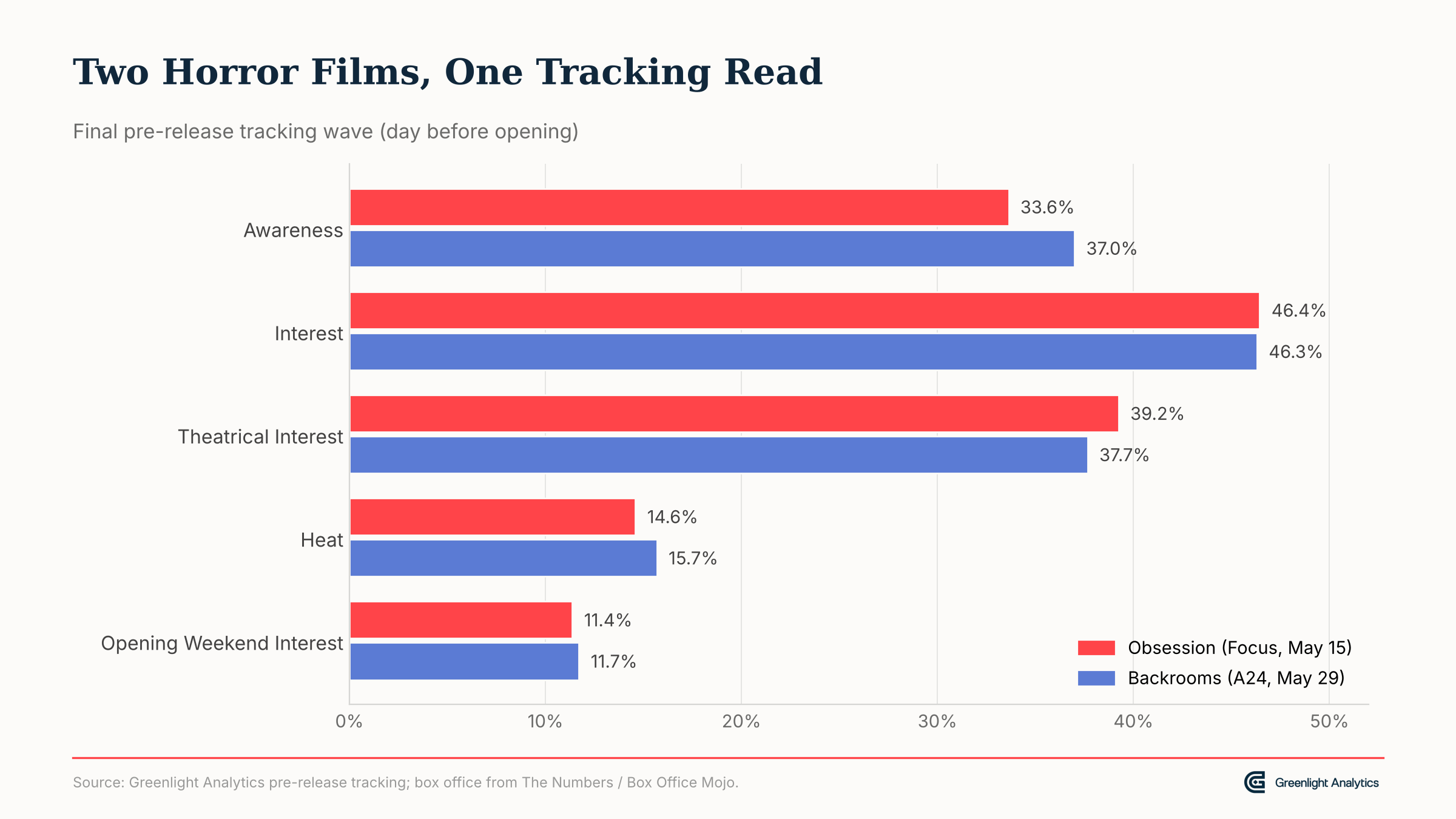
Backrooms opened to an A24 record $81.4 million across 3,442 screens, dropped 68% in its second weekend, and finished with $197.5 million domestically. That nets out to a 2.4x multiplier, or the domestic total divided by opening weekend. Obsession debuted to $17.2 million on 2,615 screens, then actually grew 39% in its second weekend and 14% in its third. It finished its run at $264 million (15.3x).
So the film that opened 79% smaller finished around $66 million ahead. How does that happen?!
Well, Obsession’s Heat—the percentage of respondents who listed their pre-release interest in the film as a 7/7—hovered between 6.8% and 10.6% for five months. It sat at 9.5% six weeks before release then rose in each tracking wave heading into its opening: 10.2%, 12%, 13.7%, 14.6%.
Conversely, Backrooms saw its Heat score jump from 9% to 13.6% between 62 and 51 days pre-release. It then hovered between 14.5% to 16.8% the rest of the way before actually dipping in its final tracking wave before hitting theaters.
The former’s buzz was still building to a crescendo when it opened. The latter had peaked weeks earlier. The big question is if this is a consistent pattern or one-off noise?
Our Box Office Legs Case Study
Greenlight Analytics looked at 107 films that opened on at least 2,000 screens from April 2025 through September 4, 2026. Our aim: unearth potential connections between pre-release tracking and box office legs. Here we’re using domestic multipliers (with a library median of 2.52x) and second weekend drops (with a library median of -58%) to define legs.
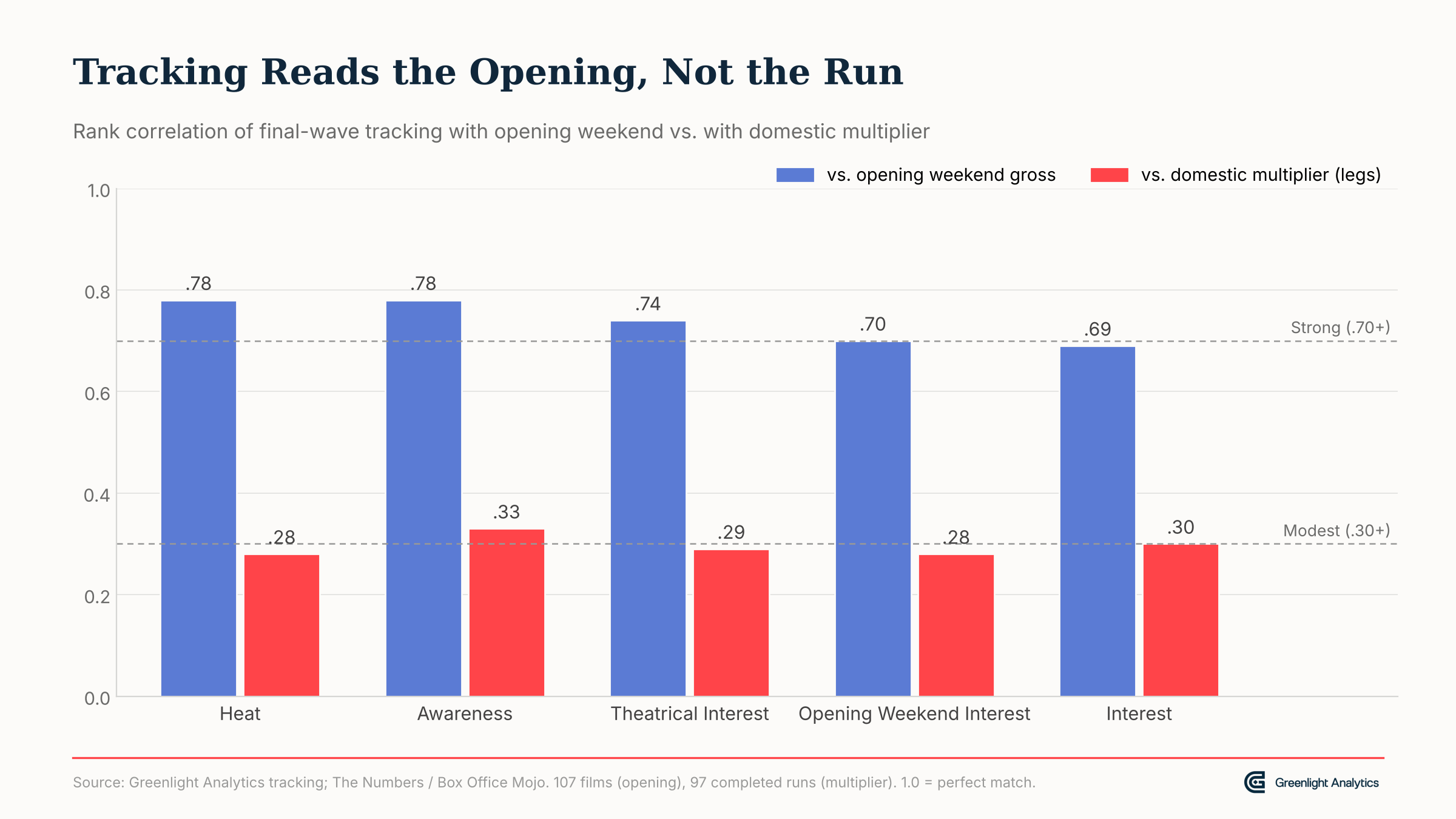
As a rule of thumb from here on: a 1.0 correlation is a perfect match, .70 and up is strong, .30 to .50 is modest, and under .20 is very weak.
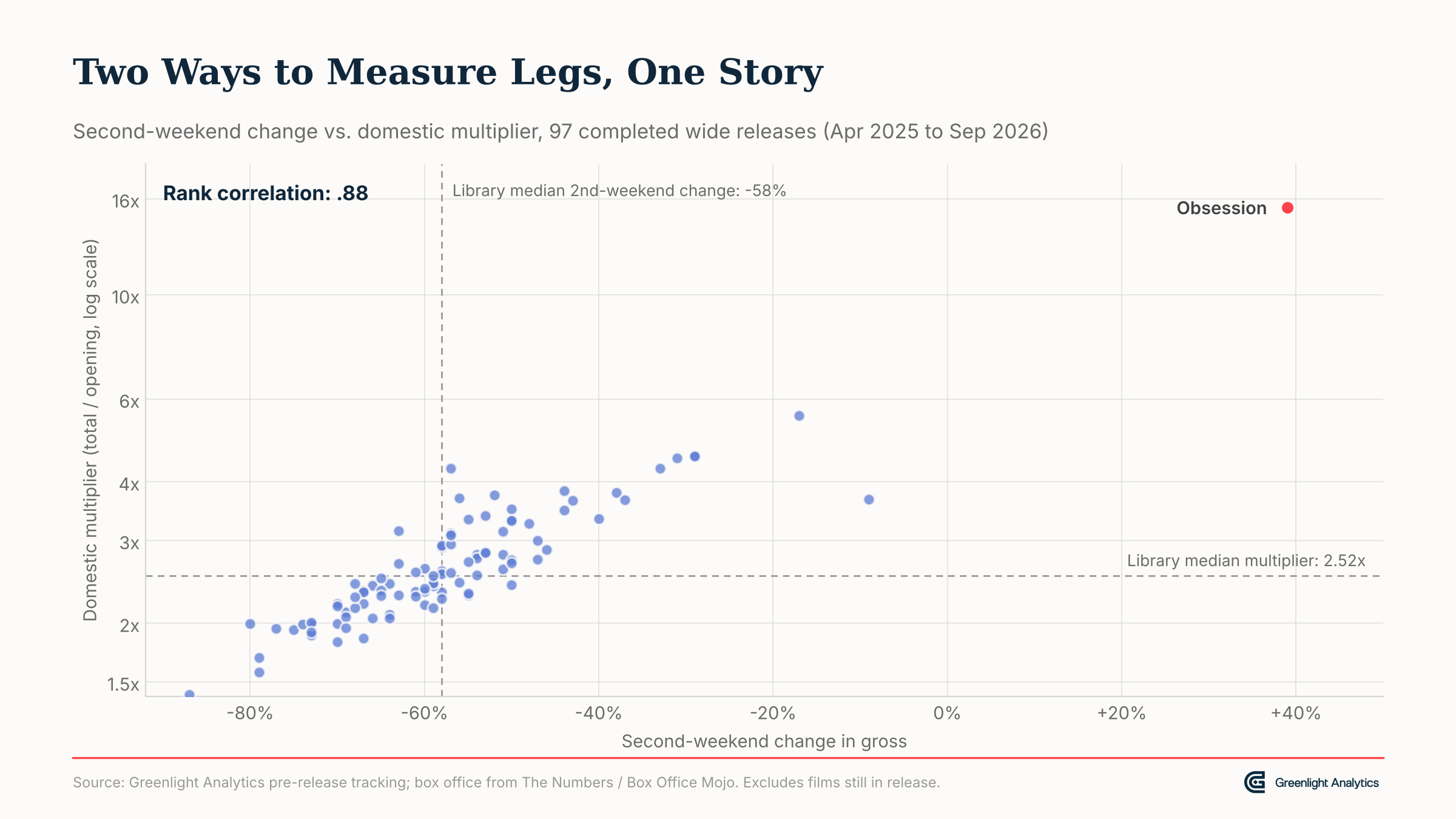
We looked at both where a metric sat in the final tracking wave in the week of release, as well as the momentum change over the final six weeks before a movie actually came out. It’s important to note upfront that legs also depend on reviews, word of mouth, competition, the calendar, and windowing. Today, we want to know if tracking carries any real sneak peek into the future beyond opening weekend. We’re not here to say that it explains everything. It doesn’t.
Tracking the Box Office Opening vs Legs
Unsurprisingly, pre-release film tracking is strongly aligned with opening weekend performance. Since May 2025, Greenlight Analytics’ debut box office projection ranges are accurate 70% of the time. Bully for us. Yet when we compare raw final wave tracking metrics to domestic multipliers, correlations get shakier.
The record-breaking Spider-Man: Brand New Day ($957.2 million domestic and counting) is a notable exception to the larger pattern. It delivered the fourth-highest final Awareness mark (82.8%) and top Heat score (38.6%) of any film in our dataset en route to a record $360.1 million opening. Its second weekend drop was 60%, right in line with the library median.
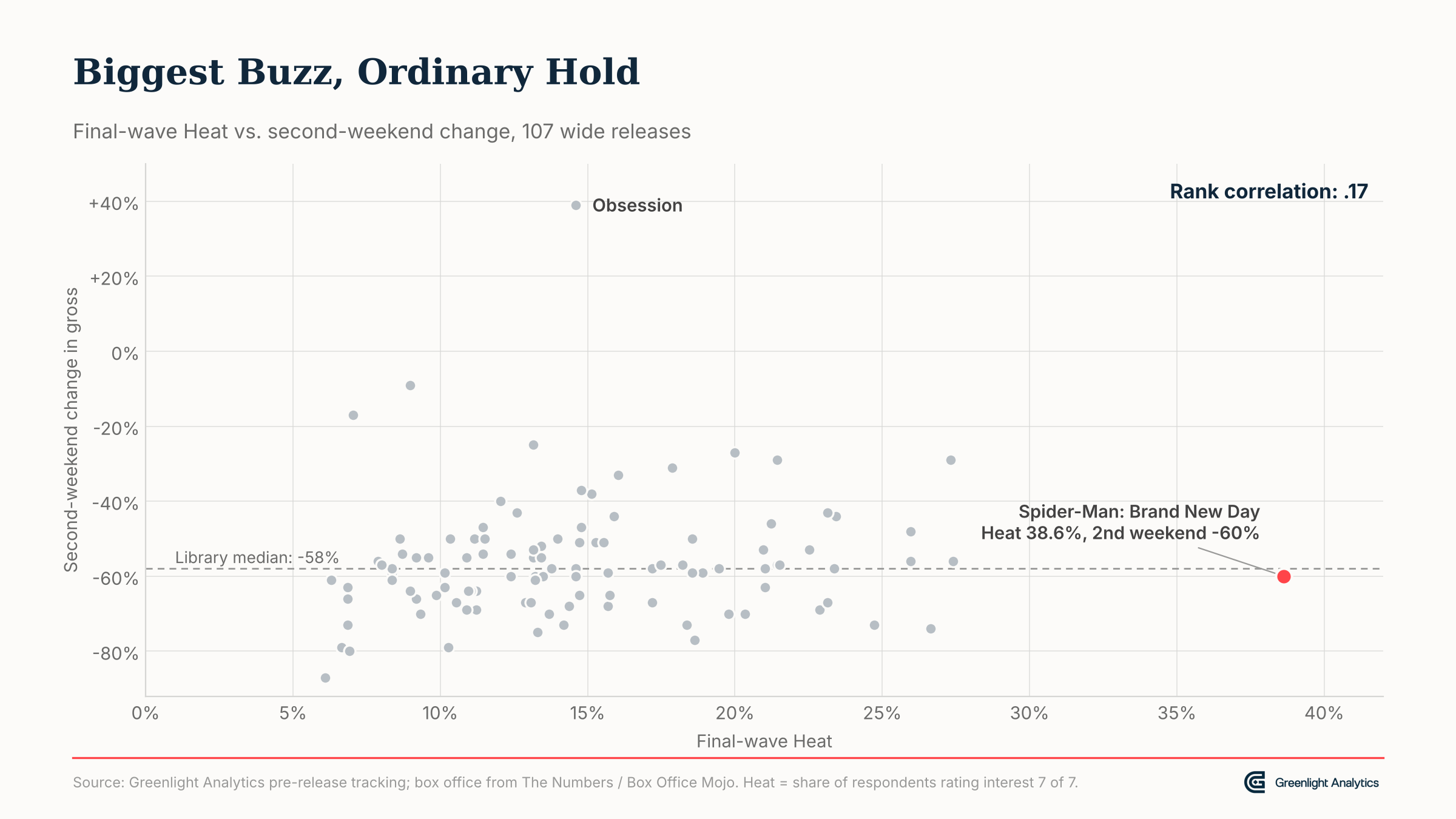
While helpful, final wave snapshots don’t consistently forecast box office legs. So let’s change our lens.
Momentum Shift
We examined how Heat scores changed from six weeks out through to the week of release. In doing so, we found a stronger pre-release signal for box office legs.
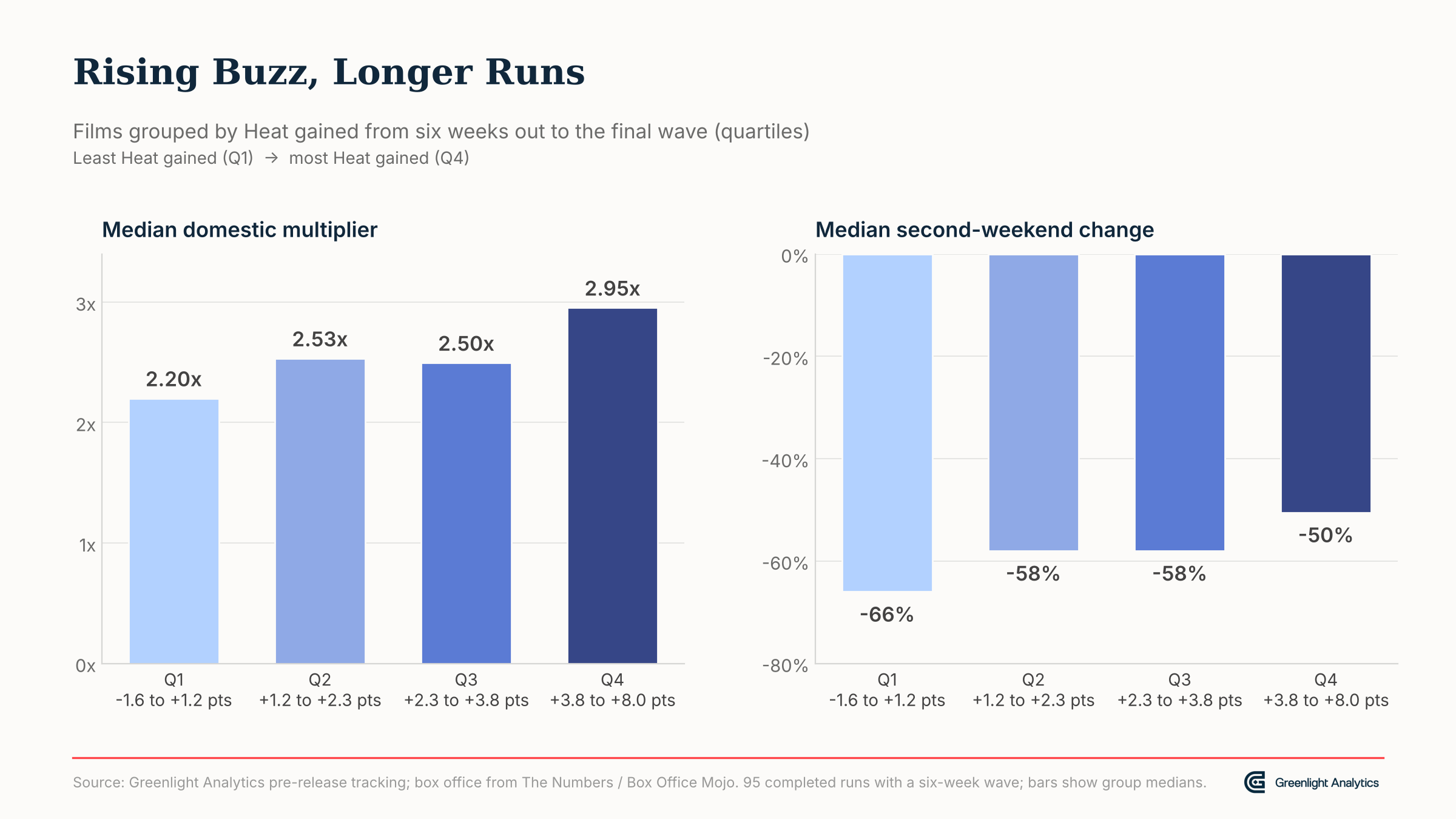
Pre-release Heat momentum is a more useful directional compass for domestic multipliers (.46) and second-weekend drops (.41) than final wave Heat scores (.28). It’s not a crystal ball predictor, however.
Movies that saw Heat rise the most in the last six weeks earned roughly three times their opening weekends and held on to half their audience in their second frames (top quartile). Films whose buzz grew the smallest only earned about two times while losing roughly two-thirds of their viewers in the following weekend (bottom quartile).
One signal underneath this umbrella is when tracking momentum remains relatively static for slightly more niche, fandom-driven events. We saw that last year with theatrical anime releases Demon Slayer: Infinity Castle and Chainsaw Man: Reze Arc. Demon Slayer’s Heat score grew just 1.4 points in the final six weeks. Its box office fell 75% following a $70.6 million debut and it legged it out to just 1.9x. Chainsaw Man’s Heat didn’t grow at all and it sank 66% in its second weekend. The core fans showed up opening weekend for both, but there was little expansion to general moviegoers afterward.
Even when you remove Obsession, the most notable outlier, the result remains virtually the same (.45). Even when you remove holidays such as Thanksgiving and Christmas, which famously provide generous legs, the pattern still mostly holds (.43). Even when you compare films with similar final Heat, things remain pretty consistent (.37). And even when you compare films with similar opening weekends, it mostly aligns (.38). That said, the signal is strongest for movies debuting to less than $40 million. Among $40 million-plus openers, the momentum measurement did not separate hits from misses as cleanly, potentially due to reviews, word of mouth, schedules, and other external factors.
But that’s not always the case. The Odyssey saw Heat jump 5.5 points in its final six pre-release weeks (14.5% to 20%). It posted a remarkably strong hold of just -27% after a $123.5 million opening. Heat jumped 4.0 points for One Battle After Another (10% to 14%) and the prestige film delivered a 3.3x multiplier from a $22 million opener.
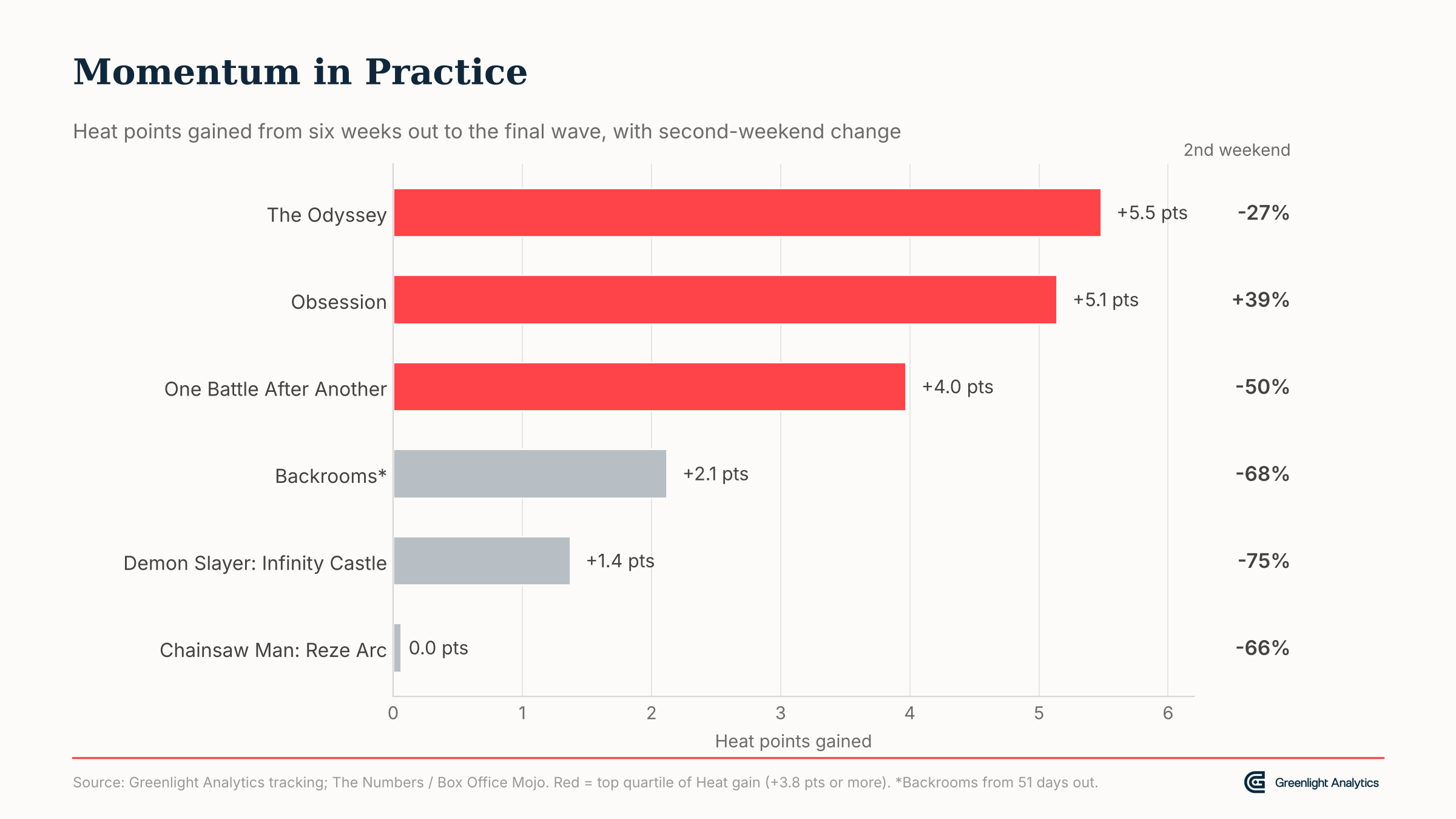
So if Heat is still rising heading into opening day, it signals that enthusiasm keeps building instead of stalling out. Conversely, peaking weeks earlier suggests a movie’s marketing campaign has potentially hit its ceiling in capturing the most locked in audiences.
It’s a modest signal overall, but a trend worth Hollywood’s attention.
So What?
Of course, no data set is perfect. Respondents who wanted to see a film in theaters, but not on opening weekend, surprisingly did not align with real outcomes as accurately as we expected. The same goes for Awareness growth and Interest Among Unaware Audiences. Yet overall, there are some actionable takeaways here for the industry.
Studios need to pay attention to the final six weeks of pre-release Heat tracking. A relatively muted opening with strong momentum could indicate that a post-release marketing campaign might unlock untapped value. Few films will replicate Obsession’s performance, but verdicts are too often reached prematurely after opening weekend. Sizable openings with flat momentum may result in steeper drops, though momentum is less certain for blockbuster-level titles. For exhibitors, that same momentum provides an advance read on which titles are worth keeping in stock in subsequent weeks, especially for walk-up business.
Pre-release tracking won’t spit out an exact prediction of how long a film will last in the weekly Top 10. Yet it can help you better understand which way the wind is blowing earlier in the process. Usually, that’s good enough.