
Box Office Behavior: How ‘Spider-Man: Brand New Day’ Beat ‘No Way Home’
August 3, 2026
The streets of New York City, normally abuzz with around-the-clock activity equal parts raucous and riveting, were unusually quiet during the weekend of July 31st. I didn’t need to bob and weave through Grand Central’s normal flow of foot traffic congestion. There was nary a busker to be found on their typical 4-5 uptown subway routes. Even the cab drivers seemed abnormally subdued. It’s likely an oversimplification to chalk up the city that never sleeps’ temporary tameness to the all-consuming success of Spider-Man: Brand New Day. But the film’s explosive debut certainly didn’t hurt.
Brand New Day, the fourth standalone entry in Tom Holland and Zendaya’s Marvel Cinematic Universe-set Spider-Man franchise, opened to a record $360 million domestic and $932 million worldwide. That global figure is the second-largest kick-off in box office history behind only Avengers: Endgame. Both debuts were far above even the most generous industry projections heading into opening weekend. It’s reached full-blown cultural phenomenon status. Those totals are also leaps and bounds ahead of 2021’s Spider-Man: No Way Home ($260 million domestic, $587 million worldwide), which brought Holland together with Tobey Maguire and Andrew Garfield’s iterations of the character for a multi-generational sensation.
The question is: how did this film manage to so thoroughly out-perform its franchise-altering predecessor?
Same Finish Line, Very Different Climb
From early on, Brand New Day’s tracking across Greenlight Analytics’ four core metrics—Awareness, Interest, Theatrical Intent, Willingness to Pay (ticket, VOD transaction, or new streaming subscription)—was far more stable than No Way Home’s. This set up a fairly straight forward momentum arc.
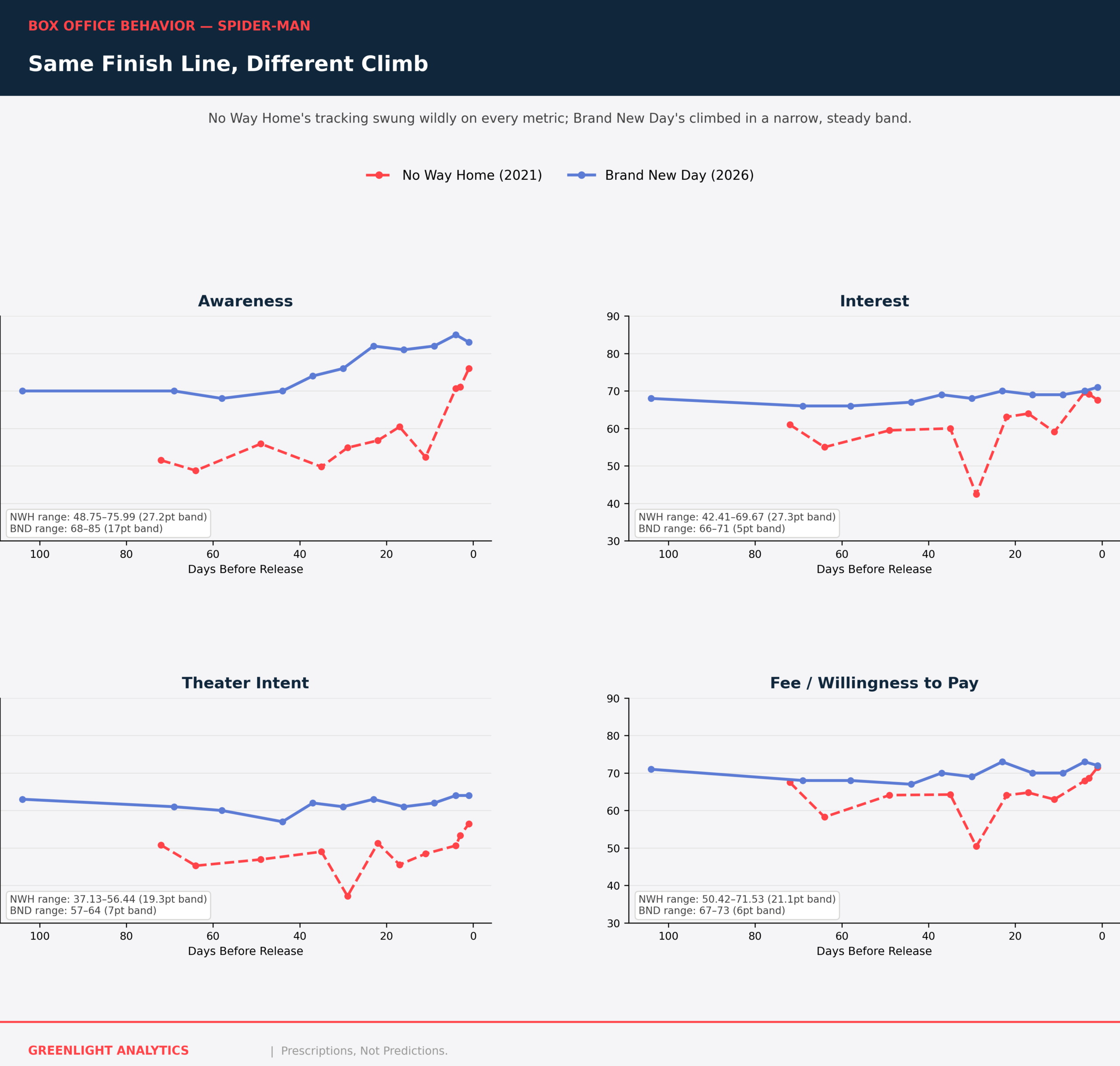
No Way Home saw far more volatile swings (pun very much intended). Interest fell to 42% on November 18, down from 60% one week prior, before popping back up to 63% one week later. Awareness dipped eight points in the first week of December, before surging 18 points last-minute. The multiverse speculation surrounding the film was absolutely a boon, but created distinct peaks and valleys.
Meanwhile, Brand New Day’s audience was steadier. None of the major metrics saw one-week movement exceed four points. Not only was the audience locked in from early on, but it was growing over time across a broad swath of demographics. That consistency likely led to less heart palpitations among the studio C-suites.
The Marketing Machine: Scale and Efficiency
Sony Pictures built two of the most robust promotional campaigns in recent memory for these releases. No Way Home’s global brand marketing value was $202 million, according to Deadline. This was anchored in promotional partnerships across the automotive industry, (Hyundai), social media (TikTok), gaming communities (Fortnite, Asus: Republic of Gamers, PUBG Mobile), and even insurance (Liberty Mutual).
Brand New Day upped the ante to an even greater degree. Its campaign totaled an estimated $309 million in media value, an all-time Hollywood record, per Deadline. If you thought Peter Parker’s webs were sprawling, you haven’t seen anything yet. Sony partnered with 165 brands for BND, and reached 2.86 billion across social (exceeding Endgame’s 2.4 billion). It was a deliberate and “true 8- to-80-years-old movie, it’s for everybody,” Sony EVP of Brand Strategy & Global Partnerships Jeffrey Godsick told the outlet.
The tight conversion funnel and declining No Interest rates we’ll cover in a moment are tracking-side proof that this mammoth campaign landed with more of the audience. It wasn’t just empty reach. There was substance behind the strategy.
Compounding Star Power
The swelling success of The Odyssey certainly helped boost the trio of Zendaya, Tom Holland and Jon Bernthal. Greenlight Analytics’ Talent DNA reveals two very different but complementary fandom shapes for Zendaya and Holland that also benefited Brand New Day.
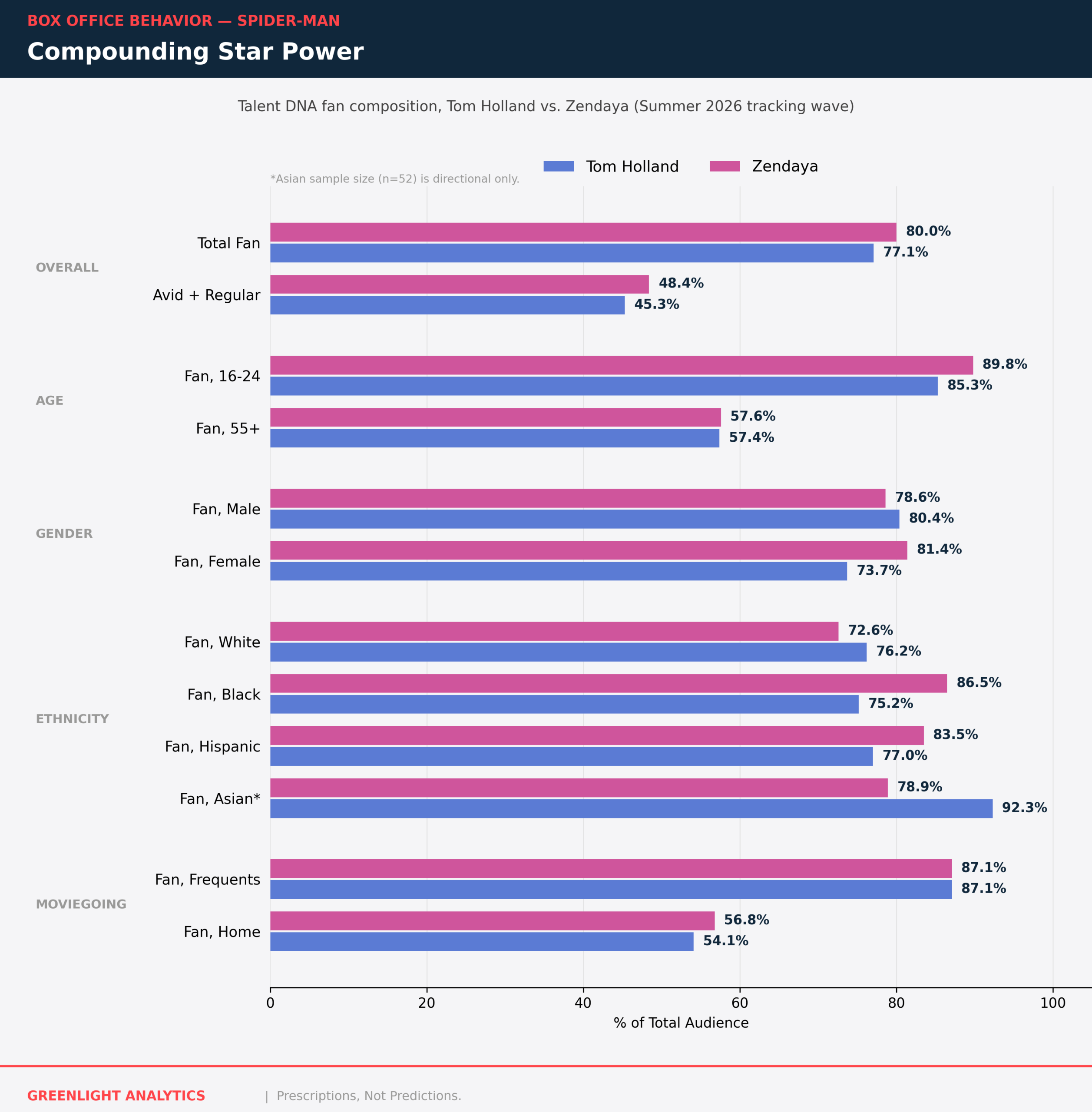
Among those who consider themselves fans, Zendaya over-indexes with Black (86.5%) and Hispanic (83.5%) audiences while skewing female (81.4% female vs 78.6% male). She’s helping to pull in audience demos that may occasionally fall outside the standard Spider-Man core. Holland is flatter and broader across race (75-77% across White, Black, Hispanic) but skews male (80.4% vs. 73.7% female). His fandom is slightly more concentrated. Both boast identical fandom scores among Frequent Moviegoers (87.1%), supplying a theatrical base. Combined, the two are additive rather than redundant.
Both were still ascending names in No Way Home coupled with nostalgia hooks in Maguire and Garfield. In the years since, the profiles for both have grown in different, helpful ways.
Final Wave Comparison
Let’s compare both films in their final tracking waves directly before release, shall we? That gives us a strong apples-to-apples comparison right as the money begins to roll in.
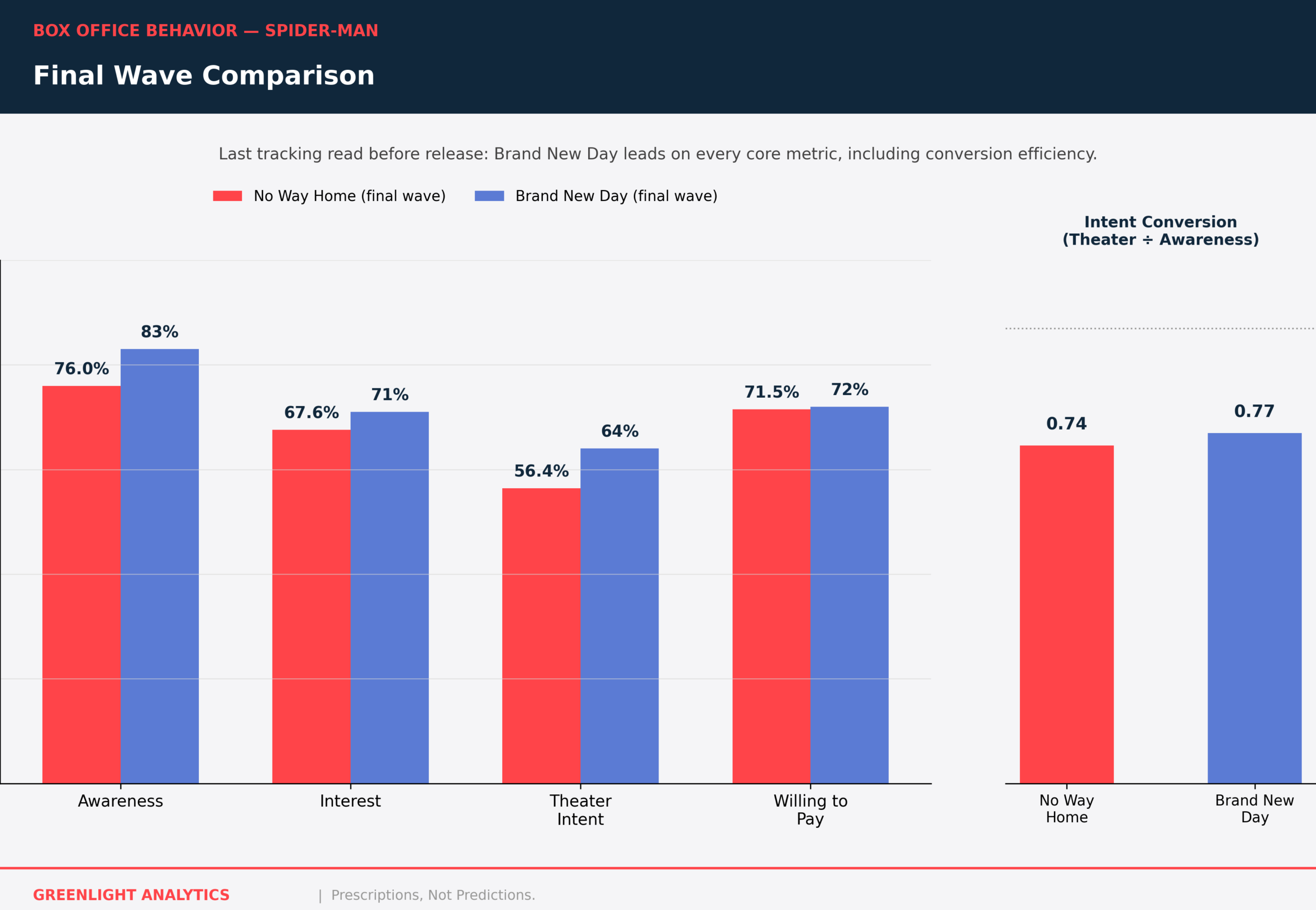
Brand New Day led in Awareness (+7 points), Interest (+3.4 points) and Theatrical Intent (+7.6 points) while finishing even in Willingness to Pay. Crucially, Intent Conversion (Theatrical Intent ÷ Awareness) reveals that the latest entry also translated marketing reach into theatrical desire slightly more efficiently: Brand New Day (.77) led NWH (.74).
Yes, I know that sounds like a bunch of buzzwords smushed together. But it speaks volumes about the effectiveness of the promotional materials, particularly the film’s trailers. The Spider-Man and Marvel brands obviously help establish an immediately high floor. But the movie actually has to look good too. Audience curiosity and enthusiasm was high throughout.
Who Actually Drove Opening Weekend
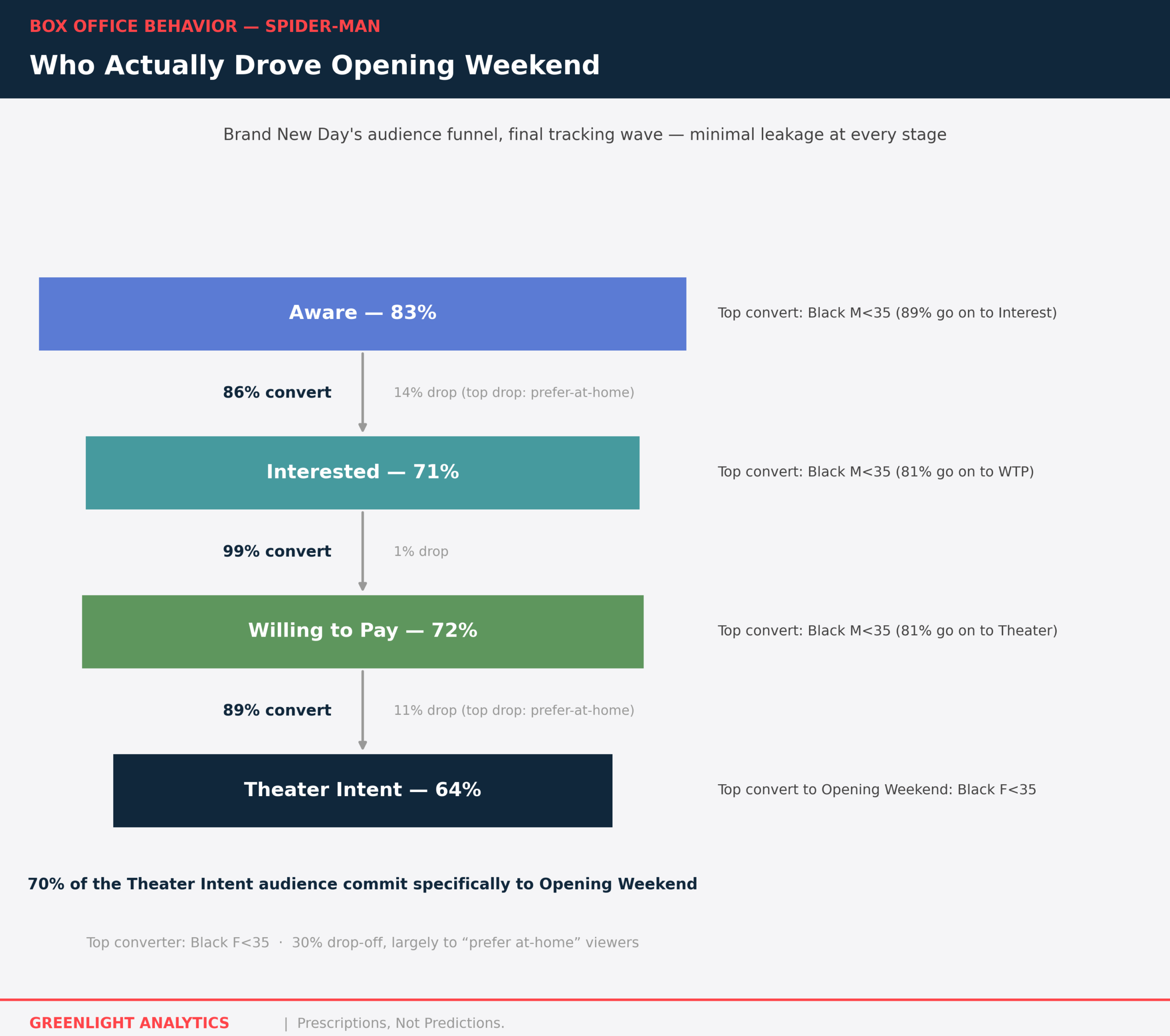
Spider-Man is the most relatable superhero and that’s borne out in the diverse array of audiences the character attracts. Black and Hispanic men under 35 were the clear standout demos heading into release: 89% and 82% Interest (respectively), 81% and 77% WTP. Heavily monetizable, as were Black Women under 35 who led in opening weekend intent (26%).. Even the weakest overall audience demo, White women 35+, still posted numbers most films would be quite happy with (49% Interest, 52% Theatrical Intent).
In the final pre-release week, the No Interest cohort—audiences who said they didn’t care about the film—dropped a full percentage point. Not exactly a mathematical tidal wave, but it suggests efficient last-minute targeting converted late holdouts. What Sony Pictures and Marvel Studios can really hang their hats on is the minimal leakage throughout every stage of the funnel: Aware→Interested→WTP→Theater→Opening Weekend.
Brand New Day’s elite Premium Large Format Intent score (26%) is made all the more impressive by the fact that The Odyssey still owns all the IMAX screens. BND was “forced” to settle for setting format records in Dolby ($10 million), ScreenX ($7 million), and 4DX ($5.2 million), per Deadline. There was a highly committed premium audience that sought out alternatives to see this film in the biggest medium possible. The urgency was tangible.
Final Takeaways
No Way Home was never released in China (where Brand New Day opened day-and-date with $121 million) or Russia while Brand New Day also benefits from 2026 ticket price inflation. It’s only fair to point out the structural mismatches within this comparison. Yet the former, while massively successful, reached its ceiling through streakier peaks and valleys. The latter steadily built from a massive starting point over time. Which would you prefer?
Brand New Day’s campaign was bigger, better targeted, younger, more multicultural, and more consistent. Its audience growth was still accelerating down to the very last wave when it finally plateaued just a smidge. Its efficiency at this size is downright staggering and it’s now on-pace to somersault past No Way Home’s overall box office totals.
Take a bow, Sony. This is your box office magnum opus.