
The World Cup and ‘The Odyssey’ Wanted the Same Audience. Both Won
July 20, 2026
There are two unshakable realities that help determine a company’s success or failure: both consumer attention and disposable income are terrifyingly limited resources. Without an endless supply of either, the sports and film industries attempt to establish squatter’s rights on the schedule to corner both. Yet in today’s multi-faceted attention economy, there are fewer and fewer openings on the calendar to do so.
This past weekend saw the year’s most-anticipated film, Christopher Nolan’s blockbuster reimagining of The Odyssey, and the world’s most-anticipated sporting event, the World Cup Final, arrive together. Normally, this would be a problem. Overlapping core target audiences for both (male viewers) have had their attention bifurcated for more than a month. Films don’t compete in a vacuum. Yet The Odyssey exceeded all reasonable expectations with a debut landing in the neighborhood of $125 million, while the 2026 World Cup final between Spain and Argentina is projected to reach 1.8 billion global viewers. How can both achieve such undeniable highs simultaneously? The lack of cannibalization between the two speaks volumes about alignment, visibility, and audience targeting today.
The Attention Economy
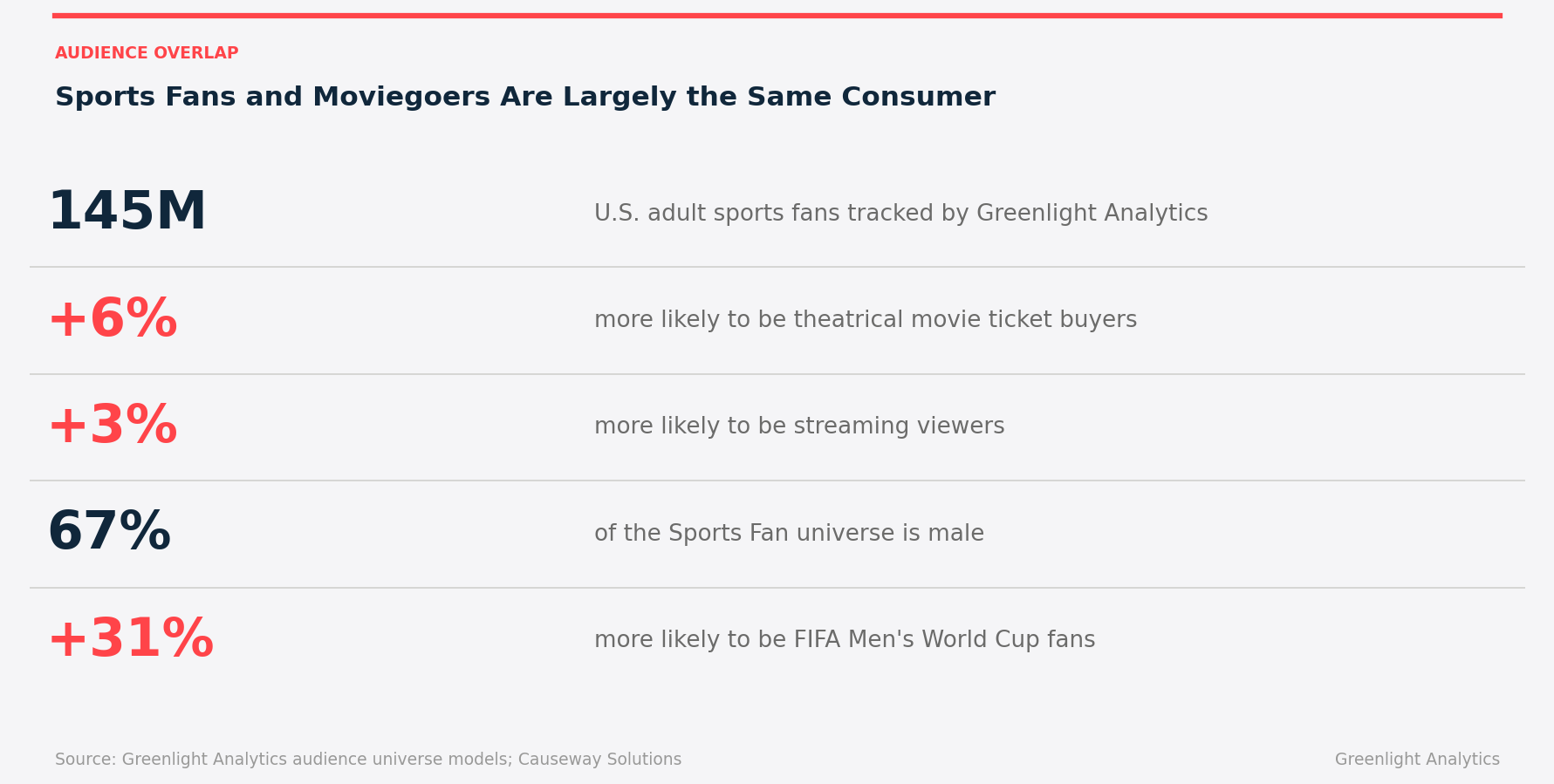
As mentioned, there exists a helpful overlap between the two cultural moments that creates a more complementary environment than initially expected. According to Greenlight Analytics, the U.S. adult sports fan universe (145 million consumers) over-indexes on theatrical movie ticket buyers (+6% more likely) and streaming viewers (+3% more likely). Surprise, surprise—sports fans and moviegoers are largely the same person.
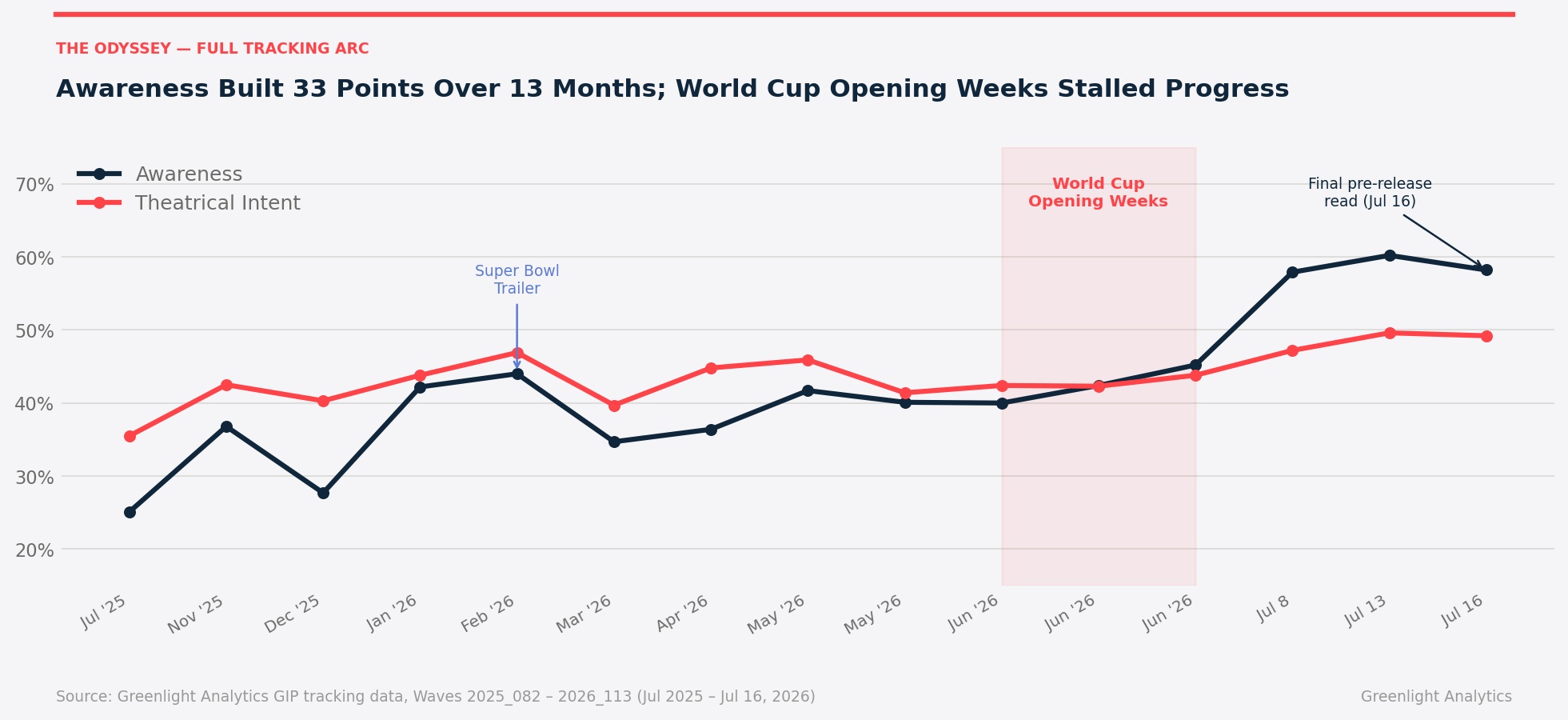
In its final tracking wave one day before release, Men 35+ were most aware of The Odyssey (67%) and the film was resonating strongest with Men under 35 (66% Interest, 58% Theatrical Intent, 73% Willingness to Pay). This doubles as Nolan’s core adult male audience, and the same viewership block that the World Cup has been courting in prime time for the last four weeks. Wouldn’t you know, Greenlight’s Sports Fan Universe also skews 67% male and over-indexes on FIFA Men’s World Cup (+31% more likely). This is the real, tangible overlap.
Frequent Moviegoers unsurprisingly showed the strongest monetization potential of any demographic. These are the consumers studios need to reach and activate first and foremost, and they were watching the World Cup. This completely alters the marketing math. It’s no longer a question of whether The Odyssey’s box office is impacted by the World Cup, but whether or not Universal’s campaign accounted for it.
Fortunately, the film’s tracking arc can show exactly how the magnetic push and pull between the two cultural events played out.
The Tracking Arc
In July 2025, more than a full year before release, The Odyssey’s Awareness (25%) and Theatrical Intent (36%) showed off an impressive floor. By this February’s Super Bowl, Awareness had risen to 44%, followed by Theatrical Intent (47%) and a notable jump in Willingness to Pay (58%). From June 3-17, the World Cup opening weeks, Awareness, Theatrical Intent, and Heat all stalled to a degree. Given the exploding World Cup popularity hosted in the U.S., this is not a total surprise in retrospect. Attention was being siphoned away on a global stage. But this was merely a temporary battle.
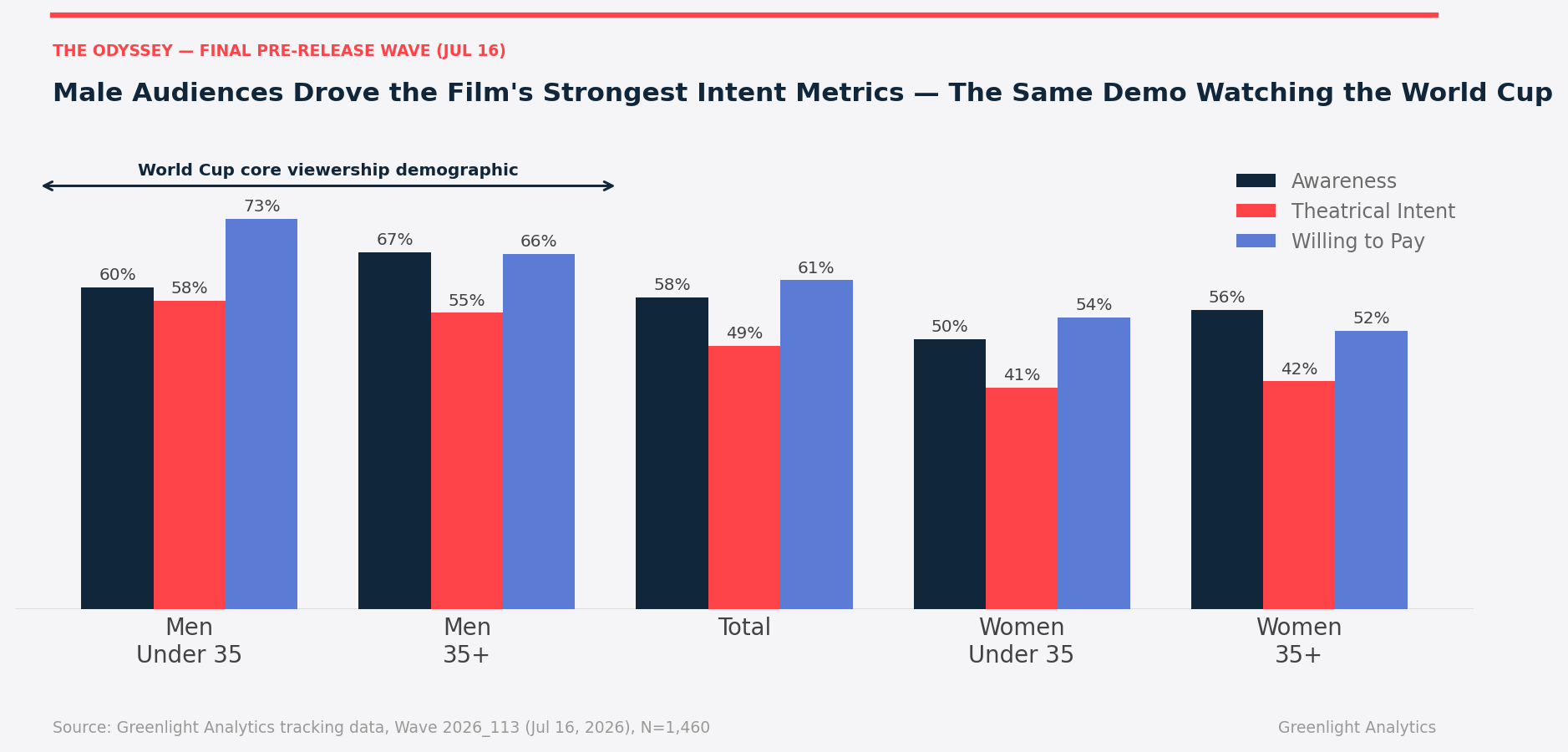
In the final three pre-release weeks, which coincided with the tournament’s highest-viewership matches, The Odyssey enjoyed strong week-over-week gains as momentum built. This included the single-largest Awareness spike in its entire tracking arc. Yes, this follows traditional tracking patterns and late-cycle marketing spends. But it also speaks to a larger trend.
The pop culture conversation was peaking around the world’s favorite sporting event. The Odyssey tapped into that momentum via the same core audience. They were already glued to their screens, and Universal captured a portion of that attention with global soccer star Erling Haaland’s digital tournament diary series.
Zooming out, we see a methodical 58-point awareness build over 13 months, with the most constrained period coming during the four weeks the World Cup was consuming the same adult male audience the film needed most.
This Is What Competition Can Look Like
Movies no longer compete only against other movies. The Odyssey’s real rival wasn’t another Hollywood tentpole. It was the World Cup, drawing tens of millions of viewers from the same demo the studio needed to lock in.
Two World Cup matches this summer rank as the most-watched non-NFL U.S. sporting events since the 1994 Winter Olympics. This is the crowded attention economy at work in real time, and it is hardly the only example. Toy Story 5 and Spider-Man: Brand New Day flank The Odyssey in July, as do streaming original releases such as Amazon’s Legally Blonde prequel series Elle and Netflix’s Enola Holmes 3, a national address from President Donald Trump, peak summer travel, etc. Release date scheduling has an endless number of variables playing a potential role on the bottom line.
The Odyssey’s tracking plateau in June during the World Cup’s opening weeks accounts for those variables, as does its late-cycle resurgence.
The movie campaign built awareness from 25% to 58% over 13 months. The one sustained flat period—four weeks, 40–45% awareness, minimal intent movement—directly coincides with the tournament’s group stage and round of 16. This static section most likely reflects a deliberate studio strategy to conserve marketing ammo during the loudest cultural interval leading into the final stretch.
Theatrical Intent Among Aware held at 63% through the final read. WTP closed at 61.4%. The audience that was reached was well-converted. The open question, which tracking can surface but box office alone cannot, is whether the plateau represented a ceiling that was harder to break through because of the World Cup, or simply the natural rate of a late-stage campaign finding its remaining persuadable audience.
The Final whistle blows. The opening credits roll. The audience is the same people. Audience intelligence is the only tool that tells you where they were, what they were watching, and whether your campaign reached them before or after the distraction.