
Box Office Behavior: From Black List Buzz to Audience Buy-In
September 22, 2026
Every December for the past 21 years, film producer and all around great Twitter/X follow, Franklin Leonard releases The Black List: Hollywood’s favorite unproduced screenplays, as voted on by hundreds of film executives. It’s a sophisticated sample of which stories industry insiders are most drawn to. But an industry vote is not always a 1:1 reflection of general audience taste.
ScriptLens concept testing, which pulls from nearly three million first-person film tracking audience surveys from 2020-present, is designed to plug in long before a frame is shot. It helps validate a creative’s instincts, position studios to spend more efficiently, and translate post-COVID audience tastes into helpful slate direction. The top two screenplays from 2025’s Black List, Best Seller and Equity, have already earned the industry’s favor. Here, we’ll show how ScriptLens identifies the audience potential.
Buzz vs. Buy-In
The Black List is a fantastic signal of taste, but that isn’t necessarily the same thing as general audience interest. And it’s audience interest that often dictates greenlights. In order to translate this screenplay buzz into studio offers, creatives increasingly need to prove the commercial potential and risk of their projects.
So we tested each title sight-unseen against a 1,000-person synthetic panel, calibrated against those real consumer surveys collected since 2020. This enables us to model how different audience demographics have historically responded to comparable movies, and apply those track records across loglines and a few key variables (budget tier, cast, director, genre). It’s a proxy for how an audience would react to a title they’d just heard about for the first time. Those baseline scores are then compared to the average scores that real released films in the same genre and budget tier posted. From there, we stretch the concept to see what helps and hurts its prospects, reframing the pitch, tone, or casting a handful of different ways to see how significantly it impacts Interest.
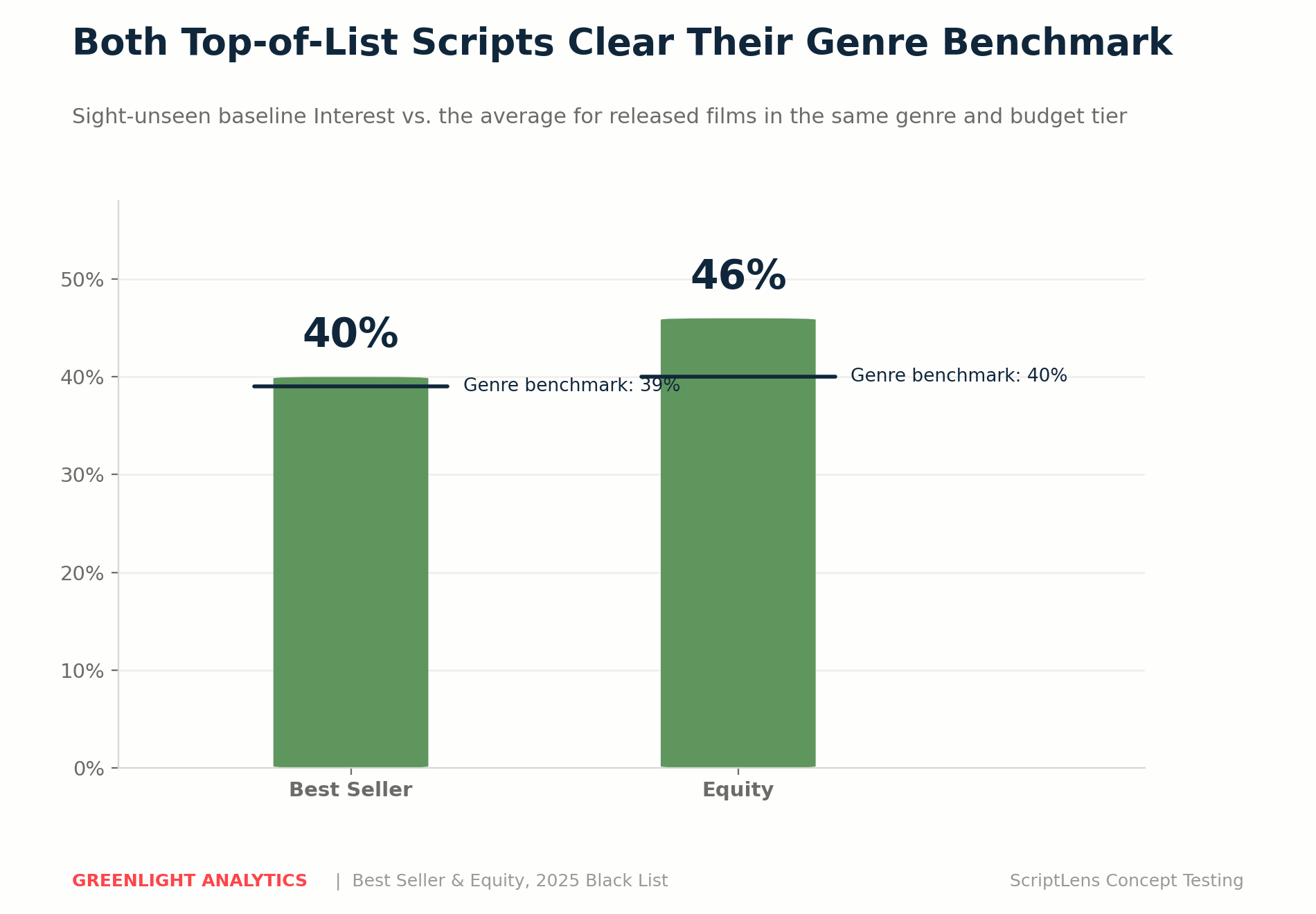
Writers Matisse Haddad and Ward Kamel will be happy to know that their titles cleared the baseline comp benchmarks. Best Seller (Haddad), which follows a struggling writer and her famous novelist husband in New York’s literary scene, earned 40% general audience interest compared to the 39% of its drama comp set. That means the concept elicits interest from roughly 40% of the modeled audience before packaging or marketing revs up. Equity (Kamel), which is set in the high-stakes world of big pharma finance, scored even better with 46% compared to 40% for its thriller comp set.
The craft and creativity that landed each script onto Hollywood’s Black List appeals to audiences as well. But that’s not enough at the negotiating table. We also have to know how solid or volatile these numbers can be.
Case Study: Best Seller
For Best Seller, we ran a concept test with the assumption that it would be a mid-budget ($15 million-$50 million) drama with an emerging cast and director (not star level, but not completely unknown either).
In addition to 40% Interest, it also scored 4% Heat (those who rate their interest as a 7/7), 44% Willingness to Pay (theatrical ticket, VOD transaction, or new streaming subscription to watch), 33% Theatrical Intent (will see in theaters) and 8% Opening Weekend Intent (will see opening weekend).
Crucially, Best Seller’s baseline clears Interest and Theatrical Intent, but misses WTP by a single point (44% vs. a 45% floor). It’s a reminder that data cannot predict the future. But it can tell you exactly where you stand. Again, this is sight-unseen. Packaging elements (talent) and marketing have the ability to push all of these numbers up or down.
Back to our point about durability vs. volatility: the concept is mostly stable, but positioning matters. Across the four framings we tested, Interest moved by as much as 32 percentage points, with Women 35+ and frequent moviegoers consistently showing the most interest. Zooming out, here are the four variants ranked by how much they move the needle:
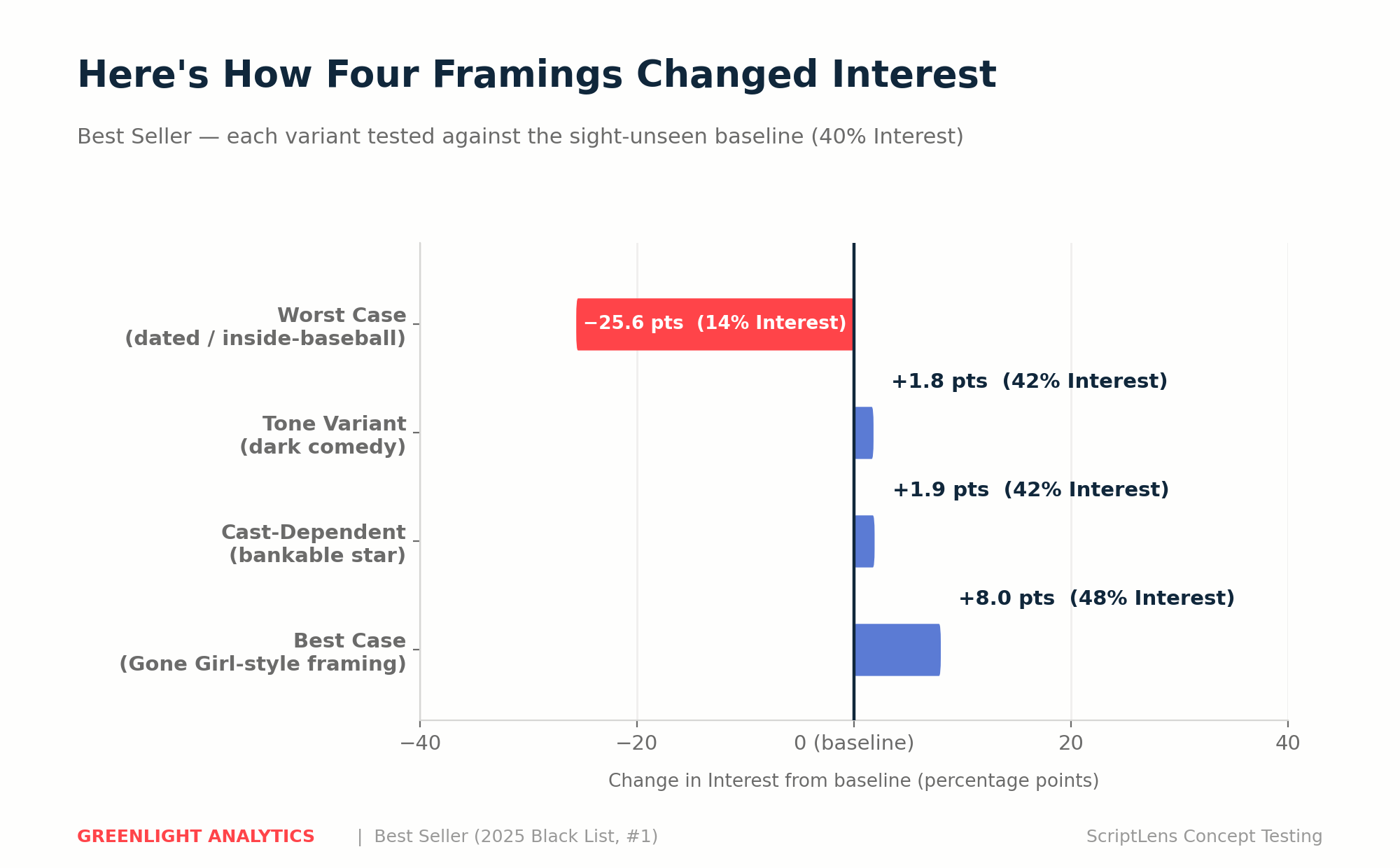
In the lowest-performing scenario, the premise reads as too dated and/or inside baseball. In the best case, you get a Gone Girl-esque cultural framing that engages the Under 35 audience. With the tone variant, which repositions the film as a dark comedy, you only see a minimal lift in overall interest. Similarly, the cast-dependent scenario in which a bankable star is attached doesn’t dramatically raise the ceiling either, though it obviously doesn’t hurt. Protecting the premise from feeling culturally archaic is the real lever of note here. Girl on the Train and Knives Out are ideal comps thanks to clear marketing hooks and the strength of their ensembles.
Bottom line: yes, Best Seller absolutely has a durable commercial floor as a female-skewing drama…as long as the execution and positioning is sound.
Case Study: Equity
We ran our Equity case study under the assumption of a low budget ($5 million to $15 million) thriller with an emerging cast and director. The result was a wider range of outcomes: 46% Interest, 4% Heat, 52% Willingness to Pay, 38% Theatrical Intent, 10% Opening Weekend Intent.
Equity raises a few more questions than Best Seller, but boasts higher potential upside on paper. Its Interest swings were even larger from floor-to-ceiling across demos, with Men Under 35 enjoying the strongest baseline (50%) and the widest gap between framings. Here are the four variants ranked by how much they move the needle:
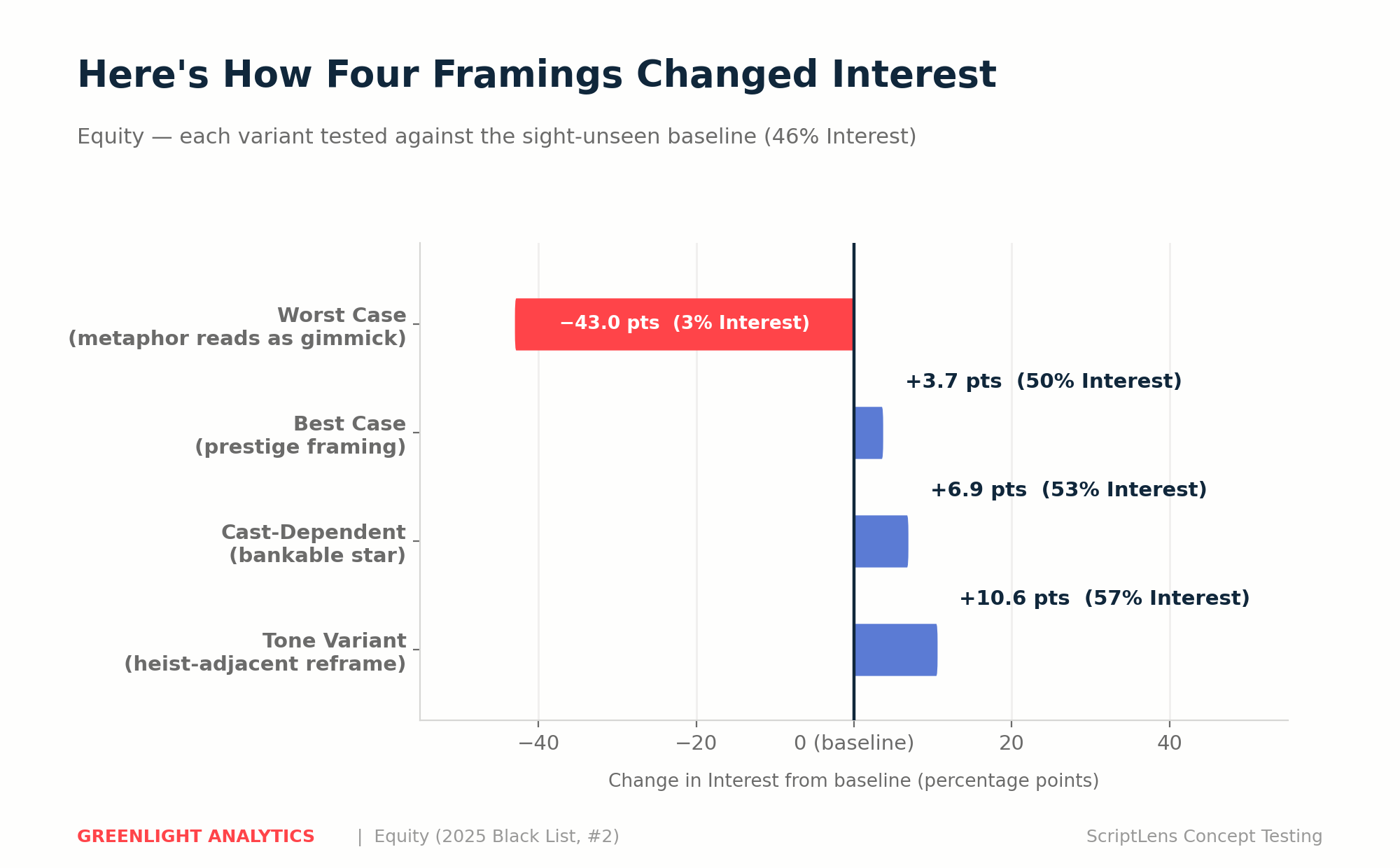
In the lowest-performing scenario, Interest plunged 43 percentage points as the film’s high-stakes battle read as more of a gimmick than a hook. With a tonal reframe, in which Equity is presented as heist-adjacent, Interest popped up by nearly 11 percentage points. In the best-case scenario, the film plays like a commercial prestige offering and bumps up by nearly 4 points. And unlike Best Seller, the cast-dependent scenario offers more upside with a 7 percentage point lift when an A-lister is cast. Though Equity skews more thriller than western, Hell or High Water is a real-world proof point.
Equity is a bit more volatile, but its upside is compelling.
Votes vs. Variance
The Black List reveals which scripts Hollywood insiders are buzzing about. ScriptLens conveys the uncertainty underneath an unmade concept. Both titles clear the baseline audience thresholds we’d expect relative to their respective genres and budget assumptions. But that’s just about the totality of their similarities.
Best Seller, voted No. 1 on the Black List, appears to have the safer floor. Second-place Equity has a wider range of potential outcomes, but more upside. Neither is “better.” They simply come with different commercial paths. Concept tests for both help us understand where industry buzz and audience profile risk match and diverge.
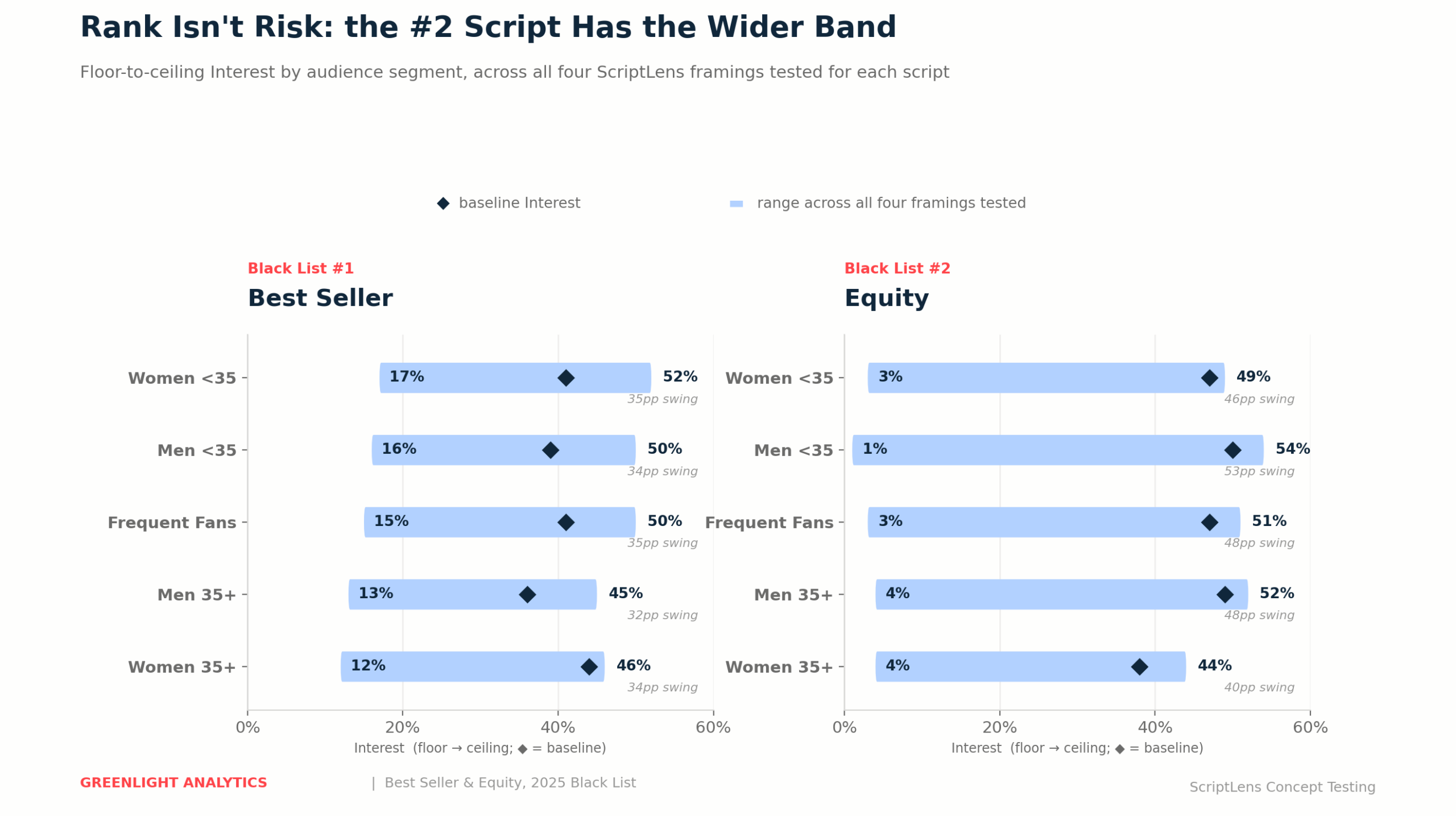
For Best Seller, tone and clarity of concept (-26 points) is far more important than casting alone (+1.9 points). For Equity, a slight genre reframe (+11 points) could unlock its full potential if done well. These are essentially findings for pitching scripts and maximizing results across different genre and budget tiers. And they’re measurable long before millions of dollars have been spent.
Black List placement is a vote of confidence from industry peers in the creative. Concept testing helps extrapolate the range of possible outcomes, and which levers to pull to avoid pitfalls and maximize audience upside.
For creatives, the talent that landed them on the Black List in the first place can be validated by audience data. No, not as a replacement for the special alchemy that is creativity. But as a GPS helping to find the packaging choices that breathe life into the work rather than erode it.
For studios and financiers, greenlight decisions can keep moving away from gut feelings and more towards projecting accurate performance ranges. That can result in fewer costly unknowns after development/greenlight, and a better allocation of resources. You can’t erase risk, but you can see its contours before it wrecks your bottom line.
Data cannot reverse-engineer the next Oscar-winning blockbuster. If we could make The Odyssey in a spreadsheet, we would have already. But data can help creatives aim more accurately and help studios spend more efficiently. In doing so, both sides better understand the risk and reward before millions of dollars are spent.