
Box Office Behavior: Stop Greenlighting the Best Case Scenario
May 18, 2026
Is the glass half empty or half full? Does every cloud have a silver lining or are you looking through rose-colored glasses? Personal lives may reward eternal optimists while punishing buzzkills. Your volume of annual wedding invites can attest to that. But pie-in-the-sky idealism may be slowly killing Hollywood.
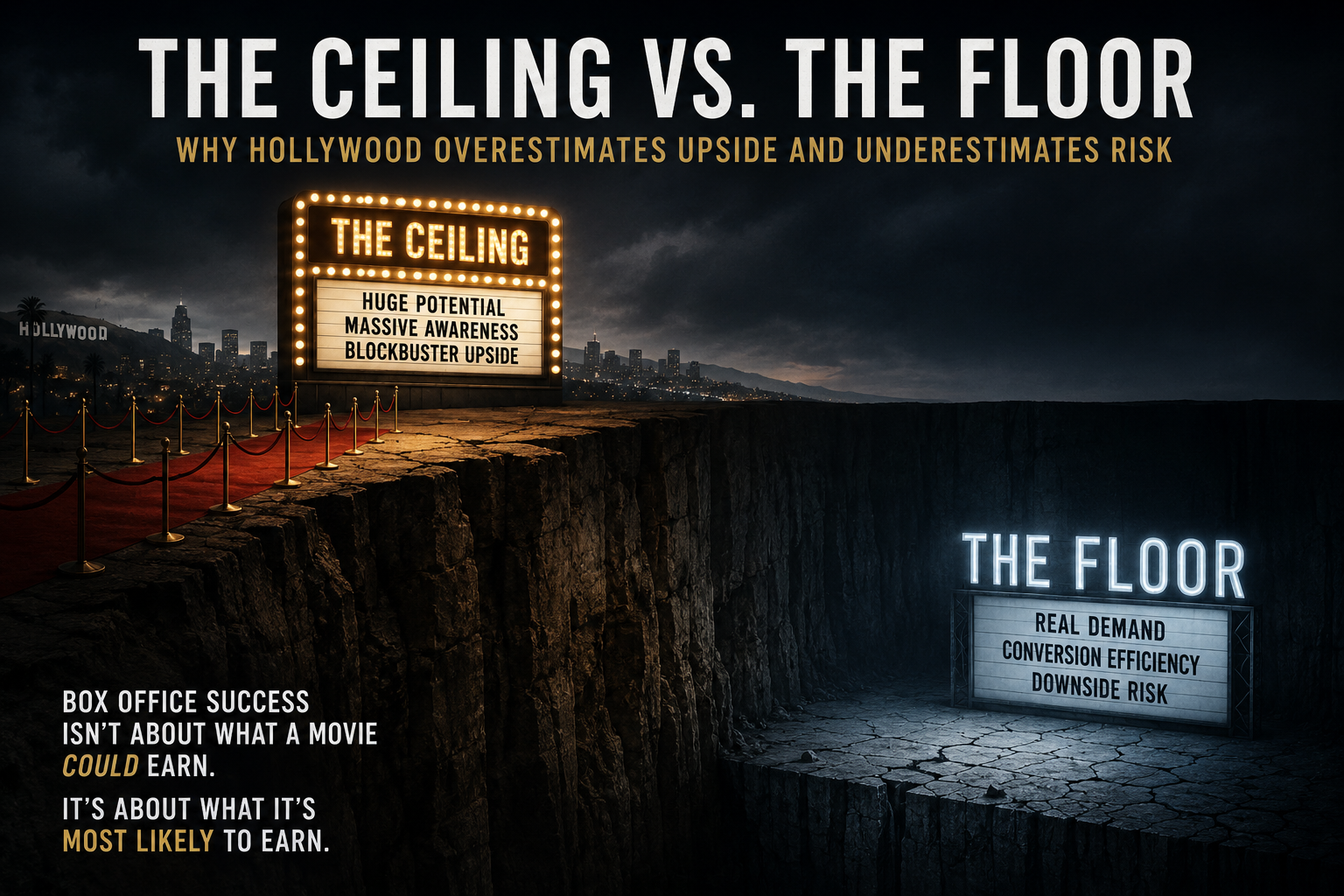
Greenlight decisions and box office projections are too often made with a film’s upside in mind. Not enough regard is given to the downside risk. Ceiling vs. floor is an eternal debate. But creating comps, leading tracking with raw awareness, allocating marketing budgets, and forecasting performance based on best-case scenarios is a short-cut to disappointment. ROI is modeled on the upside—what a film could earn instead of what it is most likely to earn.
What happens if everything goes right except ticket sales? Probing the floor isn’t doom-and-gloom pessimism. It’s risk management. It’s the 10th man rule from World War Z: giving credibility to the improbable. The reality is that there’s a clear data-driven warning system for bottoming out that most of the industry either doesn’t measure or doesn’t care about.
Defining the Terms in Data
What comprises a ceiling projection? Raw awareness still plays an outsized role. Studios understandably want to maximize the known reach of a title prior to release. Why spend $100 million-plus on a blockbuster if no one knows about it? But broad recognizable footprints can inflate upside signals (which we’ll touch on later). Awareness is a proxy for the size of the potential audience, but doesn’t provide insight into how many will convert into ticket buyers.
A few different metrics can help us better understand the floor. Intent Conversion (Theatrical Intent divided by Awareness) is a strong reflection of marketing efficiency. Ratios closer to 1.0 reflect more efficient activation. Audiences are reached by marketing, enjoy what they see, and intend to buy a ticket.
Excess Awareness captures the percentage of aware audiences that hold no interest. It’s like inundating someone who hates superheroes with endless ads for Avengers: Doomsday. Marketing to these viewers is a waste of money. Other quality floor signals include Theater Intent Among Aware (what percentage of audiences that know this film exists want to see it in theaters) and Persuadable Audience (what percentage of audiences don’t know this film exists, but express interest at the logline/poster).
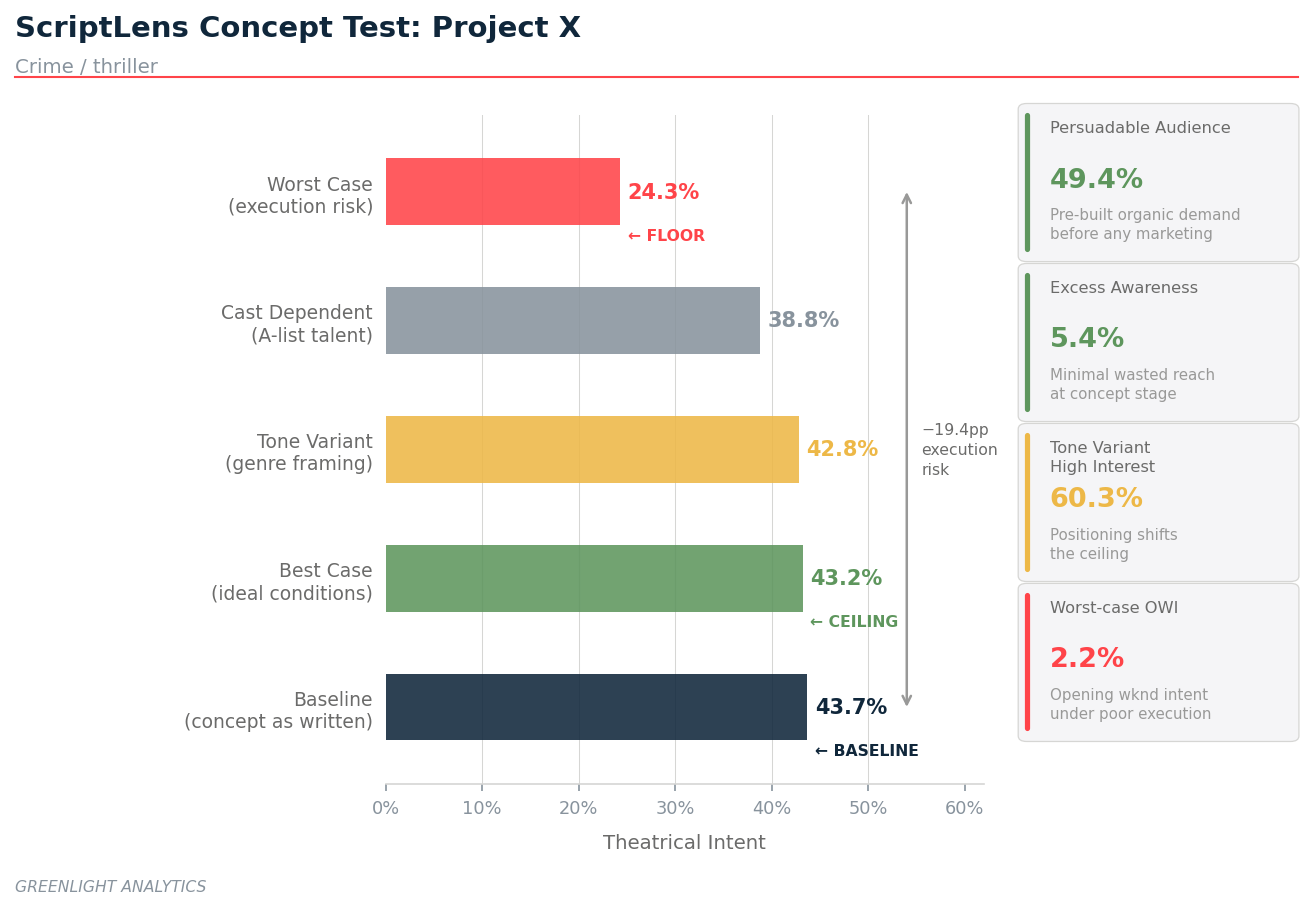
These same pre-release tracking signals can also be projected in the concept development phase prior to greenlights and committed production budgets. Greenlight Analytics tests scripts and logline variations simultaneously: baseline (concept as written), best case (ceiling), worst case (floor), a repositioned tone variant, and a cast-dependent variant. The quality of execution marks the difference between the best and worst case. The gap between the baseline and cast-dependent variations reveals whether or not there is enough core concept appeal to stand alone or if it needs to be lifted by name brand stars.
This is where a recent crime thriller project we tested lives. Based on 2.7 million consumer surveys from 2020-Present, our audience testing panel suggests this project would have a persuadable audience of 49% before any marketing was released. In other words, nearly half of viewers would express organic interest in the film’s concept. That’s the built-in floor. In the worst-case scenario, theatrical intent shrinks from 44% to 24%, a 19-point tumble resulting from poor execution. That’s what the greenlight budget should be tied to. But what budget level is appropriate based on these metrics? That’s the question data can help answer prior to production.
The Spectrum of Case Studies
Entertainment is inherently subjective and audiences are notoriously fickle. That’s why refining the entropy of opinionated taste into tangible financial prescriptions is so vital.
In the concept testing stage above, you can flag a misaligned market fit before wasting any money on it. But you can also apply the framework to active slates. To give an example of just how to do that, we’re going to look at five post-COVID films with pre-release tracking patterns that made box office outcomes clear from a mile away.
Strong Floor Archetypes
John Wick: Chapter 4 (Budget: $100 million)
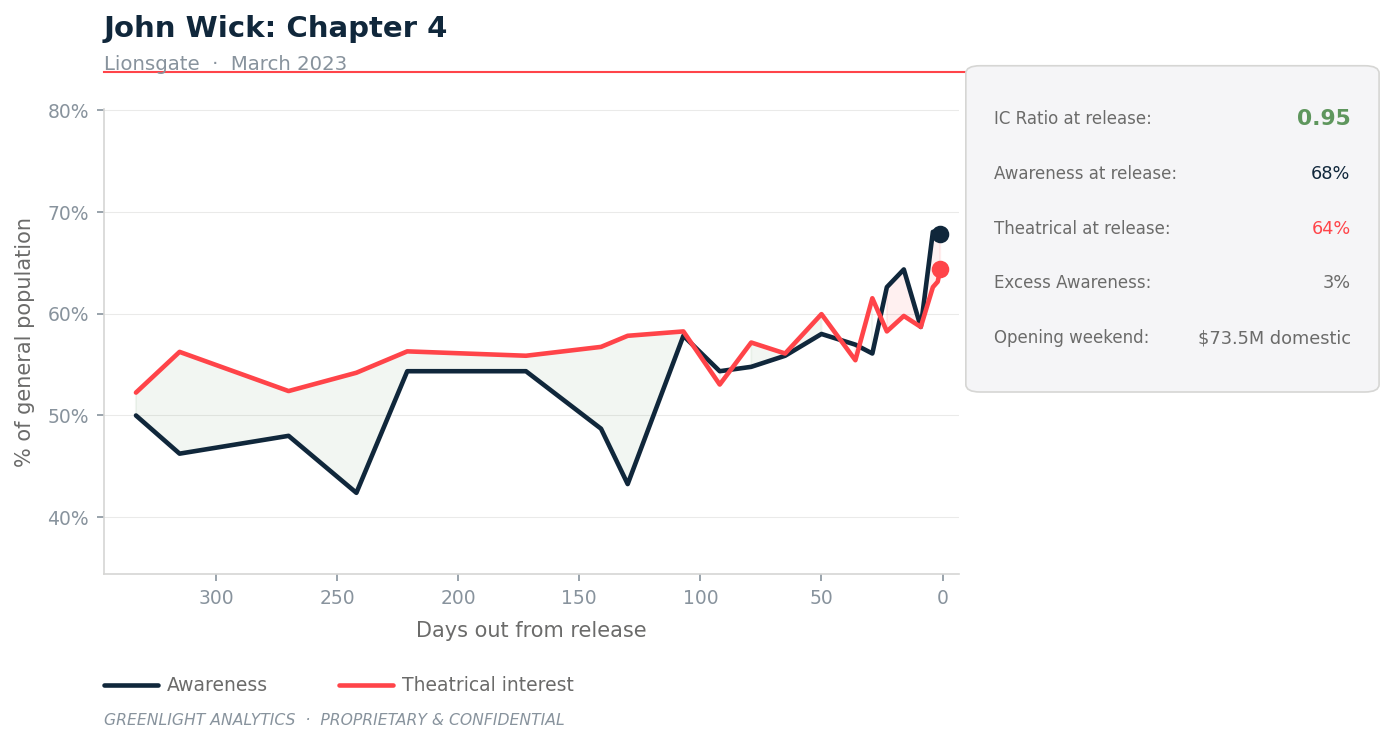
John Wick: Chapter 4 was not only a symphony of balletic violence, but as close to an immaculate pre-release arc as you can get. A .95 Intent Conversion ratio showed that the people who knew about it wanted to see it. As a hard-R action film, its audience was more narrow than a four-quadrant blockbuster, but highly committed.
There was a very small gap between the floor and the ceiling, as evidenced by miniscule excess awareness (3%). Theatrical Intent Among Aware was 95%! A $73.5 million opening domestic weekend and $440 million global box office slapped the exclamation point on its overall performance.
The Batman (Budget: $185M–$200M)
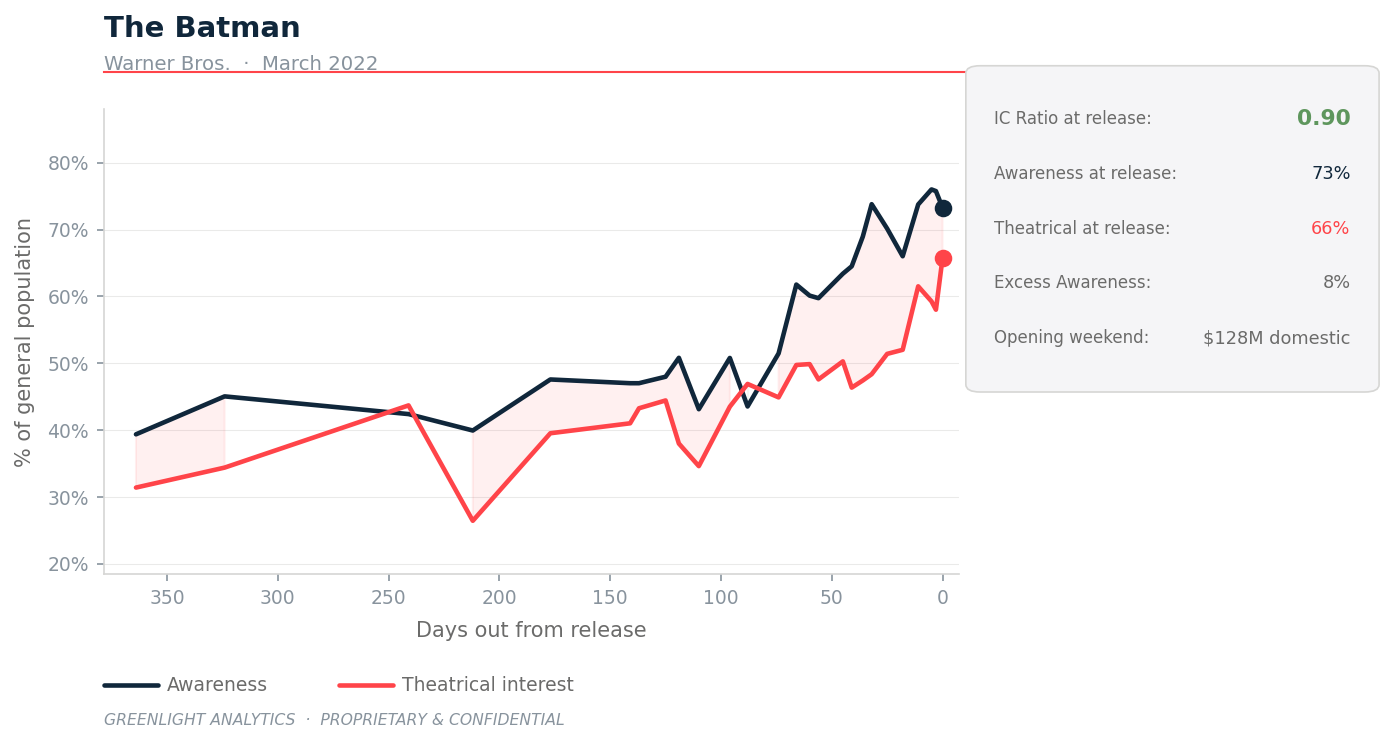
Batman is the crown jewel of DC Comics, and that’s rewarded with big budgets. Given Batman’s longstanding cultural footprint, its massive awareness (73%) was no surprise. What was impressive was how efficiently (.90) Warner Bros. converted that awareness into intent.
The core DC audiences and the glowing critical reception provided enduring demand for this reboot. In this case, the broader awareness was a feature, not a bug, and the ceiling was so large that it overwhelmed any floor concerns. Excess Awareness was low (8%), Theatrical Intent was high (66%), and Theatrical Intent Among Aware was even higher (90%). The result was a successful $128 million opening weekend and $770 million worldwide gross.
Complicated Case
Ant-Man and the Wasp: Quantumania (Budget: $330M)
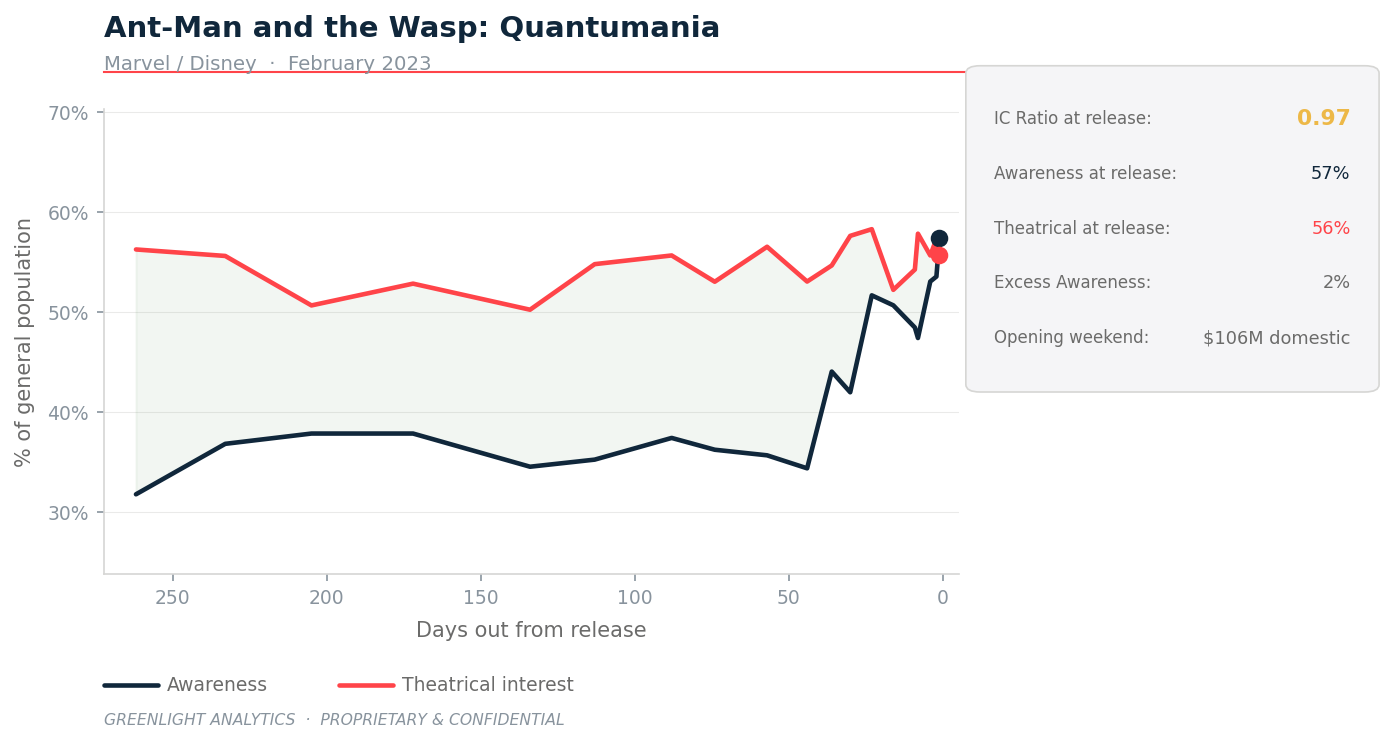
Quantumania may be the most important example here.
On paper, Ant-Man 3’s Intent Conversion rate (.97) is a nearly perfect 1:1. But this is why more than one metric is needed to tell a complete story. Since the overall size of the aware population (57%) was so much smaller than prior MCU entries, there were cracks in the film’s ceiling before it even hit theaters. Strong conversion alone was not enough to overcome growing apathy.
Brand erosion and a poor critical reception ensured that a franchise-best $106 million debut would not move the needle long-term. The film’s failure, outside of an engorged budget, wasn’t due to Marvel Studios chasing upside. It was the assumption that the MCU brand automatically guaranteed a massive awareness pool despite post-Endgame fatigue.
Ceiling Archetypes
The Flash (Budget: $200M–$220M)
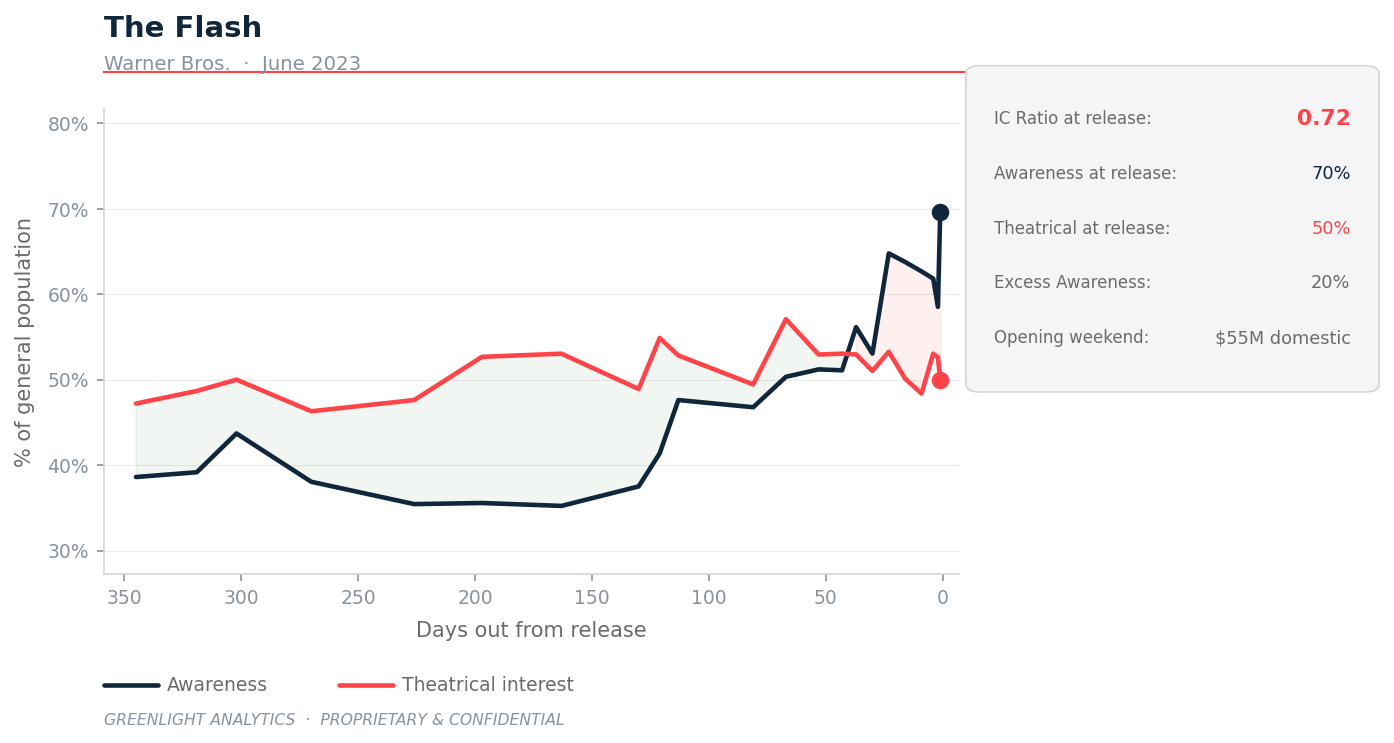
This isn’t the first time we’ve used The Flash as an example of what not to do. While Awareness (70%) stood strong, Theatrical Intent (50%) and Theater Among Aware (72%) told a completely different story. That ~20 percentage point gap represented the ceiling/floor mismatch—a massive swath of aware viewers with no desire.
A $220 million production budget demands strong theatrical buy-in and enduring enthusiasm. The tracking data flagged this precarious reality before release. Throughout the pre-release window, awareness rose steadily (starting at 38% 270 days prior to release) while intent remained marooned in the 48-53% range. Warner Bros.’ marketing campaign built tons of recognition, but could not manufacture enough demand. RIP DCEU.
Wicked: For Good (Budget: $150M)
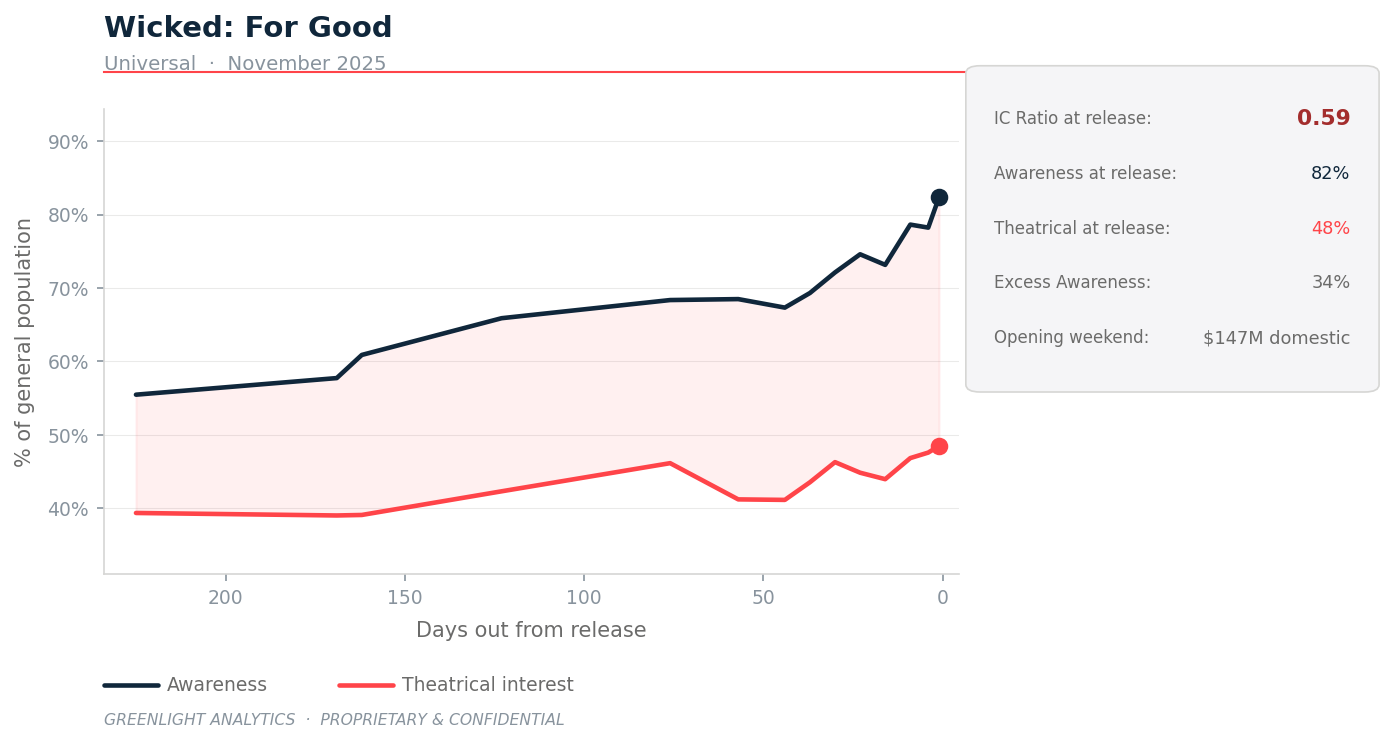
Wicked: For Good was objectively successful, but underperformed relative to ceiling expectations following the breakout original.
Awareness grew a whopping 27 percentage points over the campaign window (and the 82% final awareness score is the second-highest from 2021-2025). Theatrical Intent grew by 9 points. Theatrical Intent Among Aware was just 53%. Conversion (.59) was far more inefficient than the original film by every metric, especially when expanding beyond the core female audience.
Wicked devotees were locked in from day one; saturation was hit almost immediately. Everyone else was harder to convince. Excess Awareness (34%) was the key tell here. It’s why the sequel earned $132 million less domestically and $219 million less globally.
Floor Signal Framework
When reading the signals together, earlier indications of performance become clearer. Yes, it’s a sliding scale, but there are general tracking tiers every film should be aiming for.
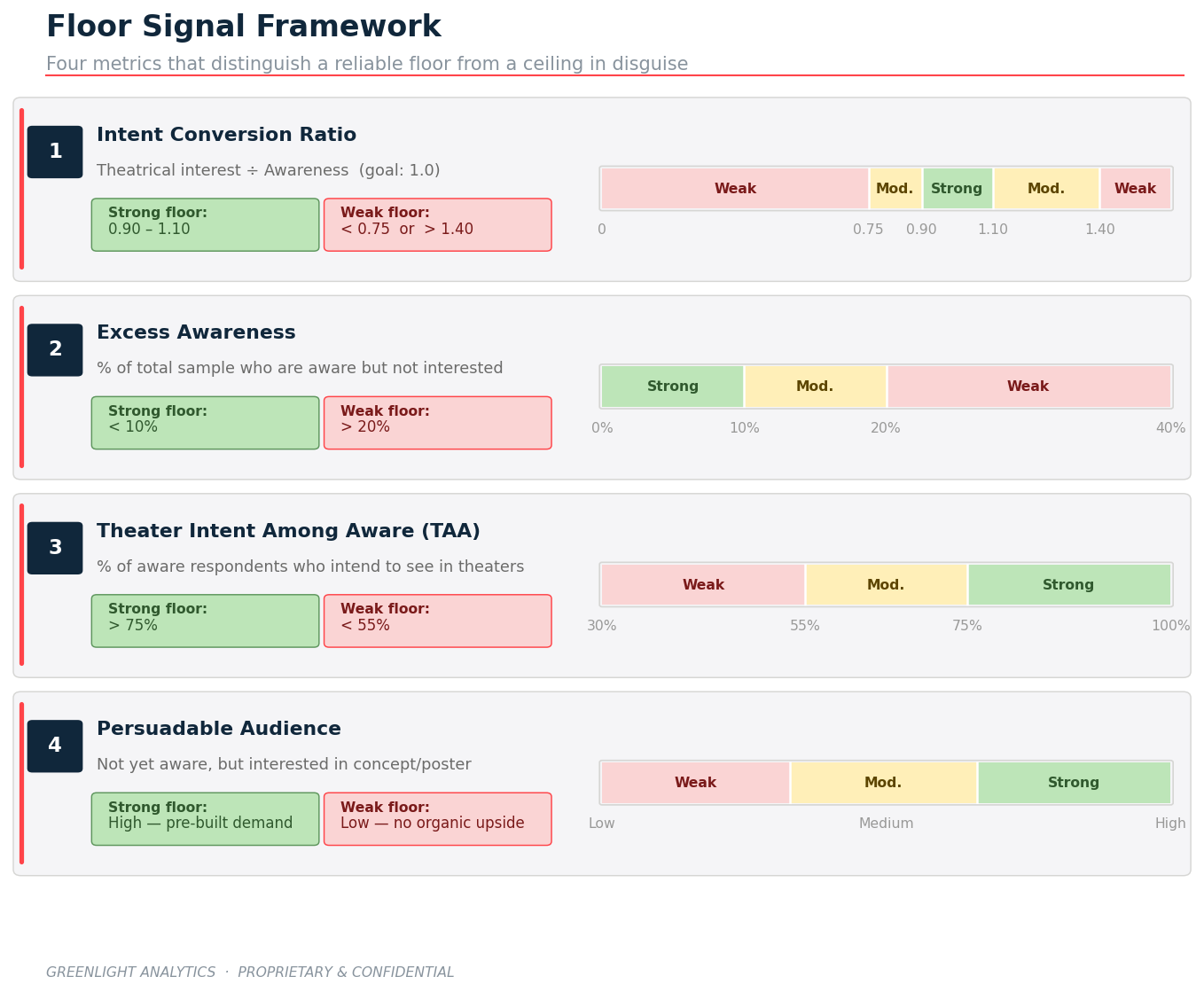
Intent Conversion should ideally never drop below .90 or shoot beyond 1.10. Studios should work to push Excess Awareness to below 10% by the time of release. Theatrical Intent Among Aware should rise across the pre-release campaign and hopefully sit at 75% or higher by the time it hits theaters. The Persuadable Audience should start high—indicating core concept appeal—and shrink over the campaign as marketing reaches (and converts) these intrigued audiences.
The best case scenario is John Wick 4. Low excess awareness + high Theater Among Aware + good conversion = a reliable floor. Ant-Man is more complicated: It had strong conversion and low excess awareness, but lower total awareness shrunk the ceiling. The floor was real (as evidenced by $476 million worldwide), but smaller. The Flash is the worst-case red flag scenario. High excess awareness + low Theater Among Aware + a conversion ratio below .75 = an inefficient marketing campaign that failed to elicit viewing desire. The ceiling was etched in stone, while the floor was a bottomless pit.
Why Hollywood Keeps Chasing the Ceiling
At this point, I bet you’re wondering why Hollywood continues to make the same mistakes if the warning signs are this easy to read. Well, for better and for worse, the film industry is highly fragmented. Different departments are working towards different incentives that may only loosely interlock.
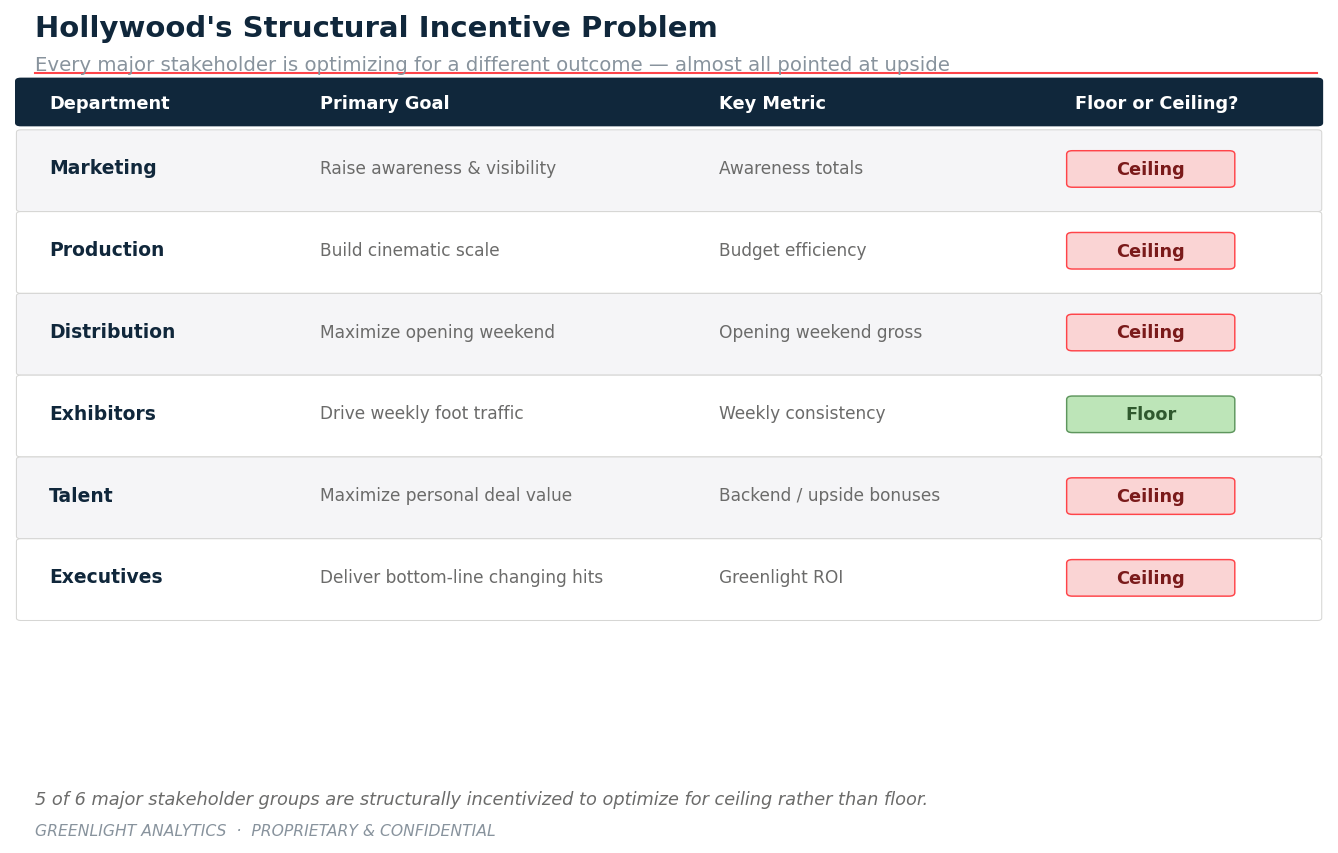 Marketing teams are tasked with raising awareness and visibility. Yet their job security often depends on financial performance despite the fact that they have nothing to do with the actual filmmaking. Production teams aim to build scale to give customers a sense of cinematic eventization, but are tasked with doing so at a budget. Distribution teams emphasize opening weekends while exhibitors prioritize weekly consistency. Talent contracts are largely tied to upside performance incentives. Executives are rewarded for bottom-line changing hits and punished for misses.
Structurally, Hollywood is built to chase the winning lottery ticket rather than build around high floors.
When Chasing Upside Destroys ROI
There is an audience out there for nearly every single title. It may not always be a big one. But it’s there. That is the core high-conversion, low-excess-awareness base. The Book-Tok fans rushing to see the latest literary adaptation in the opening weekend.
Unlocking upside requires broadening the campaign beyond this core target demo. The problem is that non-core audiences are naturally less interested. They convert at lower rates, causing excess awareness to increase.
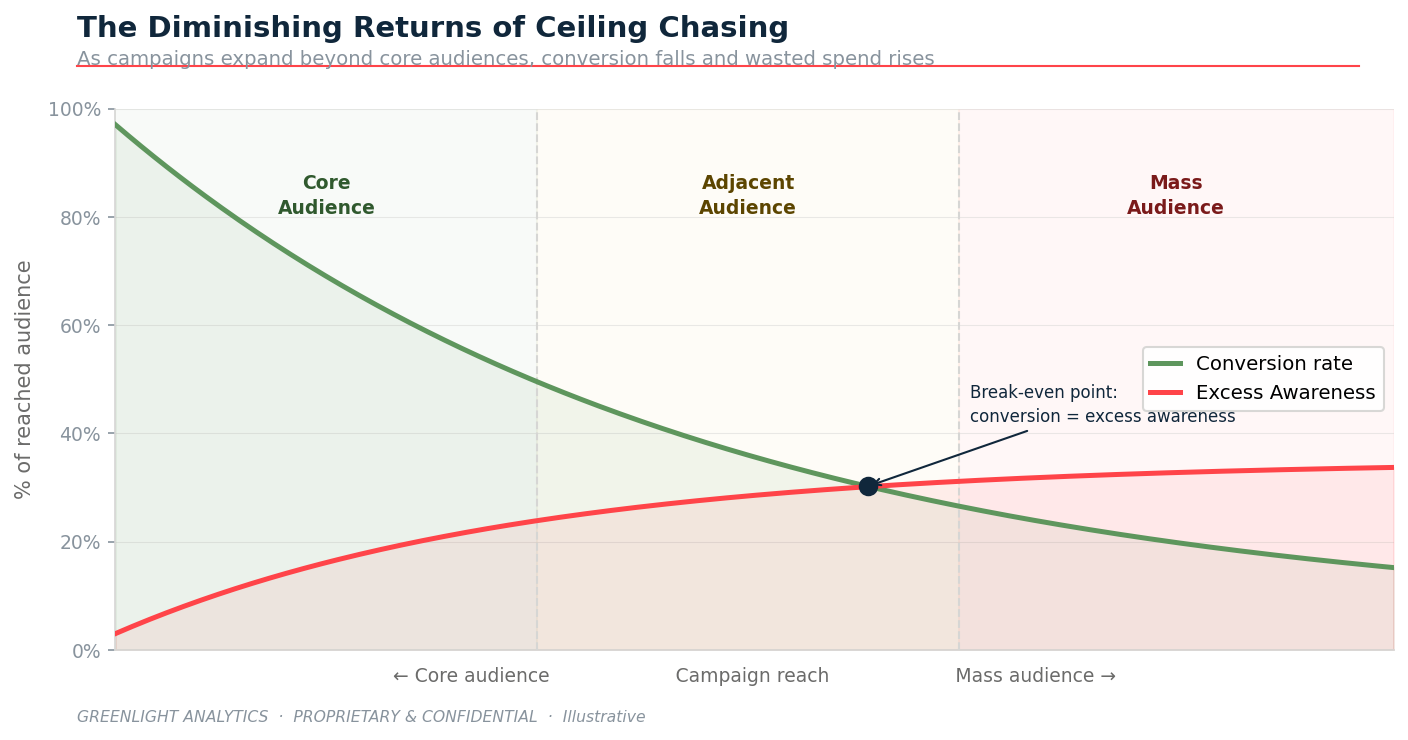
When studios chase the ceiling, they invest more into marketing aimed at lower-value audiences less likely to convert. Downstream decisions such as production budgets, talent deals, sequel optionality, and marketing budgets all flow from this. Every dollar invested above parameters set by the floor is a gamble on converting audiences who historically would not be theatrically engaged. It’s like the Boston Red Sox paying top dollar for World Series expectations despite a mediocre roster.
Budget ranges need to be dictated by realistic floors instead of upside bets. Tracking should be guided by gaps in awareness and intent, not just raw totals. If excess awareness remains high, you know you have a problem on your hands. If Theatrical Intent Among Aware remains static, your film’s floor is concerningly low and marketing alone won’t fix that.
Hollywood is a hits-driven business. The home runs pay for the strike outs. Chasing the ceiling isn’t crazy. But it should be treated as speculative, rather than tangible. If a film needs to achieve its best-case-scenario to break even, then you need to rethink the greenlight process entirely.
This isn’t about being a glass half empty pessimist. This is about managing risk in a highly volatile industry. Hollywood’s most common mistake is confusing the potential upside for probable outcomes.