

Box Office Behavior: Hollywood Can’t Keep Up With Culture
April 27, 2026
Damien Chazelle’s Babylon was a critically divisive yet ambitious portrayal of Hollywood’s runaway train evolution in the 1920s. Martin Scorsese’s Killers of the Flower Moon was a stirring historical crime drama that challenged audiences with America’s ugly past. The Holdovers was a wonderfully enjoyable crowd-pleaser about finding connection in a lonely world. All three went into development years before they hit our screens.
Audiences who found these films were often deeply interested. The tracking data backs that up. But all three titles struggled with box office returns. The reason wasn’t quality or even marketing. It was timing. When a film finally reaches audiences, it’s often addressing a version of culture that no longer exists. And Hollywood isn’t equipped to see that far ahead.
The Timeline Problem
There is no such thing as a fast deal in entertainment. You celebrate three to five birthdays working on a movie from development, packaging and greenlight through production and release. All the while, the creative and commercial decisions that spurred that initial go-ahead risk growing culturally stale before production even begins.
Babylon was greenlit in the wake of La La Land’s triumph. It was a bet that Chazelle’s ascent mapped onto audience appetite for big, bombastic Hollywood swings overflowing with dazzling indulgence (not totally unlike Scorsese’s The Wolf of Wall Street). By its 2022 release, and following the commercial struggles of Chazelle’s excellent First Man, the era that would have celebrated it had deflated. The shelflife was shorter than anticipated. Similar realities came for Killers of the Flower Moon and The Holdovers.
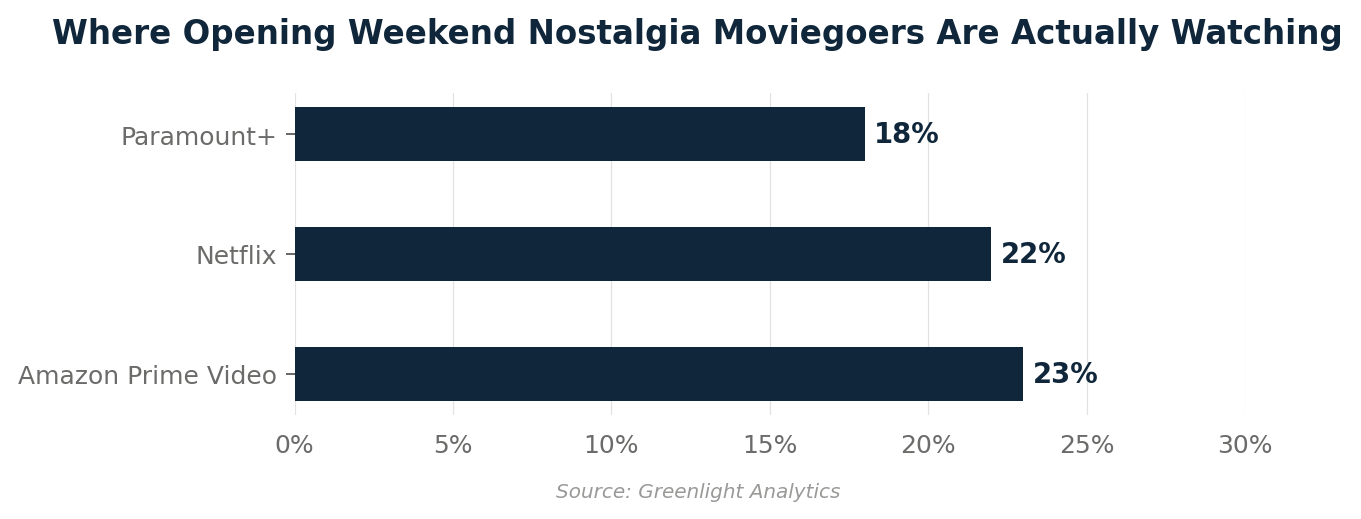
The former was designed for adult-skewing audiences with the patience for prestige storytelling. Yet the 3.5 hour epic was released to a post-pandemic audience craving escapism. Sociocultural alignment existed at greenlight; it had shifted by debut. The latter was given a thumbs up as a feel-good smaller-budget dramedy that used to makeup Hollywood’s middle class. But its audience had not so quietly moved to streaming by the time it arrived. There are an estimated 41.8 million opening weekend nostalgia-driven moviegoers. They are 287% more likely than the average U.S. adult to fall into Gen X, and they over-index on Amazon Prime Video (23%), Netflix (22%), and Paramount+ (18%), per Greenlight Analytics. In essence, Hollywood was programming for underserved audiences that had already been trained to wait for at-home arrival.
The commercial thinking behind these films wasn’t wrong. In the words of Stephen King’s The Dark Tower series, it was simply driven by “a world that had moved on.”
Culture Moves Faster Than Production
Seasonal timing, sociocultural alignment, talent and press cycle magic, underserved audiences and other elements all act as cultural catalysts that determine whether a film lands. Each operates on a timeline that can quickly diverge from the 3-5 year Hollywood development cycle. To protect against that downside, the film industry doesn’t need a fortune teller. It just needs better prescriptions for audience pulse checks further down the timeline.
For example, prestige dramas aren’t dead and gone. When the catalysts align, they make money. The feel-good A Man Called Otto ($113 million worldwide) proved to be a solid box office basehit in 2022. Tom Hanks is the culture’s most trusted star, often referred to as America’s Dad. The alignment of talent and concept, the sweetly handled thematic focus on aging and death in a post-COVID world, and programming for overlooked older theatrical moviegoers, worked. Urgency followed as the film hit theaters with 50% Theatrical Intent and 16% Heat (respondents who rated Interest as a 7/7).
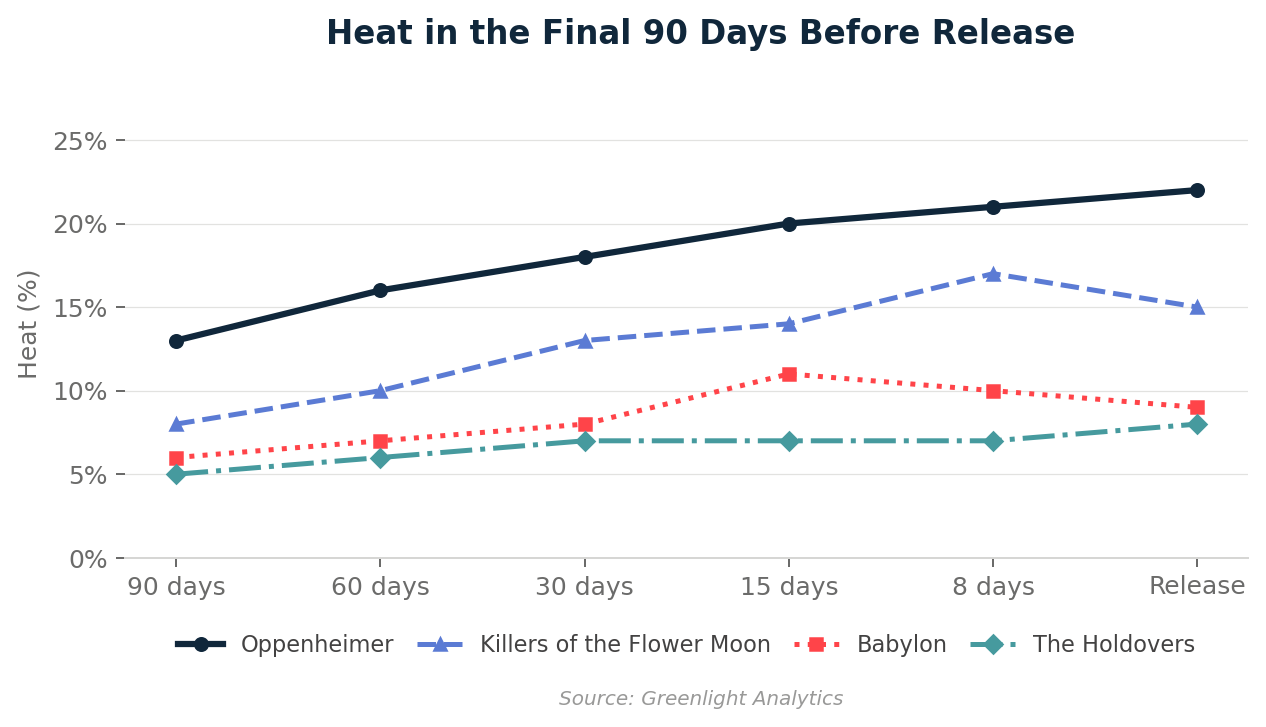
Then you’ve got Christopher Nolan’s Oppenheimer ($952 million). All four catalysts fired simultaneously, capped by the organic Barbenheimer phenomenon. This cultural event converted interest into urgency at an impressive clip, as evidenced by a near-perfect .90 Intent Conversion ratio (Theatrical Intent divided by Awareness). Two examples do not make a trend, but you get the picture.
The cultural window for each catalyst is volatile. Talent momentum is as fickle as a TV remote on low battery. Sociocultural alignment shifts with the latest trending hashtag. Seasonal programming opportunities open and close without a care in the world for production schedules. Films that hit on these often become successes. Movies that miss become casualties regardless of quality.
Greenlight Analytics has identified a total likely market of 64 million TikTok-using moviegoers aged 18-35 in the U.S. This audience is 287% more likely to be Gen Z and 113% more likely to be influenced by social media than the general population. Their cultural agenda-setting taste refreshes in weeks. This leaves Hollywood constantly on its backfoot trying to keep up.
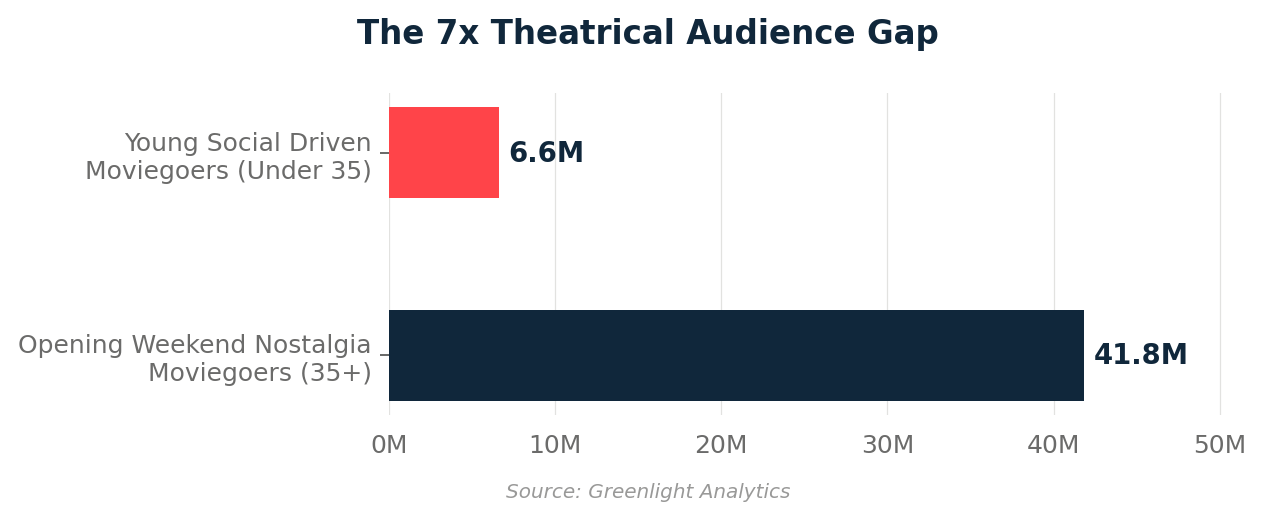
To wit, there are 6.6 million young social media-driven moviegoers under 35 vs nearly 42 million opening weekend nostalgia moviegoers 35+. The theatrical future runs through the former. But the development pipeline is mostly geared towards the latter. The 7x audience size gap isn’t an issue of demand. It’s an alignment problem.
Why Data Hasn’t Solved This
As Greenlight has previously argued, the industry has a thermometer. What it actually needs is a weather station. Older metrics such as traditional awareness were more reliable box office predictors in a world of limited choice. But in today’s multifaceted and fragmented media environment, awareness alone cannot capture cultural velocity.
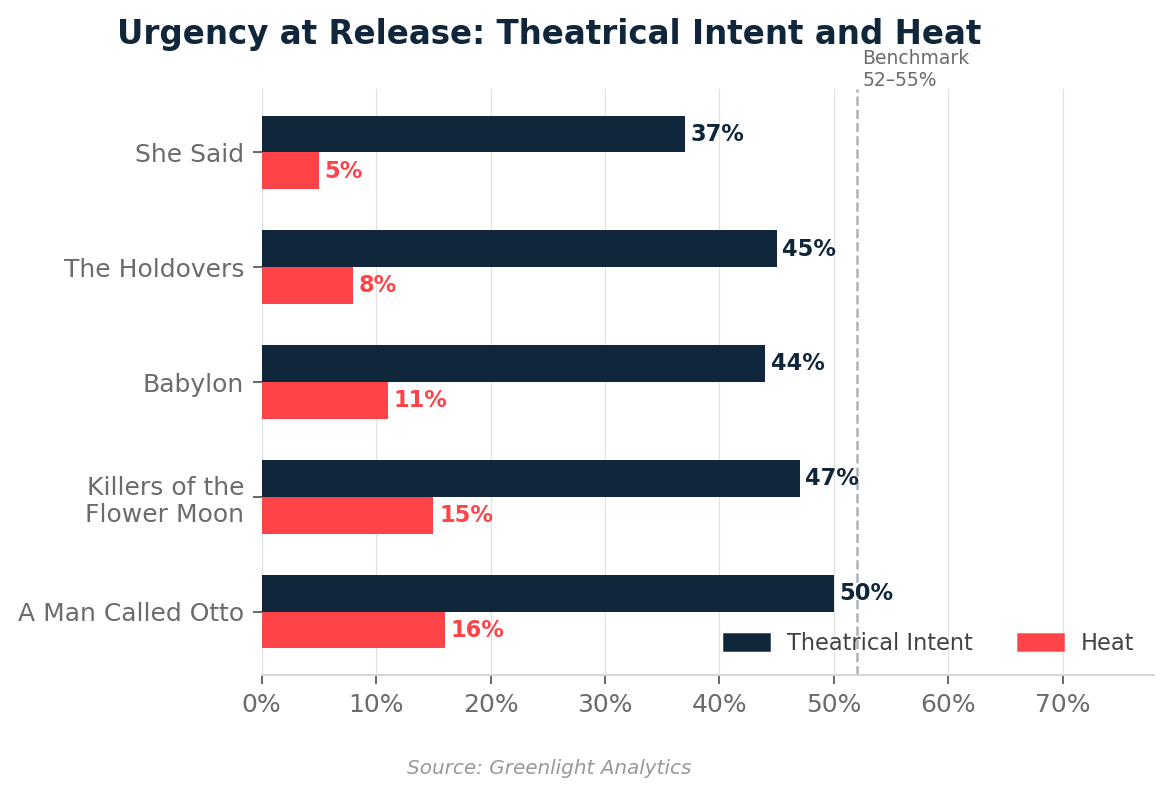
Urgency—Heat, Theatrical Intent, Opening Weekend Intent—is the metric that separates what works from what didn’t (especially when Awareness and Interest are relatively similar). Top 10 annual domestic grossers typically arrive in theaters with Theatrical Intent scores between 52%-55% and Heat scores with floors around 22%. The average Opening Weekend Intent among last year’s top 10 domestic grossers was nearly 14%.
Identifying, targeting and activating the best audiences is a big part of the equation. But the cultural output is a strong denominator as well. You can’t manufacture right time, right place with a P&A. Instead, you capture evolving consumer sentiments to better forecast the cultural condition on the horizon. This guides development and release into a more thematically linked schedule. For example, sports fans are among the most closely monitored consumer segments in America. Yet they have segmented to such a degree that a fan’s political leanings now influence where and how you reach and activate them.
Greenlight’s data identified more than 3 million politically engaged young sports fans under 30, running the spectrum from Hard Democrat to Hard Republican, and each in need of tailored messaging to convert. If that level of specificity is needed to effectively penetrate two of the most obsessed over fandoms (sports + politics), imagine what’s needed to bridge the gulf in cultural forecasting for film. Greenlight data doesn’t just hone in on title-by-title specifics. It tracks political, economic and social behaviors of the domestic audience to flag the gaps before they hurt the box office.
Let’s keep going down this data-driven audience rabbit hole.
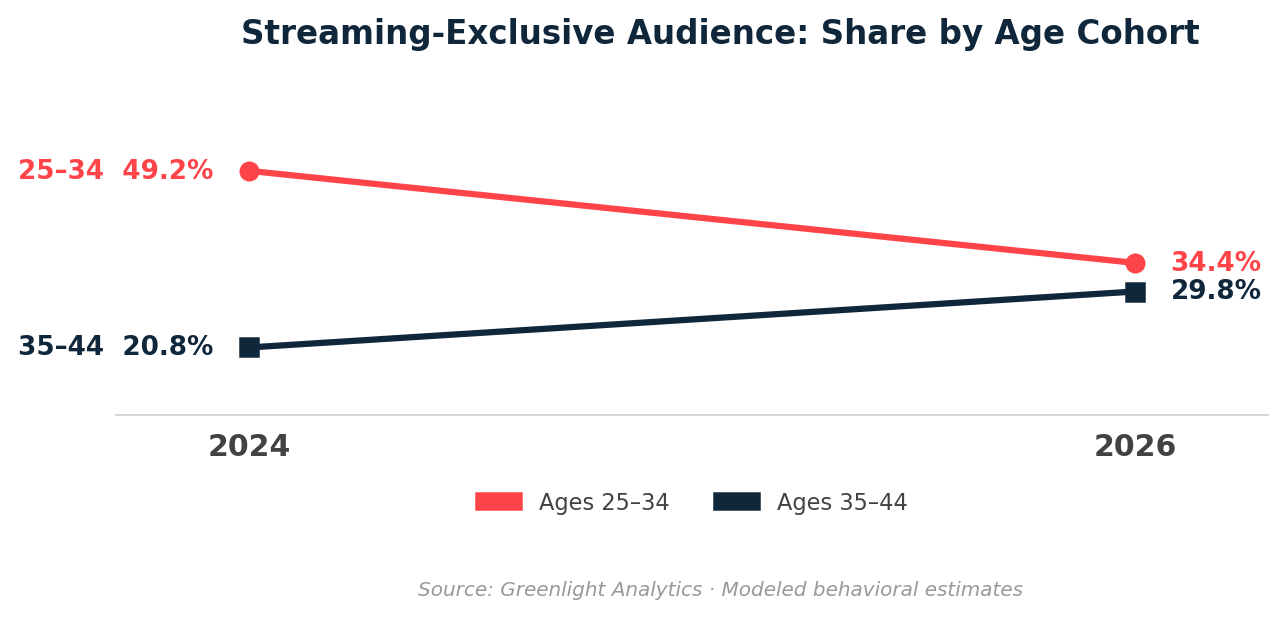
As of 2025, there were an estimated 179 million consumers that had likely reduced their number of streaming household subscriptions. Okay, got it. Yet the composition of the streaming audience foundation has shifted in ways that aren’t always immediately apparent in raw tracking. Among consumers identified as streaming-exclusive viewers—those reachable only through digital platforms—consumers between 25-34 represented nearly half the audience in 2024. By 2026, that share had dropped to just over a third, while viewers ages 35-44 rose to nearly one in three. These are modeled behavioral estimates, and some of the shift reflects changes in underlying consumer data over time. But the directional signal is consistent with broader market developments.
I don’t expect the granularity of these dynamic changes were taken into account when last year’s slate was originally approved. Distribution and audience assumptions factored into these greenlights were made in a media landscape that has materially changed.
The Result
Films arrive culturally displaced—not bad, just mistimed. She Said is an illustration of this: a hyper relevant and quality film meant to tap into the #MeToo discourse. But by its 2022 release, the movement’s wave had unfortunately already crested. Awareness was just 27% at release with Heat hovering around 6%.
Home-Intent (VOD or streaming) doesn’t mean audiences have rejected a given title. It just means their viewing preference falls into a later window. The cultural urgency meant to elicit a trip to the theater just isn’t there. Recent films with high at-home viewing preference—Rental Family (45% Home Intent), Eternity (44%), A Big Bold Beautiful Journey (42%), Good Fortune (41%), and Wolf Man (41%)—are an example. There’s viewership potential, but it’s missing the cultural catalyst that turns that at-home preference into a theatergoer.
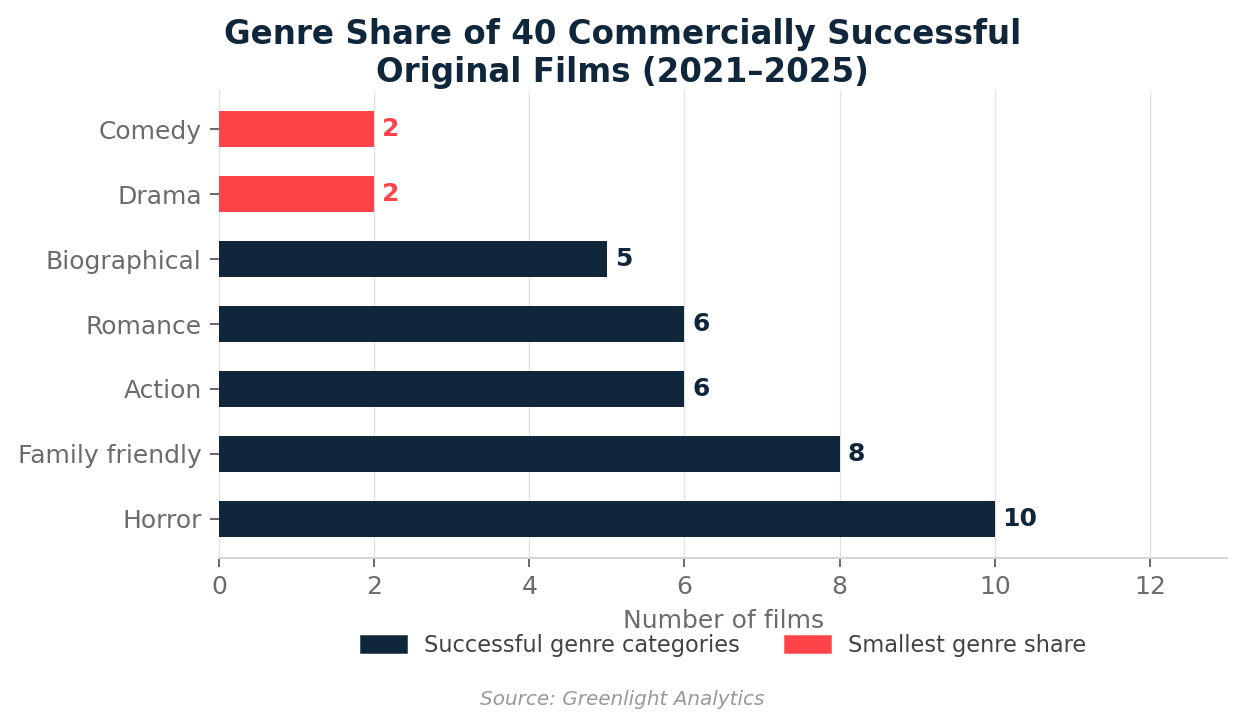
Of the 40 commercially successful original and/or new-to-screen films Greenlight studied between 2021-2025, straight dramas and comedies accounted for the smallest genre share with two apiece. Horror (10), family friendly (8), action (6), romance (6) were far ahead. Dramas and comedies can and do work. But they require cultural catalyst alignment to make up for what known IP delivers automatically. Without it, the theatrical lift becomes a Herculean task.
Final Thoughts
The industry is flush with in-the-moment data, but lacking in forward-looking prescriptive data. Tracking tells you whether audiences are aware, interested, and monetizable across different windows. Urgency and consumer sentiment reveal whether the cultural conditions will actually deliver ticket buyers. The gap between them is where prestige dramas like Killers, Babylon and Holdovers succeed or fail.
Hollywood needs a new framework for developing, greenlighting and releasing films that maximize audience reception. They need better insight into what shared themes shape audience behavior on the horizon. Audience-first narrative alignment and good timing are difficult to replicate, but not impossible. You just need the right dataset and critical lens.