
The World Cup’s Invisible Audience
July 9, 2026
FX President John Landgraf, widely considered one of the best executives in small screen history, once said 80% of television viewing is lean back and only 20% is lean-forward. What he meant was that the majority of programming is laundry-folding background noise, while only a small sliver demands our full attention. Sports falls squarely in the latter category. When coupled with the ability to break the gravitational pull of our couches, it delivers the most passionately engaged consumers in the country. And that’s a lucrative opportunity.
Though easier said than done, that’s where advertisers should funnel resources to better convert interested audiences into paying customers. It is the bridge between the call and the action.
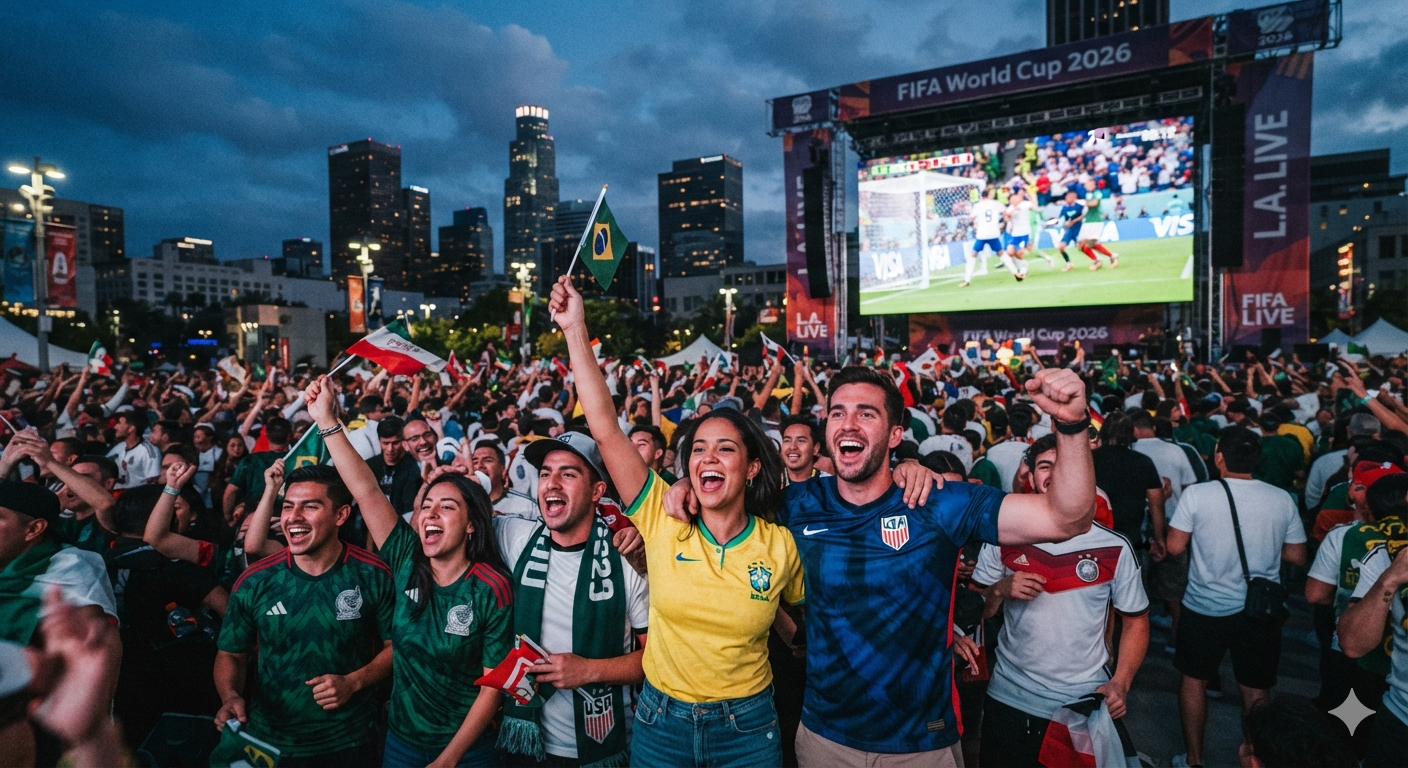
Communal viewing is on the rise as fans worldwide revel or mourn their country’s performance in the World Cup. After all, celebratory and emotional-support beers taste better with company. The World Cup out-of-home numbers make this concrete. Out-of-home viewing (bars, fan fests, public screens)—a measurement that didn’t even exist until 2020—improved Fox’s U.S. audiences by 25% for group stage matches. Yet the 100,000 fans watching at the L.A. Coliseum on opening day are not in anyone’s CRM. They are not in any ticket buyer file. But they were galvanized into paying full attention far away from their living rooms.
The audience has always been there. Now we can classify and categorize each pair of eyeballs. These are the persuadable fans. They are people who exist in the market, share characteristics with current ticket buyers, and haven’t yet been activated. The reason why is rarely demographic. It is motivational, a barrier of habit, cost, scheduling, or simple unfamiliarity that a specific message could address. Mass awareness campaigns spread across everyone rarely move the needle for those on the fence.
Sports Fans Are Entertainment Fans
Hollywood should take note. Sports fandom is the fertile soil from which additional fandom grows. According to Greenlight Analytics’ models, U.S. adult (18+) sports fans are six percent more likely than the average to be movie ticket buyers and three percent more likely to be streaming viewers. This is not a niche overlap. We are seeing this in the same consumer across different measurements. It’s directly linked.
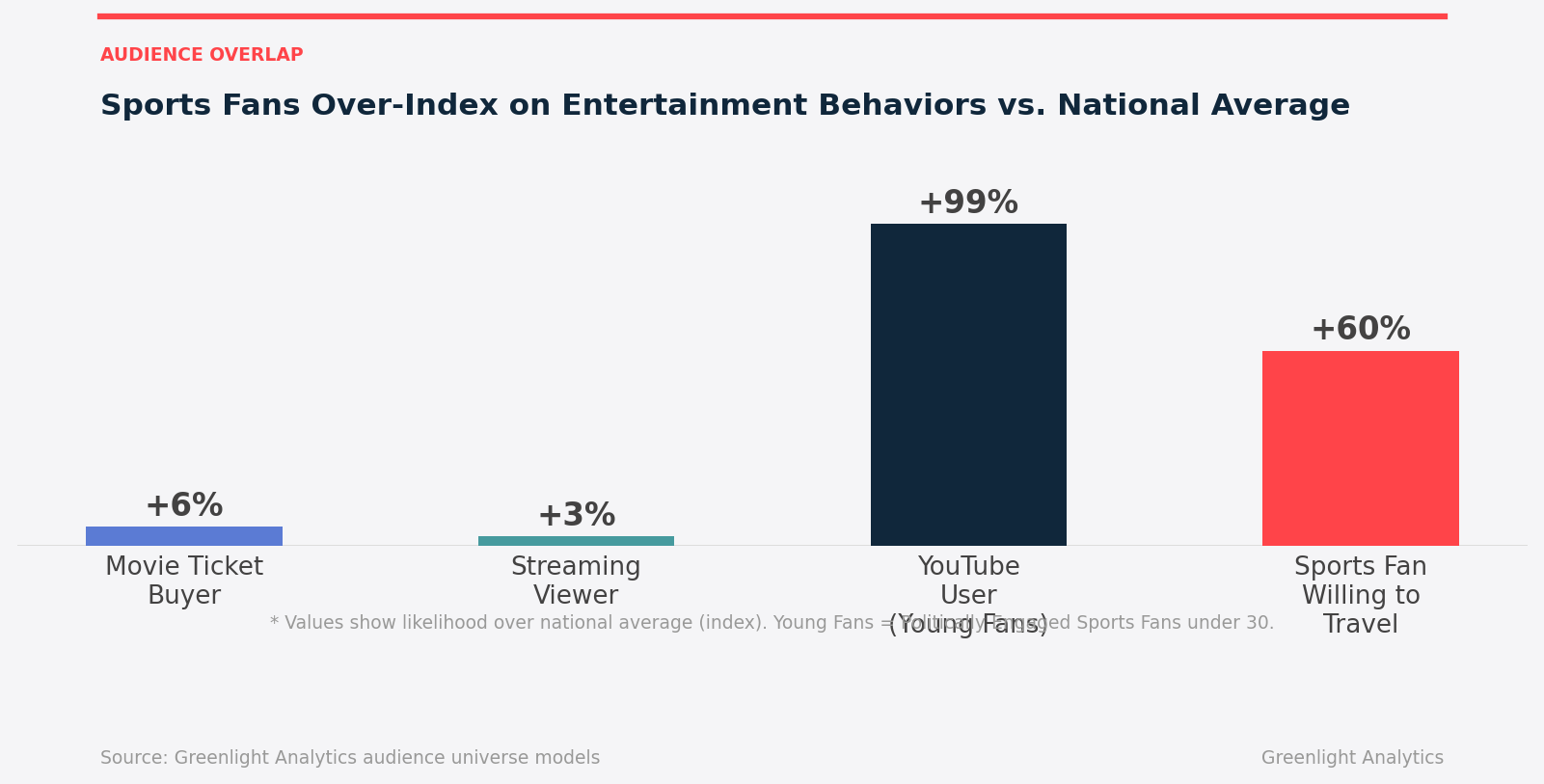
The sports fan, theatrical moviegoer, and TV junkie are not adjacent audiences. They’re largely the same person. They may have varied weekend plans depending on the pop culture schedule. But they orbit the same center of gravity.
In terms of sales and marketing opportunities, the conversion gap doesn’t rely on finding new people. Instead, tailoring the right message for viewers already traveling in these circles is more important.
Who Is The Persuadable Fan?
Persuadable audiences include those with interest who may not have been reached by marketing, or are only passively engaged with upside for more. Under our general sports fan umbrella, two distinct groups are worth exploring further.
The first is TikTok-Using Sports Fans, which Greenlight Analytics estimates number nearly 55 million in the U.S. This group is 98% more likely to be influenced by influencers and 83% more likely to be Millennials. In practicality, this means they are reachable through atypical avenues. Your standard 30-second linear TV ad-spot during major broadcasts may not do the trick. But a digital campaign partnership with select influencers might.
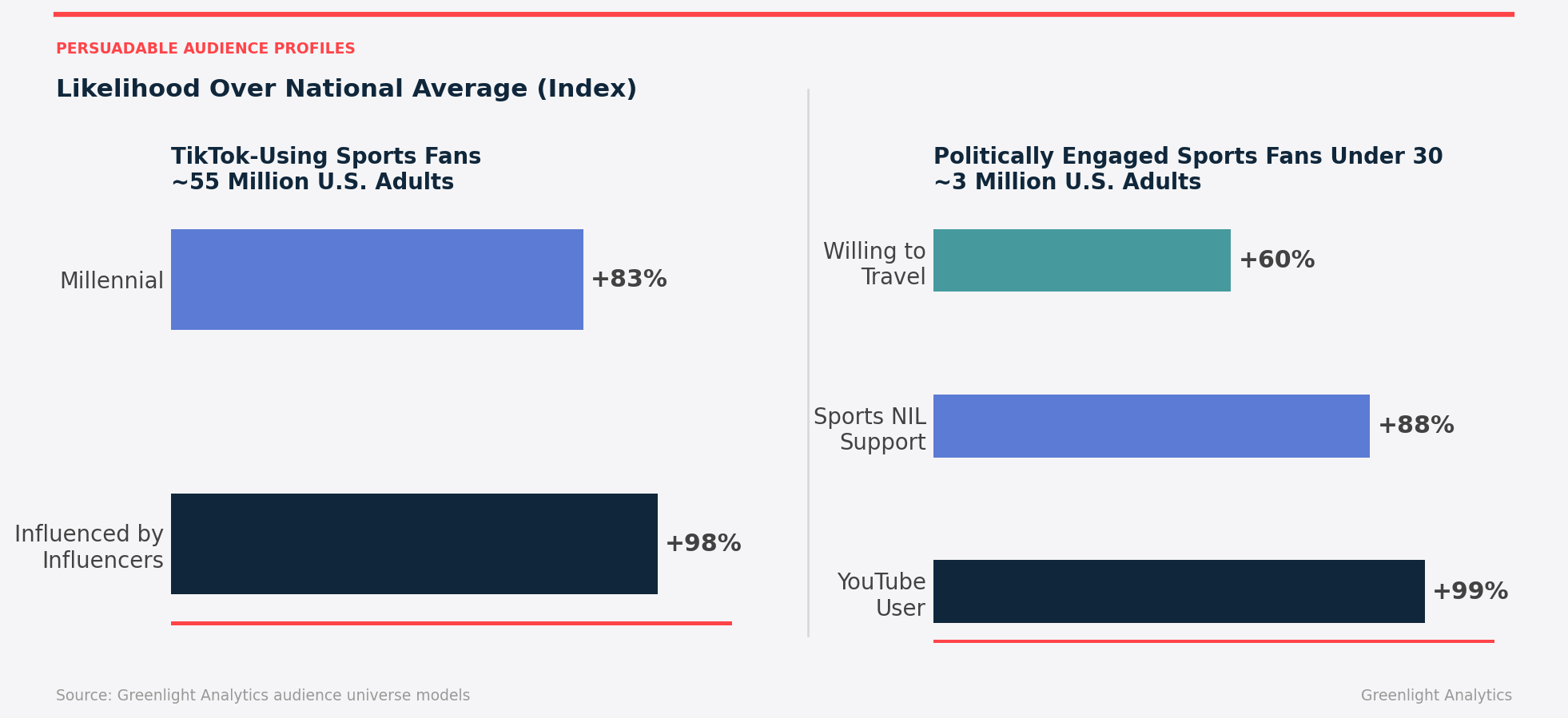
The second group is politically engaged sports fans under 30 (3 million). This group is 99% more likely than the average to be YouTube users, 88% more likely to support NIL compensation in sports, and 60% more likely to be sports fans that are willing to travel. These are not casual viewers. They are culturally engaged, active participants. In terms of Hollywood, all they need are theatrical entry points for relevant material.
The Conversion Question
The World Cup is a mass audience attraction event. The USMNT–Paraguay group stage match this summer drew 27.5 million combined viewers, the most-watched men’s group stage match in World Cup history. And 53% of the US soccer audience watched on Telemundo, not Fox. But what’s most important to bottom-line activation in a conversion funnel is what happens after the initial attention is captured.
Mass awareness campaigns reach both the interested and uninterested alike, leading to inefficient and lopsided marketing spends. Persuadable fans don’t need more exposure. They need the right message at the right time. That’s the difference between marketing and advertising. The World Cup is a strong side door entry point into the cultural zeitgeist. But converting that attention into monetizable intent demands alignment, targeting and specific calls to action. Otherwise, why waste millions of dollars advertising to large swaths of viewers who aren’t demographically relevant to whatever you’re selling?
Tracking Theatrical Intent and Willingness to Pay on either side of a major cultural event is exactly where audience intelligence justifies itself. It’s the only way to directly measure the lift (or lack thereof) provided, especially among core target demographics.
Attention is the Resource
Fox’s average 30-second World Cup ad spot is topping out at ~$2 million. U.S. networks long ago mastered the ability to price exactly how much per game viewership is worth to advertisers.
Studios and advertisers can do the same by tapping into the greater transparency we now have in audience behavior and spending patterns.
Tracking and documenting the very real audience overlap between interests on a consumer level, and how much or little awareness, interest, and purchase intent moves during a campaign, yields the same valuation. Who should you be speaking to and how much is that attention worth to the bottom line?
We know the fluid audience behaviors as well as Americans now know the pain of yet another Round of 16 elimination. Major events such as this shouldn’t be viewed solely as awareness cannonballs. It’s a targeting opportunity.
The 100,000-fan watch party at the Coliseum is a fun asterisk in the taller tale of audience behavior. But it should also be a wake up call to speak directly to the invisible audience.