

Box Office Behavior: The Surprising Science of Counterprogramming
October 20, 2026
Even without a Barbenheimer marketing crossover, many theatrical release weekends boast their own attempt at mutually beneficial counterprogramming. When there is direct opening weekend competition, the film that earns more at the box office is technically the “winner.” But the “runner-up” can still be a success in its own right. Some direct competition may have raw dollar winners obvious even to the infrequent moviegoer, but does the data always pan out in a similar way? If one movie has higher awareness and theatrical intent, is that always the guarantee of success against its competition?
Franchise Domination
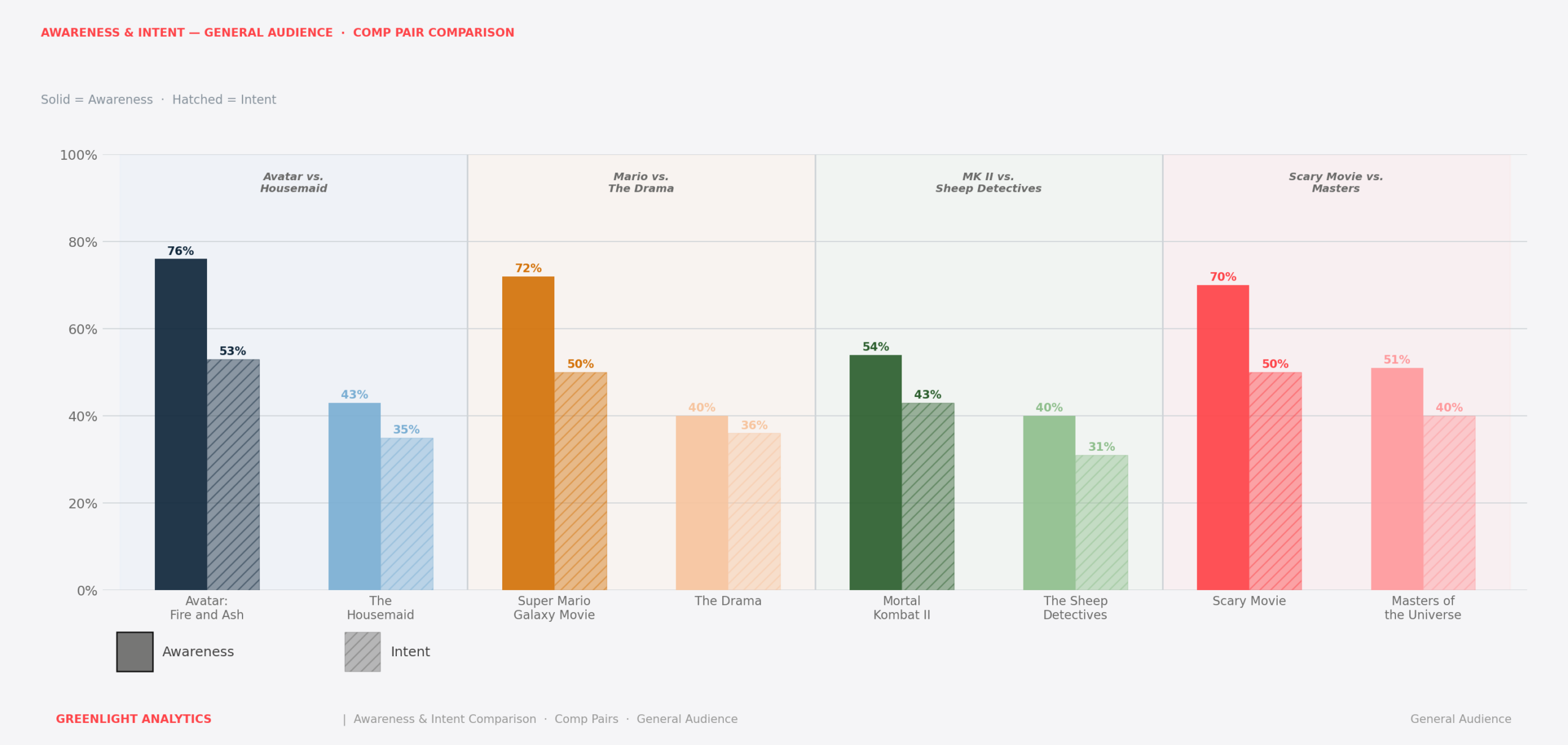
For some direct counterprogramming pairs, the answer becomes a resounding yes. Billion-dollar franchises like Avatar or Super Mario significantly beat out their female-driven drama/thriller counterparts in both awareness and intent among the general population for the winter and spring holidays.
With nearly identical awareness and intent, Avatar: Fire and Ash and The Super Mario Galaxy Movie’s final domestic hauls of more than $400 million apiece show that a billion-dollar general audience film can have standard patterns to prepare for when adequately counterprogramming. Modest performer The Drama and megahit The Housemaid also shared identical awareness and intent among the general public. They even opened within $5 million of one another. In doing so, they show the potential power of the interested audience, especially within a target genre audience. With enough of an engaged general public, films can ride momentum into opening weekend, and even beyond, against a billion-dollar behemoth.
But franchise metrics are not always so cut and dry, even if they are outperforming their counterprogramming opponents. For instance, Mortal Kombat II, riding the wave of its initial trailer release, held significant advantages over The Sheep Detectives heading into Mother’s Day weekend. MKII ($38.5 million) more than doubled The Sheep Detectives’ debut ($15 million), but only ended up grossing about $14 million more by the end of both domestic runs. In fact, Sheep Detectives grazed into opening weekend with lower overall general public intent than The Drama ($14.3 million). Yet, with its family audience adequately engaged from positive word-of-mouth, it matched its debut and out-earned it domestically overall by roughly $18 million.
Then we have two franchises competing in mid-June with each other for slices of the same nostalgia-driven male audience: Scary Movie and Masters of the Universe. Both show unique dynamics related to higher pre-release tracking delivering larger openings and tracking metrics not always equating to exact box office. While legacy tracking services saw a potential even match between the two heading into the weekend, awareness and intent among the general public told a different story.
Scary Movie, with a 10% lead in theatrical intent and nearly 20% lead in awareness, nearly doubled ($54.3 million) the launch of Masters of the Universe ($29.4 million). However, with some of Scary Movie’s key pre-release tracking signals falling in the vicinity of Avatar and Mario, the large awareness and intent here merely translated into overcoming its competition rather than a billion-dollar hit. Likewise, despite being in range of Mortal Kombat II, Master of the Universe came in almost $10 million less, showing a similar dynamic seen back between The Housemaid and The Drama. Like the female-driven drama/thriller audience, the dynamic of the male-driven legacy IP audience shows a pattern for potential power in counterprogramming. (And everything in a genre’s audience exists on a sliding scale to a certain degree).
Head-to-Head Competition
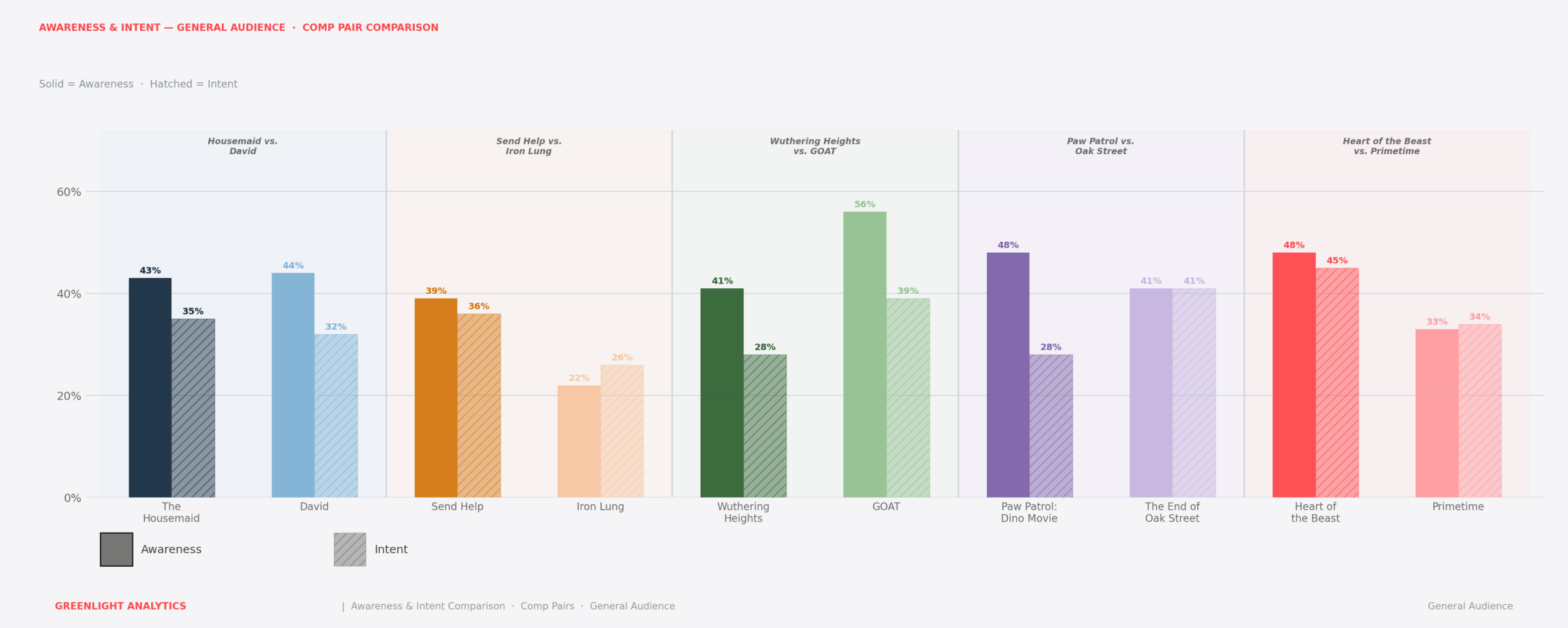
For other, smaller films trying to beat each other out for number one, the distinction between awareness and intent gaps are not so simple. Films end up performing better or worse despite head-to-head metrics occasionally saying otherwise. For instance, back in the pre-Christmas release weekend, David, like The Housemaid, carved out its own niche against Avatar as counterprogramming for the faith-based and family genre audience. David nearly duplicated the overall awareness and theatrical intent of The Housemaid, but actually ended up with a slightly higher opening weekend ($22 million).
Film matchups even with clear “winners” in their metrics can have surprising results come opening weekend. In the beginning of 2026, Send Help and Iron Lung were heading towards a photo finish for their opening weekends despite a 10% or more difference in both awareness and intent between the two. GOAT ($27.2 million) proved to be formidable competition to Wuthering Heights ($32.8 million) with higher awareness and intent. Yet we still saw slightly smaller openings across the holiday weekend.
Even in late summer, the counterprogramming dino duo of The End of Oak Street and Paw Patrol: The Dino Movie were neck and neck despite a 13% difference in intent, each pulling in their sci-fi and family audiences to varying degrees from each other but right in-line with their genres. Heart of the Beast and Primetime likewise had double digit differences in both metrics yet still opened only around $1 million apart, equally appealing to either older or younger audiences.
For some of these matchups, the intent gap can actually appear from the eventual domestic runs. GOAT’s double-digit lead over Wuthering Heights became visible in its nearly $20 million lead in its overall domestic gross despite a smaller debut. Send Help and Heart of the Beast’s slight leads over their direct competition despite even larger gaps in awareness and intent become significant leads after zooming out to examine each film’s domestic hauls.
How to Find the True Winner
The better comparison to find the true potential winners during competitive weekends comes from individual films compared to their comparable audience film rather than against its competition. Rather than focusing on which film is outperforming the other, analysis must focus on its performance within the audience and then match those performances against each other for a possible winner.
For instance, although Iron Lung ($17.8 million) was distantly behind Send Help ($19.1 million) in pre-release tracking, its metrics were right in line with Chainsaw Man ($18 million) and both ultimately performed similarly. With Iron Lung rallying infrequent 18-24 year old male moviegoers akin to an anime film audience and Send Help overperforming the standard original studio horror film audience through men 25 and over, each film coexisted successfully despite both being under the “horror” genre umbrella.
Likewise, GOAT’s competitive performance came more from intent performing significantly higher than other studio animated films like Elio, The Bad Guys 2, or David rather than how it looked compared to Wuthering Heights. Scary Movie’s performance becomes less of a surprise when you focus less on its Mario level awareness and more on its target comps of The Naked Gun and Scream 7.
When trying to counterprogram, what is generally perceived as the “bigger” film likely also becomes the “winning” film. However, the metrics themselves do not always translate into an exact box office performance formula. When comparing possible overall performance or enthusiasm between two competing films, overall rates of awareness and intent provide insight into which film might have a surprising advantage or disadvantage heading into the weekend. However, true performance comes from comparing a film not with its counterprogramming or its competition, but with its comparable audience. If a film overperforms its genre audience’s normal awareness and intent, then it can even match or exceed a film that may appear to be resonating better with the general audience. So the success in counterprogramming comes from films not necessarily grabbing the most audience but by getting the most out of their audiences.