

Weekend Preview: How ‘Project Hail Mary’ Demonstrates the Power of Tracking Growth
March 19, 2026
After Scream 7 became the first film of the year to open above $50 million all eyes are on which movie will do it next. The question is if a new-to-screen concept can plant its flag as the next blockbuster-level debut before a familiar franchise does it first.
Previous weekend previews have explored the need to understand audience patterns to better project performance. For the nearly $200 million budgeted Project Hail Mary, however, its tentpole status dramatically ramps up the stakes of its audience profile. Does it even resemble a blockbuster? If so, which one? Is Amazon MGM dealing with a lower-tier underperformer or a surprise crowd-pleasing success?
In this case, growth analysis takes on a greater importance than raw audience observation. Project Hail Mary’s tracking six weeks from release compared to opening week paints two distinct audiences with wildly different potential performance paths.
Initial tracking had Awareness worryingly below 30%, yet Interest stood at a promising 44%. Discovery was a problem, but potential for audience growth—especially among men—was there. This first wave drew immediate parallels to smaller performers and sci-fi fare such as star Ryan Gosling’s previous film The Fall Guy and November flop The Running Man. Other early comps included higher-profile male-driven action films like The Accountant 2 thanks to similar levels of moderate awareness and larger interest potential. A lofty goal for Project Hail Mary was F1. The Brad Pitt-led racing movie, despite also skewing heavily male in Interest, mobilized this group very effectively. Interest and Willingness to Pay converted at a near 1:1 clip, laying the groundwork for a strong $50 million-plus summer opening.
As weeks progressed, the F1 aspiration grew less lofty and more realistic. Project Hail Mary saw strategic Awareness gains in lock step with Interest and Theatrical Intent. Potential was being converted into monetizable behavior as a larger swath of audiences were reached by marketing and buying what Amazon MGM was selling. This was especially true for the core male target demo:
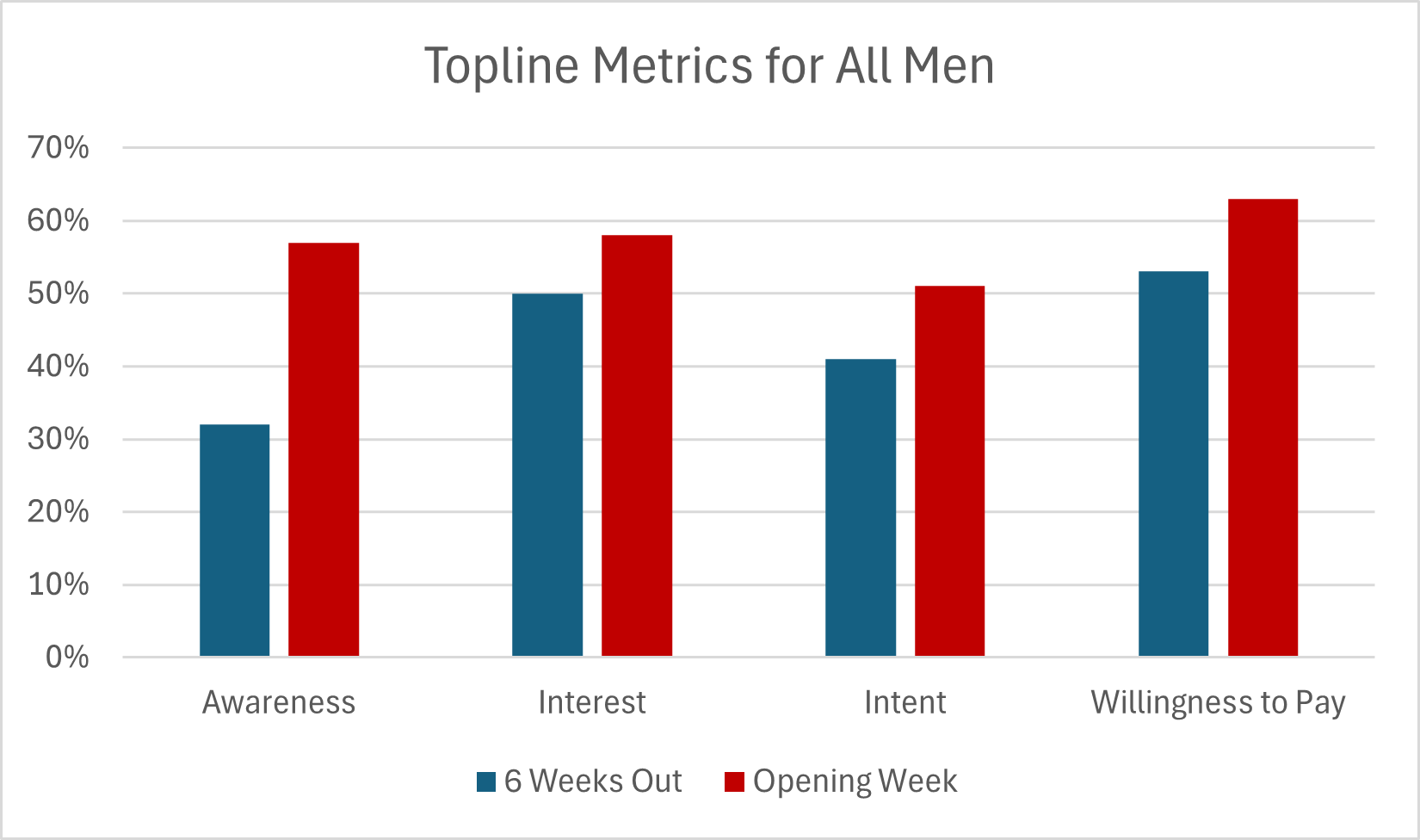
The growth demanded rising optimism for Project Hail Mary’s box office prospects. Now firmly resembling a larger performer than initially perceived, the sci-fi story’s success felt more secured. But that growth was not the end of the story.
Growth rearranges the analysis, setting new expectations on where the audience actually is and where the audience can possibly go by time of release. After reframing Project Hail Mary as not just a potential tentpole but with enough Interest and Intent to become a definite performer, the audience comparisons expand even further.
After examining the updated audience, three new distinct comparisons appear, as seen in the below graphic.
Although the F1 comparisons remain apparent, other paths for overperformance towards Mission Impossible: The Final Reckoning and Thunderbolts* become clear. Project Hail Mary, while successfully achieving similar Awareness metrics as F1, made significant gains in Interest and Intent across its target male demographic and with the general public overall.
Expanding beyond F1, Project Hail Mary shows more in common to the audience ratios found in Mission Impossible and in overall Awareness and Intent to Thunderbolts*. The most optimistic analyses even see it closing in towards larger superhero entries such as Superman or The Fantastic Four: First Steps. Where the opening weekend and overall domestic totals land between these three new comps will be up to the actual audience to decide. But these comparisons, although clear now, were far from evident a mere month ago. This growth speaks to the effectiveness quality marketing campaign and strong word-of-mouth can have on the trajectory of a given title.
True, significant growth in Awareness, Interest, and Intent becomes the marker of an overperformer rather than a film simply meeting its goals. If Project Hail Mary simply gained in Awareness, then the metrics would more closely resemble a more niche but highly aware audience, keeping expectations in-line with regular sci-fi fare with a lofty F1-type goal. Here, although expected Awareness gains did occur, Project Hail Mary expanded its range of interested audience beyond even the initial optimistic high-end benchmarks. This new audience necessitated an expanded analysis on an entirely new tier.
Without appropriately acknowledging and contextualizing growth throughout a pre-release campaign, marketing dollars are either over or under-invested and box office performances fail to line up anywhere in the vicinity of expectations, both good or bad. This disconnect leaves studios and analysts on the backfoot, unable to create positive change while there’s still time to improve the bottom line or learn from wins and losses for the future. By understanding growth on an audience level, analysis can follow the real-time tangible signals instead of the expectations, leading to an audience-driven marketing and development approach that can be duplicated for future audiences and projects.
Project Hail Mary itself follows a Hail Mary plan to save the planet (as well as Amazon MGM’s film slate). But the audience behind Project Hail Mary follows a plan for audience growth that does not have to be a “Hail Mary,” but instead a plan to reach its full potential.