Early Movers: Can Netflix’s ‘Narnia’ Reactivate a Dormant Franchise?
March 2, 2026
Early Movers is a monthly Greenlight Analytics series designed to surface which upcoming films are breaking through early and how they’re doing it. Each installment examines both full-funnel standouts and month-over-month momentum, offering a clearer view of early theatrical demand while there’s still time to act.
In a world governed by entropy, Hollywood is desperate for certainty. Greta Gerwig’s meteoric rise as a filmmaker speaks to that exact dynamic. The talented storyteller has delivered the most valuable commodity of all: reliability. Her three films—Lady Bird (8x), Little Women (5x), and Barbie (10x)—have all earned several multiples more than their budgets at the world box office. Yet November’s Narnia: The Magician’s Nephew is an entirely new test.
Netflix will release the film exclusively on 1,000 IMAX screens across 90 countries for at least two weeks before it hits the streamer. This is easily the company’s strongest foray into theatrical distribution. It comes via a dormant IP with generational familiarity. At a time when the industry finds itself at a precarious transitional moment, and the fantasy genre is in flux amid a marketplace overflowing with otherworldly stories, two key questions emerge for the future.
Can legacy fantasy still deliver commercially viable results at scale given its high costs and is Netflix leaving value on the table by not leveraging theatrical more? One film hardly makes a trend. But sink or swim, Narnia’s performance will be used to try and make sense of the existential chaos at play in the film business.
Early Signals
Narnia hasn’t even released its first trailer yet and will not arrive in theaters for another eight months. Much will change between now and then. But for too long has the film industry relied upon compressed marketing campaigns that leave little room for actionable change. And since Netflix has never rolled out a traditional theatrical marketing playbook, earlier insights become all the more valuable.
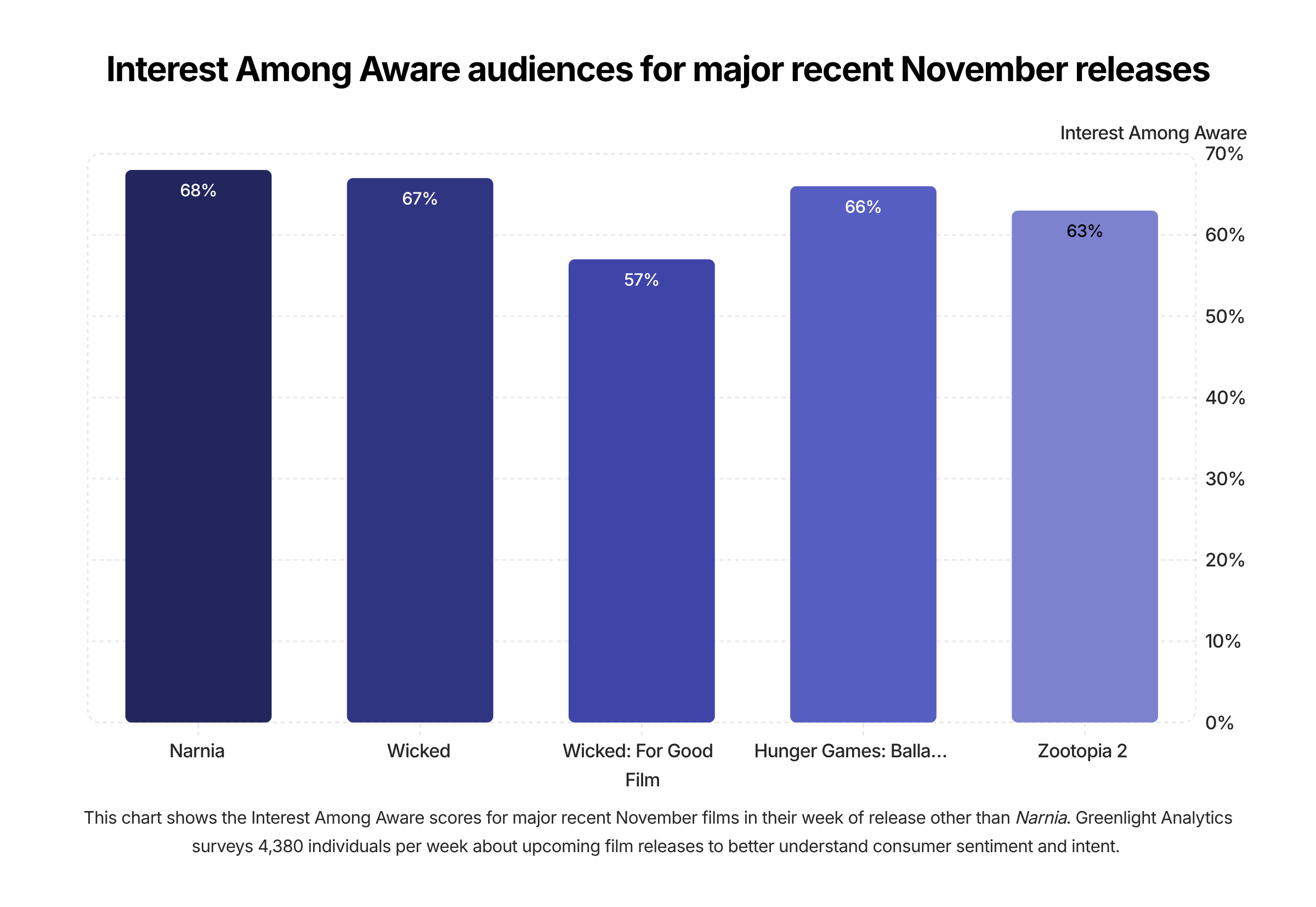
Narnia’s Awareness currently stands at 31%. That’s actually quite decent this far in advance, but not quite explosive. The true bellwether of performance is how efficiently any film converts awareness. Interest Among Aware audiences is 68%, which is incredibly strong sight-unseen. This tells us that Narnia is already converting its IP familiarity into audience intrigue. Building interest is the first domino for monetization. Huzzah! (Or whatever they say in Narnia. I’ve never read it).
The Funnel Snapshot
Let’s zoom out and examine the general scores across all four core tracking metrics. We want to know where it stands at this early juncture, after all.
Awareness: 31%
Interest: 44%
Theatrical Intent: 34%
Willingness to Pay a Fee: 46%
What can we surmise from these numbers? Not only is Narnia’s IAA looking solid, but it’s converting Awareness into Theatrical Intent at a near one-to-one ratio. That’s hyper efficient. It may change as trailers begin dropping and the marketing campaign plays out in earnest. But the film is starting with a familiar audience that wants to see it on the big screen. A WTP score of 46% this early also suggests a healthy monetization ceiling given the ample room to grow. The goal is to raise awareness with Interest ,Theatrical Intent and WTP climbing in lock step.
As of right now, this does not look like an IP play for IP’s sake or soft nostalgia. We are seeing functional engagement with what looks like the die-hard core audience. But who is that audience?
Four Quadrant Appeal
for now, Narnia is showing an encouraging distribution among demographics. Female and Male Interest (46%, 41%) and Theatrical Intent (35%, 33%) is pretty even. The wider gaps come among the Under/Over 35 audience, where Interest (49%, 39%) and Theatrical Intent (38%, 30%) skew much younger.
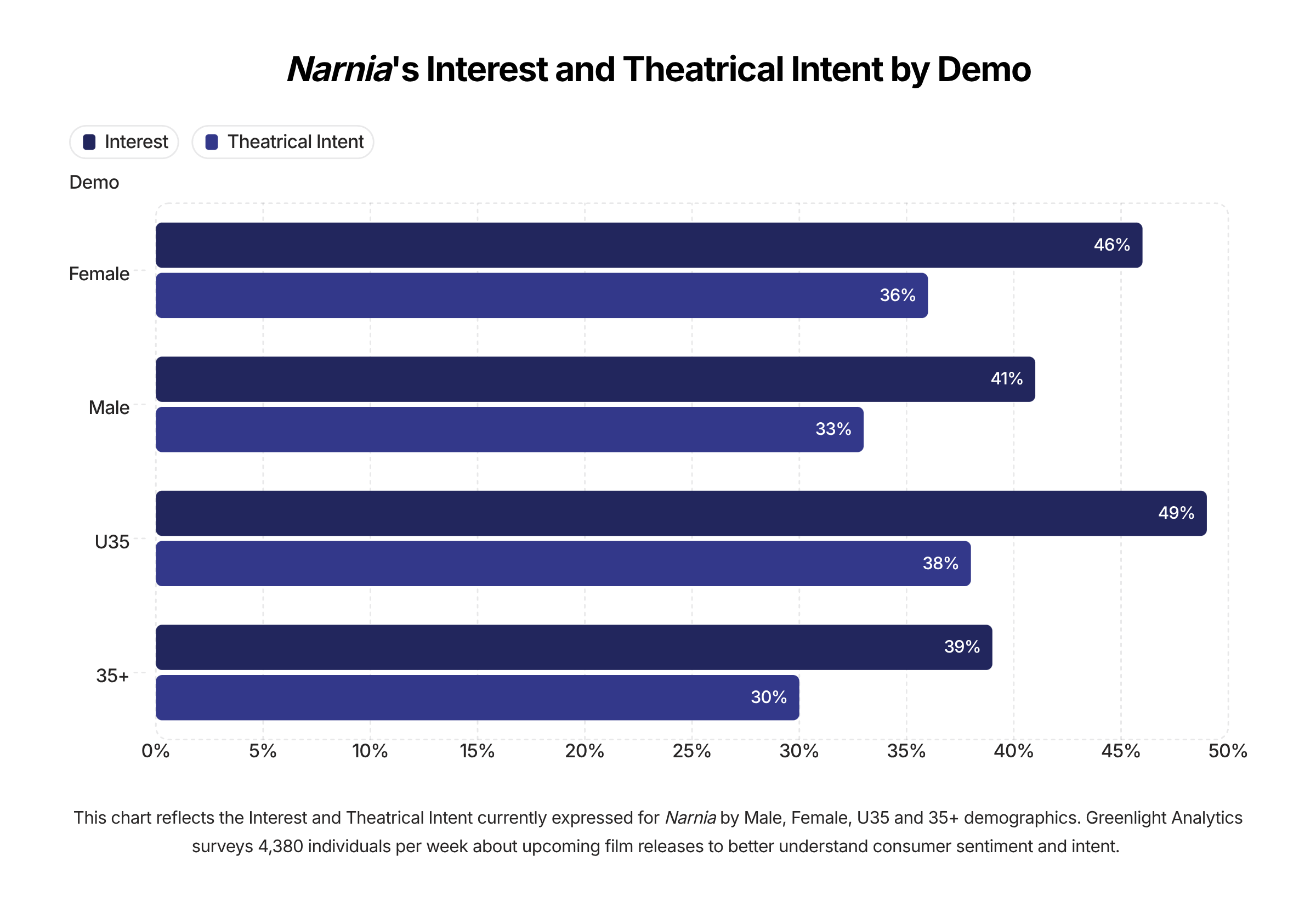
You’d like to see an older IP such as this cultivate more buy-in from older audiences as time goes by. But fantasy today often skews younger male, so the fact that Narnia is leading with women thus far is important. Netflix now knows who the foundational audience is and who are the add-ons that need to be enticed.
Monetization Signals
Though women lead in Interest and Theatrical Intent, MU35 (55%) lead WU35 (49%) in WTP. The general 35+ audience (40%) is not disengaged either. But there is once again a clear gap from younger moviegoers U35 (52%).
This tells us that the younger demo will likely drive opening weekend and early box office results. The older demo will activate for more catch-up viewing, whether that’s subsequent theatrical weekends or in the transactional and streaming windows. This tracks with at-home viewing behavior trends: Baby Boomers (65-74) boast the highest binge (41%) and retention rates (46.2%) of any age demo, according to Samba TV. This is followed by older millennials. Older demos extend legs.
Understanding these behaviors enables better planning for promotional spend across timing and targets.
Urgency Indicator
Let’s piggyback off that “right now” vs. “later” dynamic. Currently, there is a 12-point gap between Theatrical Intent (34%) and Willingness to Pay (46%). Generally speaking, top performing films hover around a 10-point delta. While there are exceptions, larger gaps between the two metrics tend to forecast a preference for at-home viewing. Or, at the very least, a lack of theatrical urgency. (For example, $100M-plus domestic grossers such as The Batman, Beetlejuice Beetlejuice, Guardians of the Galaxy Vol. 3, Deadpool & Wolverine, Ghostbusters: Frozen Empire, and Transformers: Rise of the Beasts all had gaps of 11 points at most in their week of release).
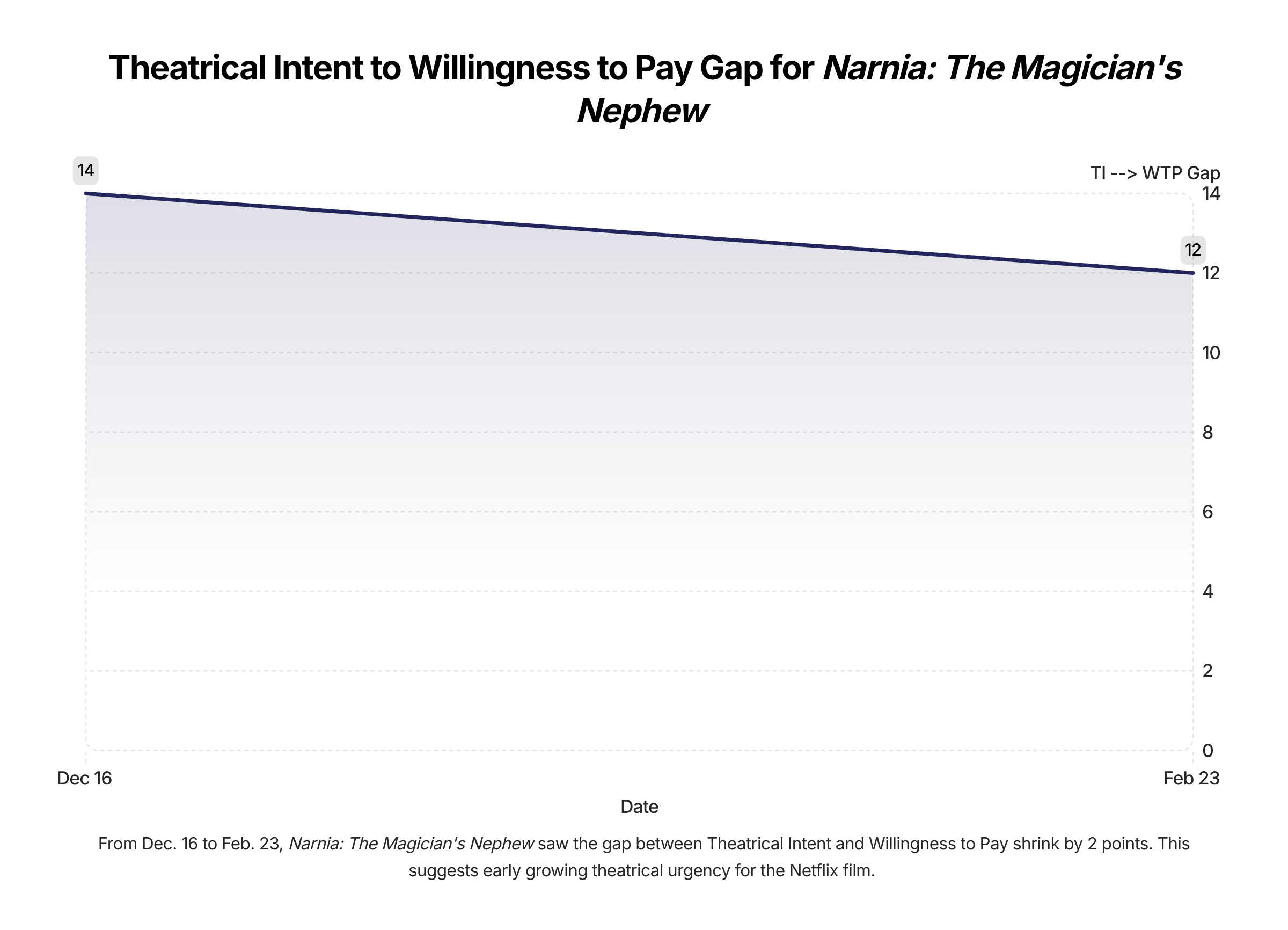
Looking ahead, if that gap begins to narrow (as does the Interest vs Intent difference), we can tell that theatrical momentum is building. If the gap widens, Narnia may become more of a passive curiosity fit for streaming than a theatrical necessity. This can be a helpful predictive layer closer to game time.
Narnia will provide valuable insight into how effectively Hollywood can recycle a once-popular theatrical property that has been out of the cultural consciousness for 15 years. It will also show if Netflix is capable and willing to deliver a theatrical hit and all the downstream multi-window value that creates. By tracking audience, enthusiasm and conversion metrics early, studios can build the most effective and efficient plan of attack.
Monthly Momentum
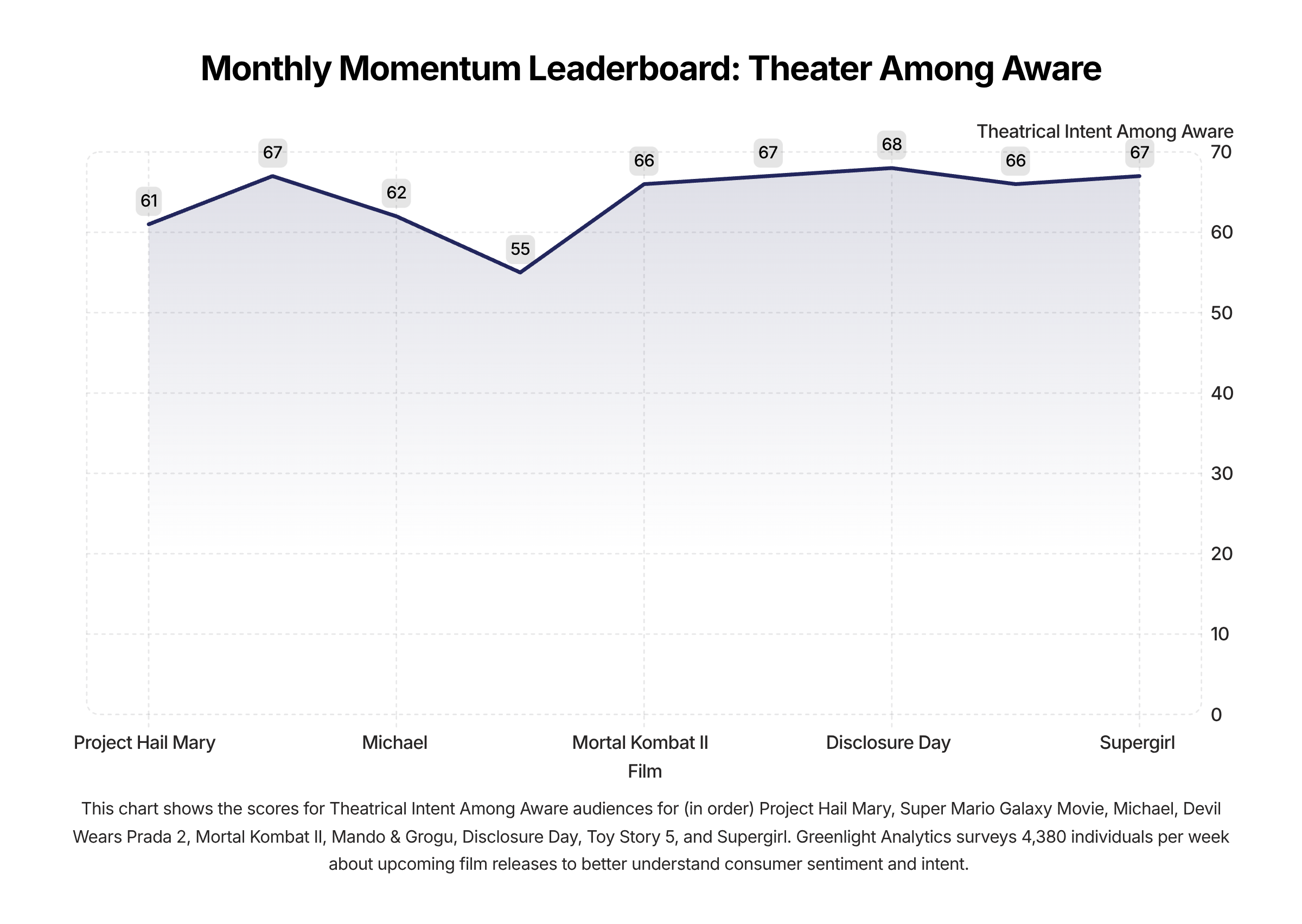
As of now, Theatrical Intent Among Aware audiences is relatively consistent for the major tentpole releases hitting theaters from March-June.