

Early Movers: Can ‘Cliff Booth’ Become Netflix’s First True Theatrical Event?
June 2, 2026
Netflix, long allergic to robust theatrical film campaigns, recently hit Hollywood with an exciting one-two punch. Greta Gerwig’s Narnia: The Magician’s Nephew will become the company’s first-ever global wide release in February, while Brad Pitt’s The Adventures of Cliff Booth——the Quentin Tarantino-penned and David Fincher-directed sequel to 2019’s Once Upon a Time in Hollywood—will receive a two-week exclusive IMAX release in November.
Forget pins and needles. This rare but high-stakes theatrical push into both prestige and franchise fare has Hollywood hopped up on hopes and dreams. Yet before we roll out the dancing lobsters, we must take a sober look at Cliff Booth’s early tracking.
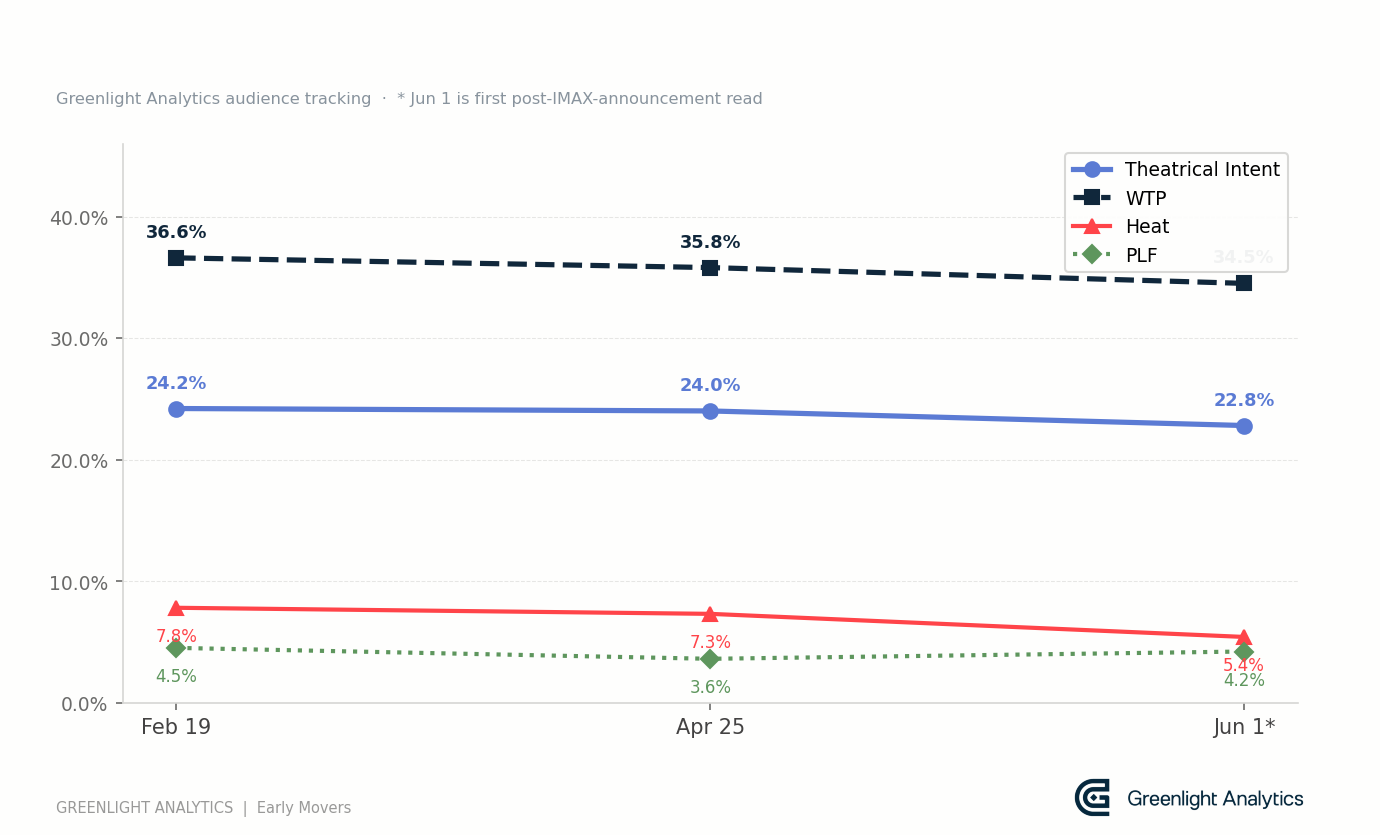
Over three waves from February 19 to June 1, the film’s core metrics are all in a gradual decline. Awareness, Interest, Heat, Theatrical Intent, etc. This isn’t a total surprise. Netflix has only released one trailer (during Super Bowl Sunday no less, a strategy that is always more sugar than meat) and only announced the change on May 20. But it’s still a bit of a flame-douser.
Here’s the catch: up until recently, The Adventures of Cliff Booth was a highly-hyped streaming release. The IMAX switcheroo fundamentally alters expectations in bar-raising fashion. Until a more significant pre-release marketing campaign is put in place, we should view these early declines through the lens of a pre-pivot baseline. Progress is coming.
Solving the Comp Problem
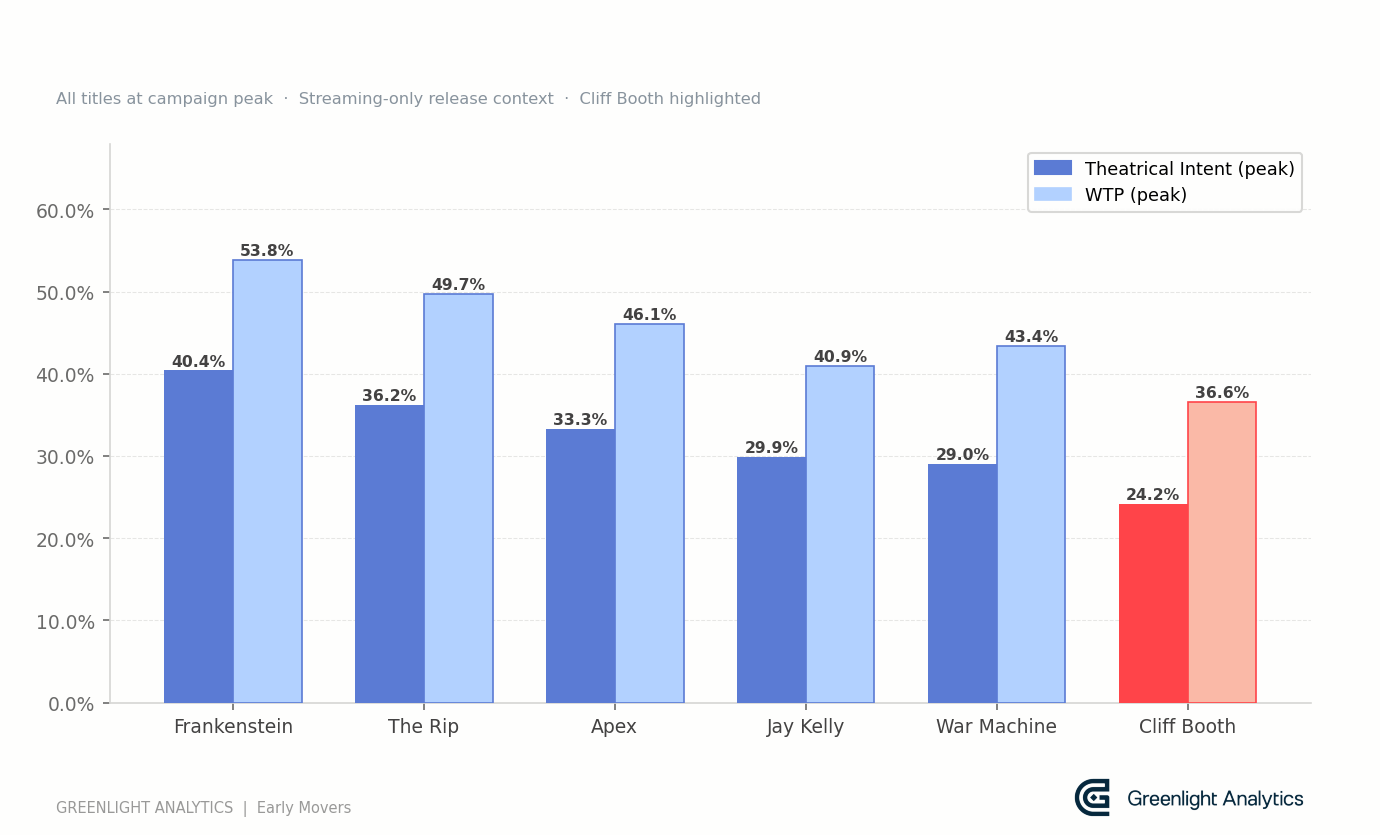
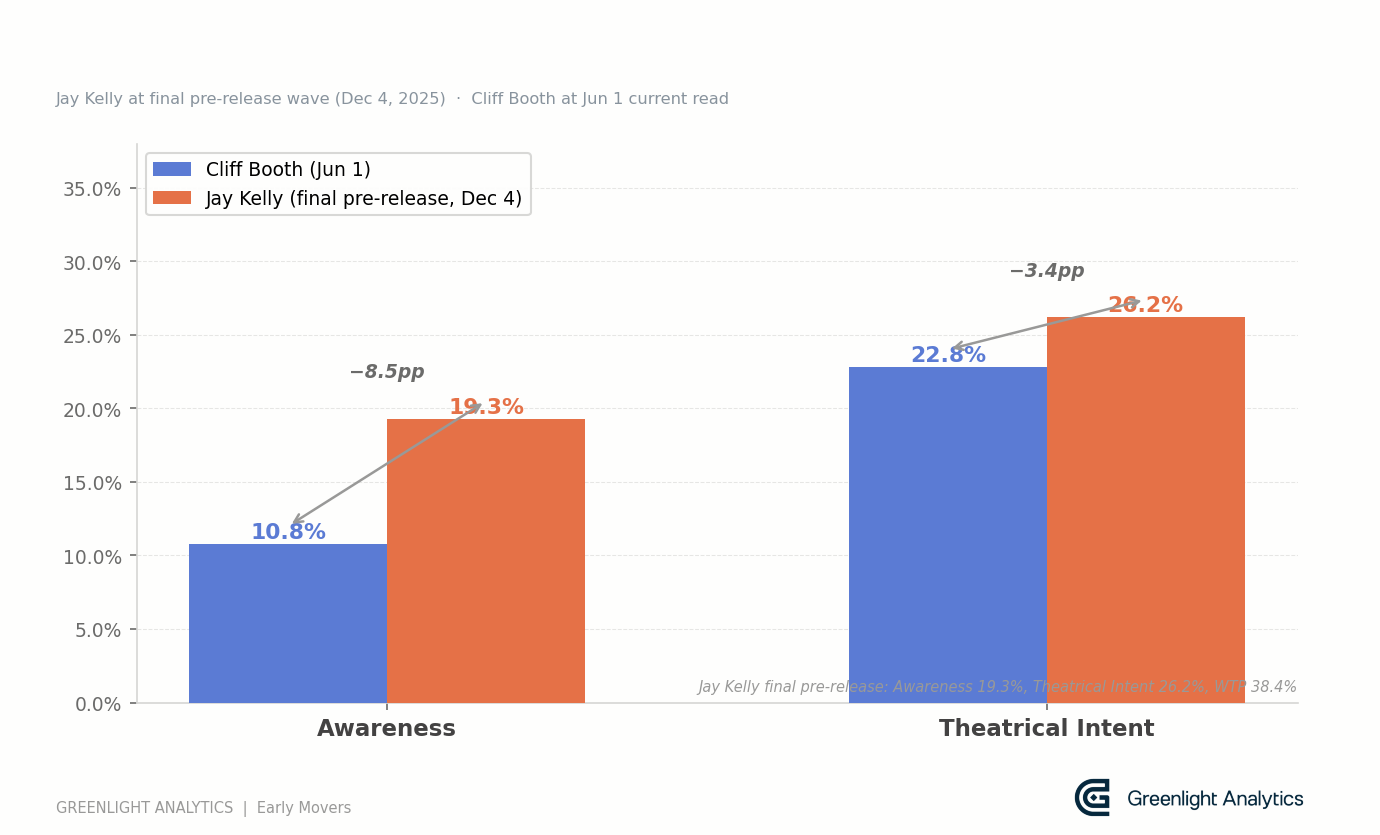
Before the release change, Cliff Booth was best compared to other recent Netflix releases such as Jay Kelly, Frankenstein and The Rip. Among this Netflix-only set, Cliff Booth’s peak Theatrical Intent unsurprisingly lags behind given its lack of promotion and faraway release. How it progressed relative to its streaming-exclusive predecessors would’ve been revealing.
The better comps now are theatrical releases that boast a similar adult-skewing prestige backbone, along with some element of premium large format (PLF) demand to account for the IMAX exclusivity. Martin Scorsese’s Killers of the Flower Moon and Christopher Nolan’s Oppenheimer come to mind.
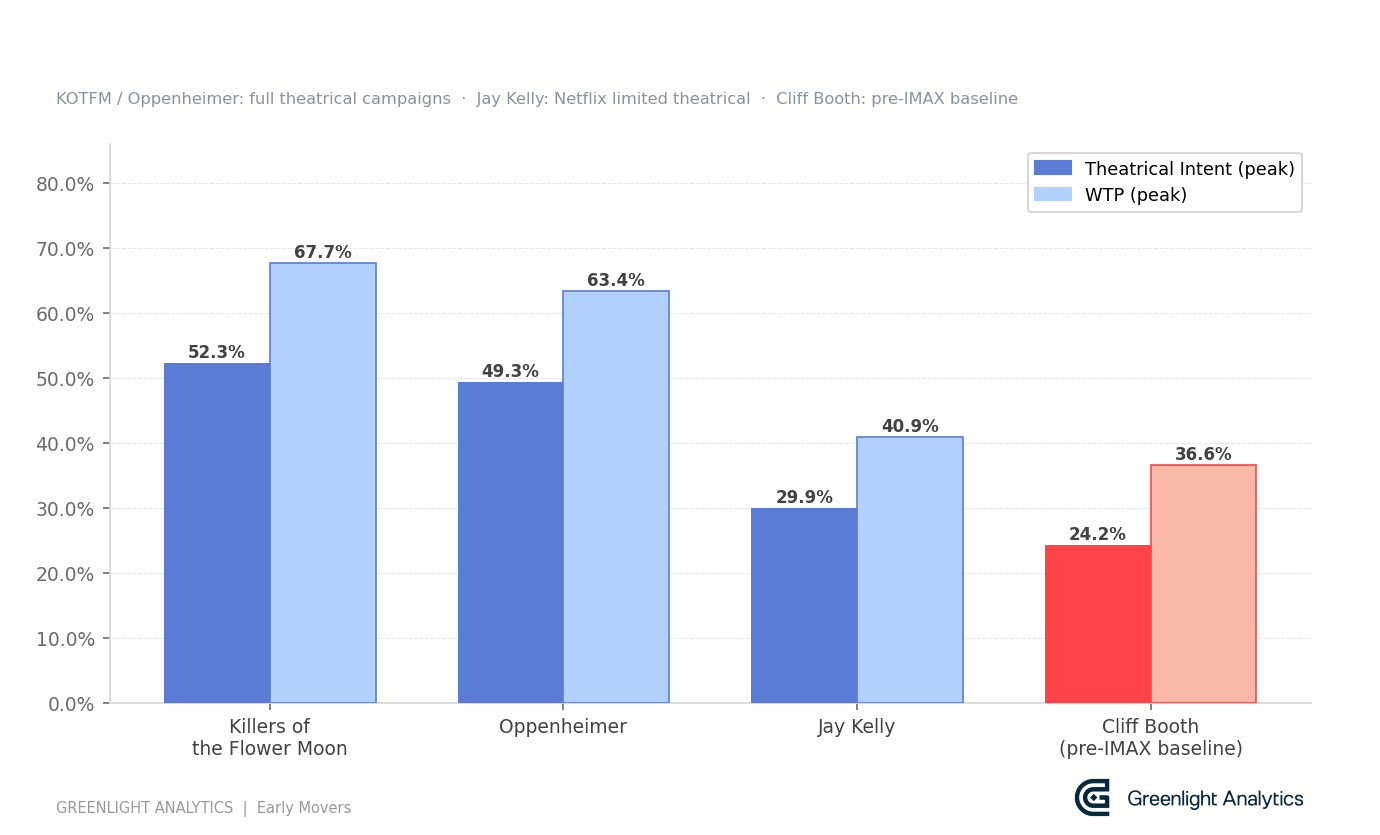
Killers hit a peak Theatrical Intent of 52% before finishing at 47% in its fine pre-release wave. Oppenheimer’s delta was much smaller—a peak of 49% and a final score of 47%. Both films also enjoyed peak Willingness to Pay scores (theatrical ticket, VOD transaction, or streaming subscription) in the 60s.
The point is twofold: 1) Cliff Booth’s ability to develop into a prestige tentpole performer will rely partly on Netflix and IMAX’s ability to market it as an “event” and 2) whether the Brad Pitt-David Fincher-Quentin Tarantino fanbase is large enough for standard conversion to produce a domestic result closer to Once Upon a Time in Hollywood than Killers of the Flower Moon.
The Bull Case
Patience is a virtue, in both life and film tracking. And the data backs that up.
The Floor: At 35% in the most recent wave, WTP is holding relatively steady even as other metrics slip. More importantly, WTP Among Aware audiences remains in the 70s. The viewers that know about the film are open to paying for it in one form or another. With premium IMAX pricing, even a smaller but higher-converting audience pool can drive solid per-screen averages. Ideally, Awareness scales in the coming months without losing that WTP efficiency.
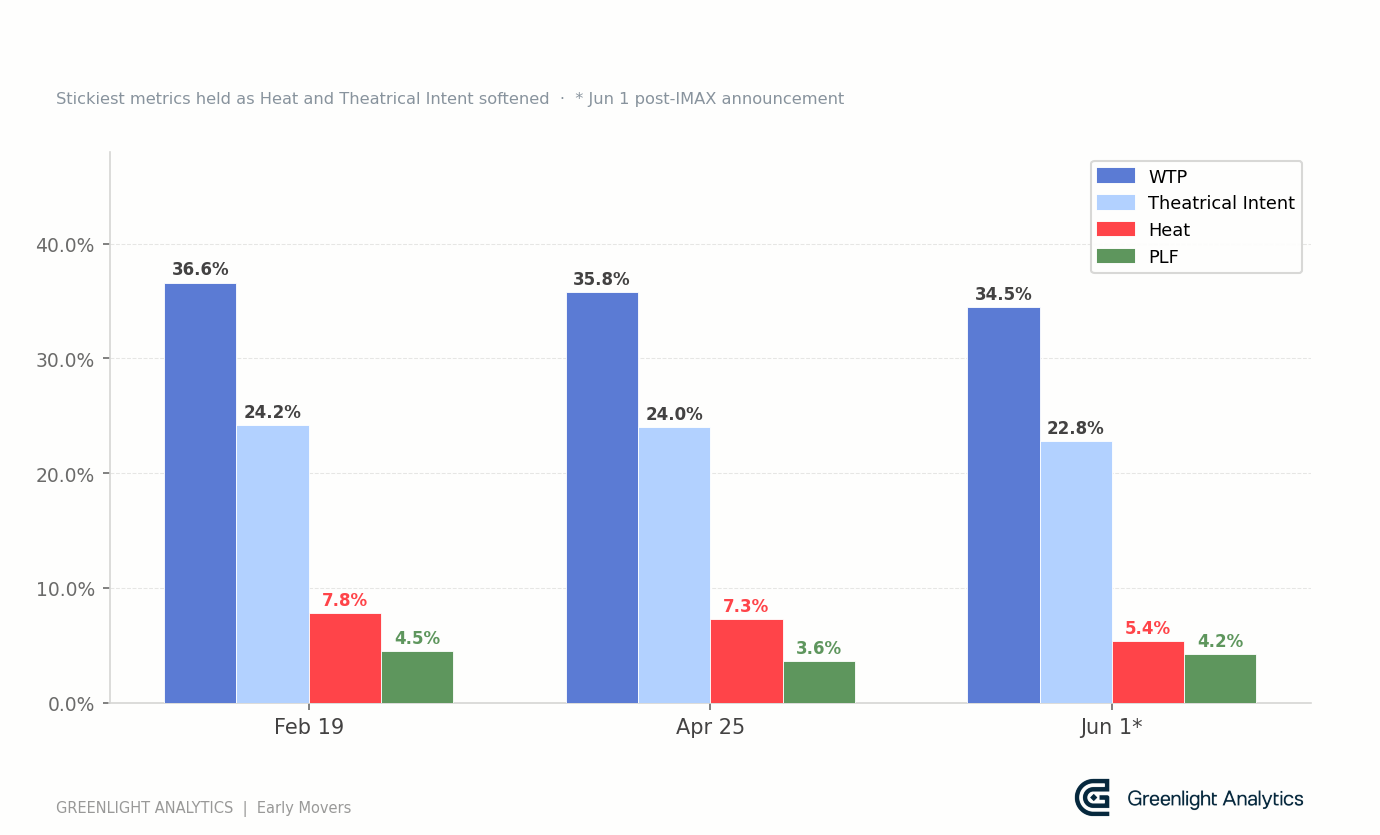
PLF Signal: PLF intent has hovered around 4% across the past three-waves. It didn’t meaningfully pick up after Netflix’s announcement, but that likely has more to do with the lack of overall awareness. If PLF begins to consistently creep up, momentum is building. Expect IMAX to push this one hard, while Netflix did have success with the limited release of the second Knives Out picture.
The Bear Case
Awareness at 11% is obviously painfully low. Netflix has a lot of heavy lifting to do during a crowded summer movie season to prep the audiences for fall. Right now Intent Conversion (Theatrical ÷ Awareness) is tracking in the 0.85–0.88 range across waves. That’s solid but not exceptional for a would-be theatrical event.
The two-week release window is both a feature and a constraint. On one hand, it creates urgency and exclusivity. On the other hand, it’s difficult to marshal audiences en masse for such a small sliver of time, especially with Cliff Booth arriving on Netflix December 23. It doesn’t help that Leonardo DiCaprio and Margot Robbie won’t be joining.
Final Thoughts
As of this moment, the data tells a single story: a prestige-leaning streaming release tracking well below where you’d expect an auteur-driven star-led theatrical holiday release. And that’s okay.
Netflix and IMAX clearly believe Cliff Booth is worth a premium release bet. With greater distance from the initial announcement, and on the back of a growing promotional footprint, future tracking will paint a picture of this film’s true reality. If Awareness, Theatrical Intent, PLF Intent and WTP tick up in relative lockstep, Cliff Booth becomes an early proof point for Netflix’s growing theatrical ambitions. If Awareness improves while Interest and Intent stay flat, then Netflix may have a harder road ahead as it prepares for the much larger Narnia bet. Either way, the next five months should tell us whether this is a true theatrical pivot or merely a premium detour.