
Early Movers: Clarifying The ‘Avengers: Doomsday,’ ‘Dune 3’ & ‘Jumanji 3’ Battle
April 3, 2026
There’s a strong case to be made that the most valuable real estate on the theatrical calendar is the December holiday window. Kids are off from school, adults are off from work. Families are desperate for distractions lest they be forced to hear Grandpa rant about how sports were better back in his day. There’s ample room for a diverse slate of high profile titles to sell enough tickets to earn studios executives healthy bonuses. Last year, it was Avatar: Fire and Ash, The Housemaid, and Marty Supreme. But this year, the Christmas corridor is unusually crowded with a salvo of tentpoles. While the industry looks for scale to determine outcomes, audience segmentation, longevity and release timing will play just as big of a role.
Avengers: Doomsday and Dune: Part Three will open head-to-head on December 18 in what fans have affectionately dubbed Dunesday (AKA Barbenheimer 2.0). It will be followed by the untitled Jumanji 3 a week later. Based on recent installments, these are three franchises with floors of $700 million worldwide at worst and upwards of $2 billion at best. Despite the generous track record, it’s fair to wonder if the calendar can support that much blockbuster firepower.
Way-Too-Early Picture
Avengers: Doomsday dominates early tracking as a true event film. Nine months out, it’s already operating at the upper-echelon of its core fanbase in Awareness (71%) and Interest (71%) among Men Under 35. Its Heat score, or those that rated their Interest as a 7/7, is nearly doubling both Dune: Part Three and Jumanji 3, underscoring upside. Its Opening Weekend Intent score of 16% this far out signals a very high floor outcome.
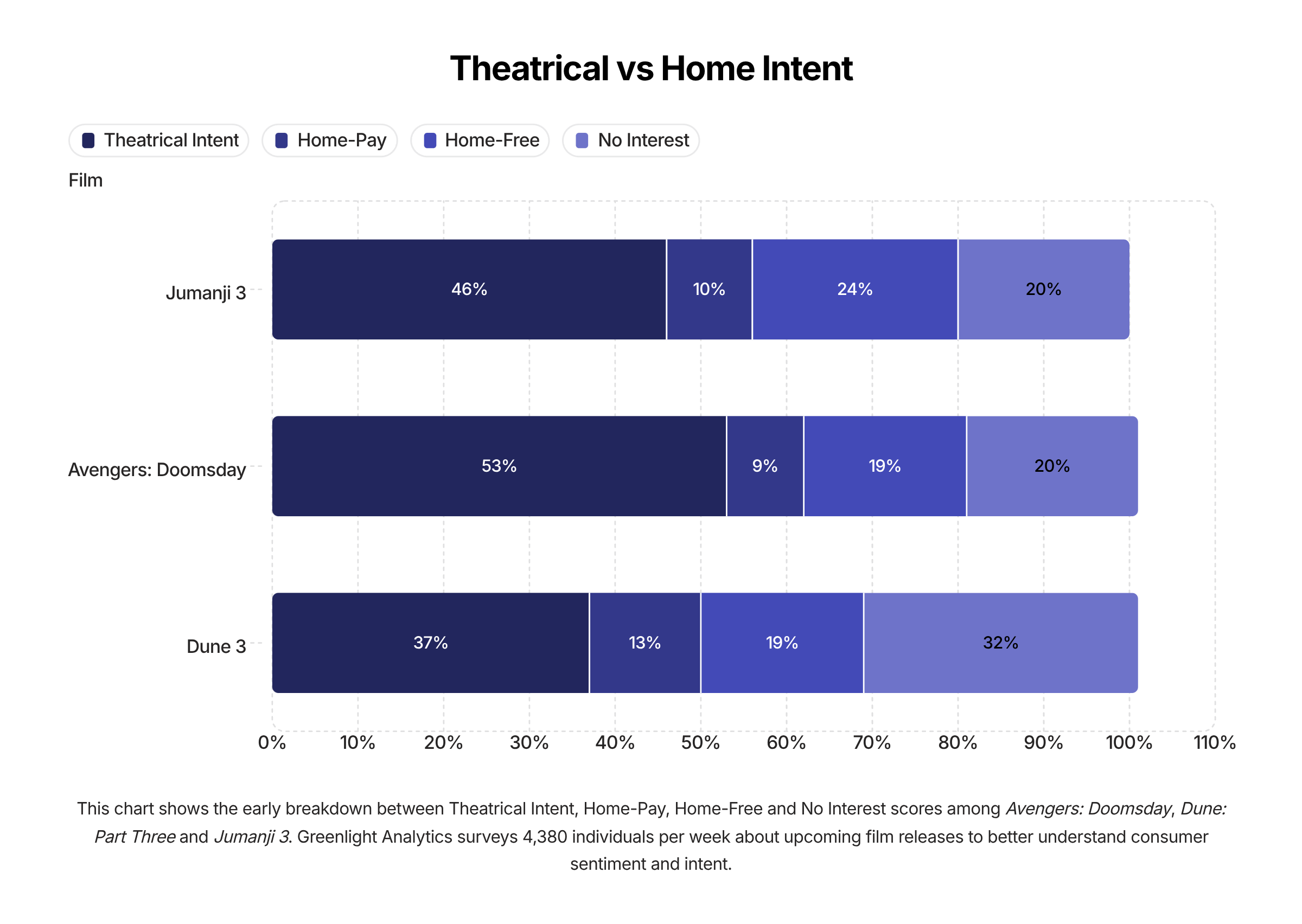
Doomsday is converting early Awareness and Interest into future dollar signs. Say what you want about the Marvel Cinematic Universe’s Multiverse Saga or retreating to the perceived safety of familiarity with the return of Robert Downey Jr. and the Russo Brothers as directors. It’s working (so far).
Wild-Card Competitor
The Dune franchise falls favorably into cerebral sci-fi territory with more esoteric elements. The severity and nuance of author Frank Herbert’s source material naturally positions it as less four-quadrant family-friendly as both Avengers and Jumanji. As such, it’s currently skewing older with Men 35+ emerging as its most engaged demographic. That narrow-yet-passionate elevated-genre angle might prove to be useful long-term. Infrequent moviegoers (25% Interest, 12% Theatrical Intent) are effectively disengaged at this stage, though could be drawn out in comparison to the more mainstream alternatives (as they were for Dune: Part Two).
This plays directly into the crucial context that Denis Villeneuve’s trilogy-capper has three-weeks of exclusive IMAX screens (kudos, Warner Bros.). IMAX can account for nearly 20% of a major blockbuster’s opening weekend domestic box office and 10% of its total worldwide gross. Dune and Jumanji (12%) may be tied in premium-large-format (audiences who said they’re willing to spend more to see the film in an enhanced format like IMAX, Dolby, 4DX, etc) scores behind Doomsday (20%). But this is a major floor raiser that simultaneously caps the ceiling of the competition. If Dune can convert some of its early Home-Pay audience (13% of respondents said they prefer to watch it home via VOD or a new streaming subscription) into theatergoers, even better.
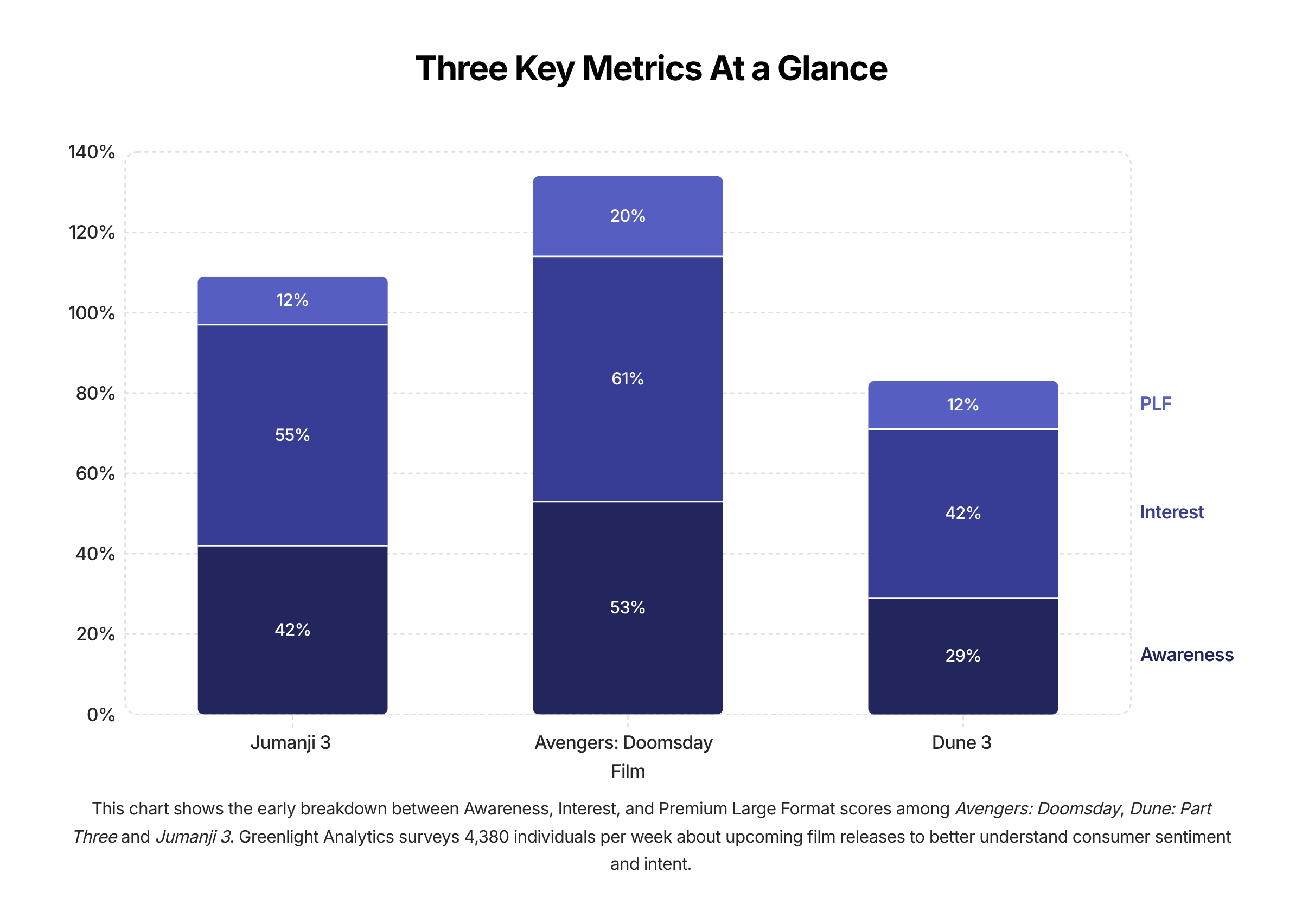
Dune’s Awareness significantly trails its rivals at this moment, but its Heat score of 15% indicates a healthy cohort of Lisan-al-Gaib converts. Right now, it has more audience overlap with Avengers than the younger-skewing Jumanji.
Dune and Avengers share an audience cannibalization risk, though the overwhelming cultural support behind the shared release date may drown that out. Dune and Jumanji currently have minimal direct competition. The IMAX factor changes the baseline earnings dynamics, but not the core audience picture.
The Second-Mover
The major worry is that Dunesday will leave very little room for Jumanji. Yet there’s a real chance it can squeak through as effective audience counter-programming.
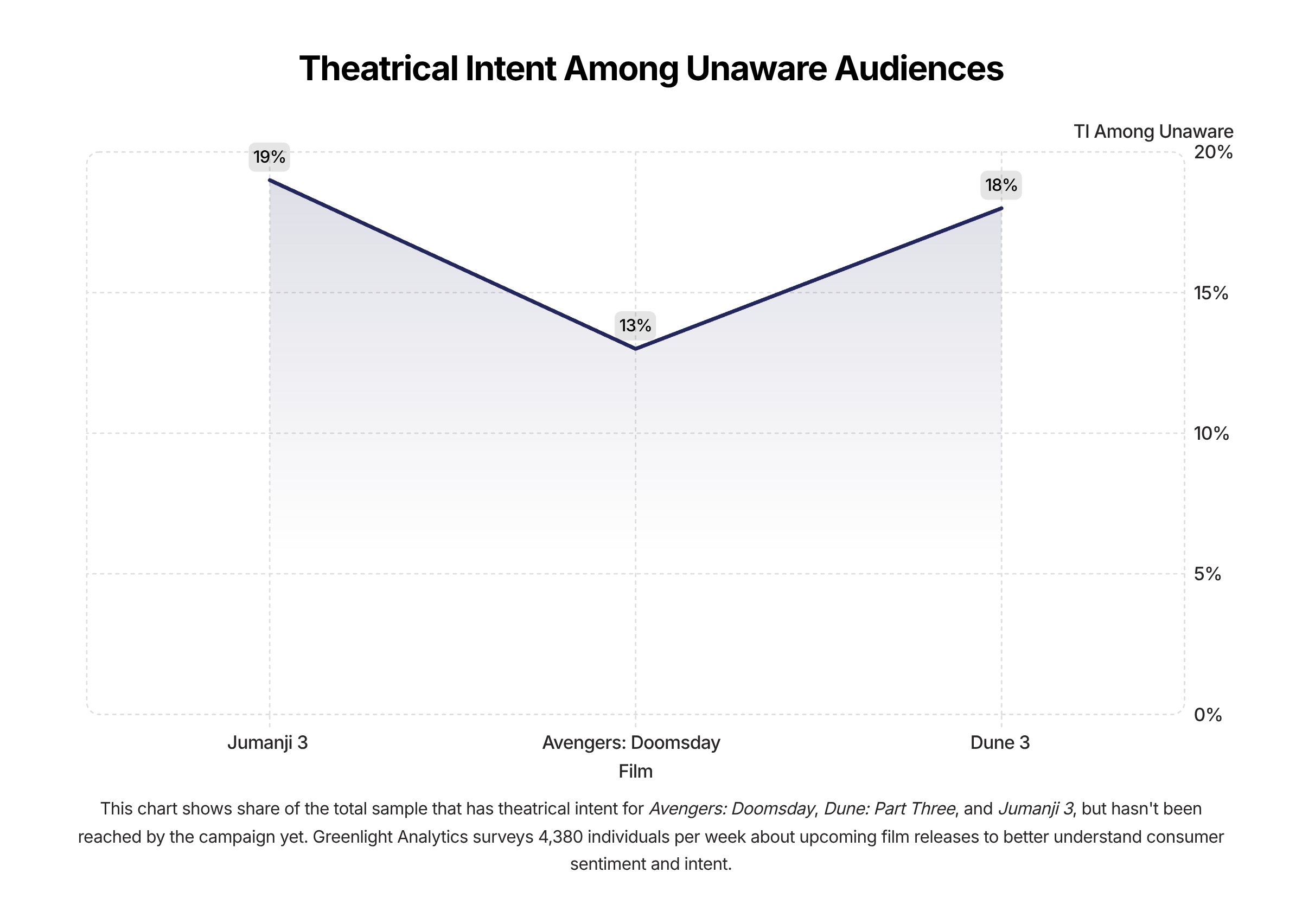
Female Under 35 Interest (57%) compares favorably to Avengers (56%), as does Women 35+ (54% vs 50%). Importantly, Theatrical Intent Among Unaware audiences – or those who didn’t know about the titles but said they would be willing to see the film in theaters after they were presented with the poster/logline — stands at 19%. Consider this the persuadable audience.
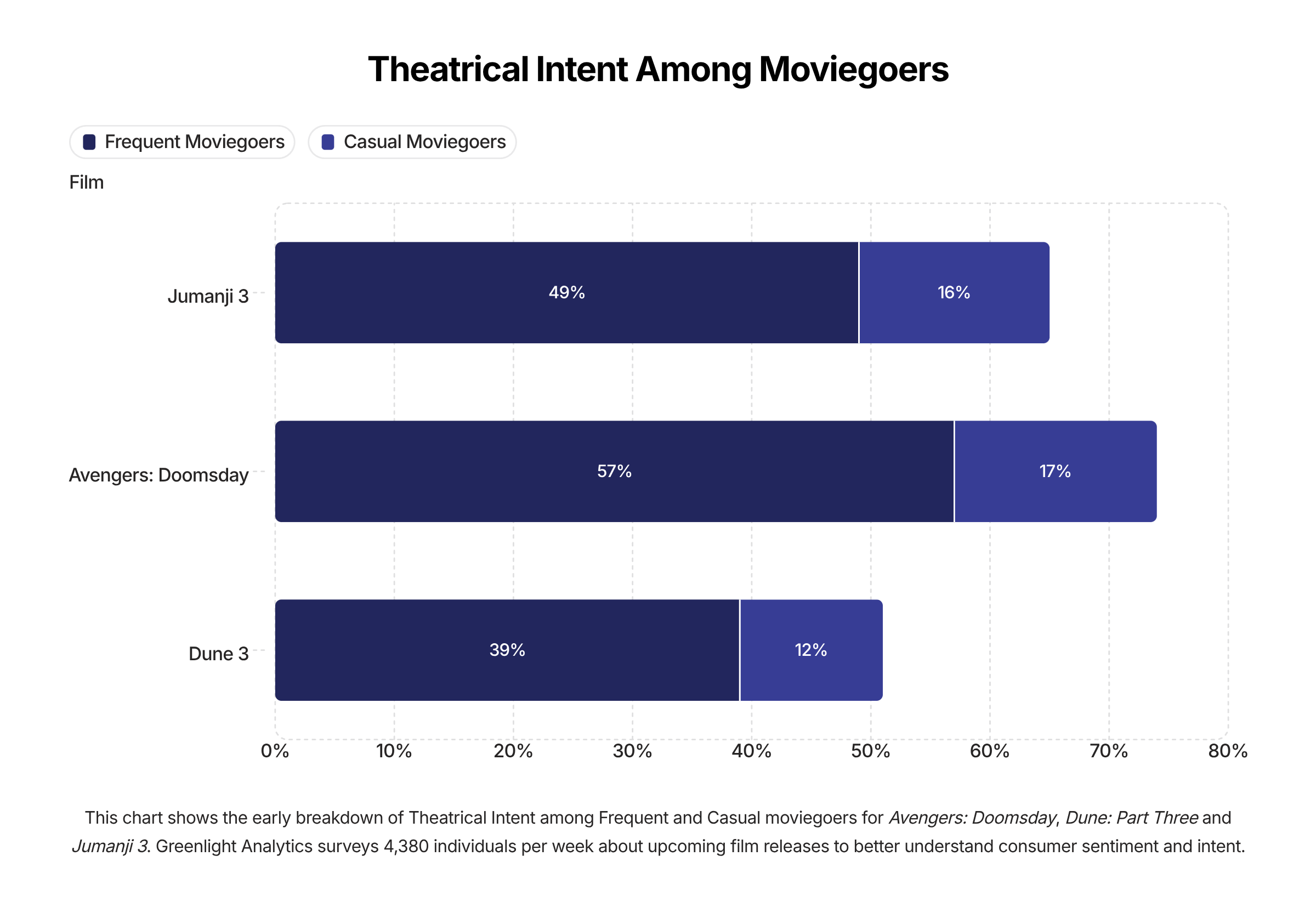
The film’s No Interest score (20%) is identical to Avengers, and when coupled with the percentage of viewers who said they prefer to watch it at home for free (24%) suggests it’s losing a portion of the early audience. But this can (and often does) change as promotional campaigns kick into gear. Compression and timing are the major factors at play here.
The competitive advantage among women and the pool of potential ticket buyers waiting to be activated is encouraging. Sony must spend the rest of the year working to convert these audiences into ticket-buyers given the room to grow.
Dynamics At Play
Dec. 18th’s Dunesday is a story of a shared male audience, but with diverging priorities. IMAX and a vastly different tone provide Dune with protective cover. Both films are buoyed by either end-of-franchise or long-awaited return urgency. Jumanji’s Christmas arrival brings with it a different demo for family-oriented viewing. This release corridor is defined by audience type, release timing, and viewing occasion.
The real fun begins when we cast an eye towards second weekends. All four Avengers films dropped between 50-60% in their second weekends, while Dune: Part Two fell just 44%. If these patterns hold, it puts immense per screen pressure on Jumanji. Underperformance wouldn’t necessarily be due to a demand problem, but to a distribution obstacle.
Outlook
Directionally, Doomsday is positioned for a top-tier opening weekend, even if its ceiling is slightly capped due to a lack of IMAX screens. It’s a full-blown event leader. Dune will be driven by a passionate but more narrow audience and a higher floor thanks to IMAX. It may not break records, but is still eyeing a healthy debut. It’s looking like a stable format-assisted older-skewing competitor. Contrary to popular belief that it stands no chance, Jumanji benefits from its demo differentiation and slightly different timeline. It’s the conversion upside play of the three.
All three should have the benefit of legs, even as some cannibalization may eat into their upfront numbers. But awareness and scale aren’t the battlegrounds here. The results of this competitive window will reveal how audience segmentation, differentiation, and distribution are replacing raw scale as the deciding factor for competitive blockbusters.