

Weekend Preview: ‘Send Help’ and Identifying Growth Opportunities
January 30, 2026
After establishing a baseline for horror, 20th Century’s Send Help is attempting to buck the average and overachieve. But beyond just future box office grosses, how can we quantify “growth” and “potential?”
Recognizable on-screen talent in Rachel McAdams and Dylan O’Brien and a cultish filmmaker in Sam Raimi surely boost Send Help’s prospects compared to other recent original horror titles such as Primate. But it remains to be seen whether that assistance translates into a $5 million bump versus a $10 million spike, or whether all hope is lost on an island at sea like its protagonists.
The answer lies more in analyzing the audience rather than marketing dollars, digital impressions and media views. First, let’s compare Send Help to 2026’s horror baseline (Primate) and a 2025 release in the same weekend (Companion).
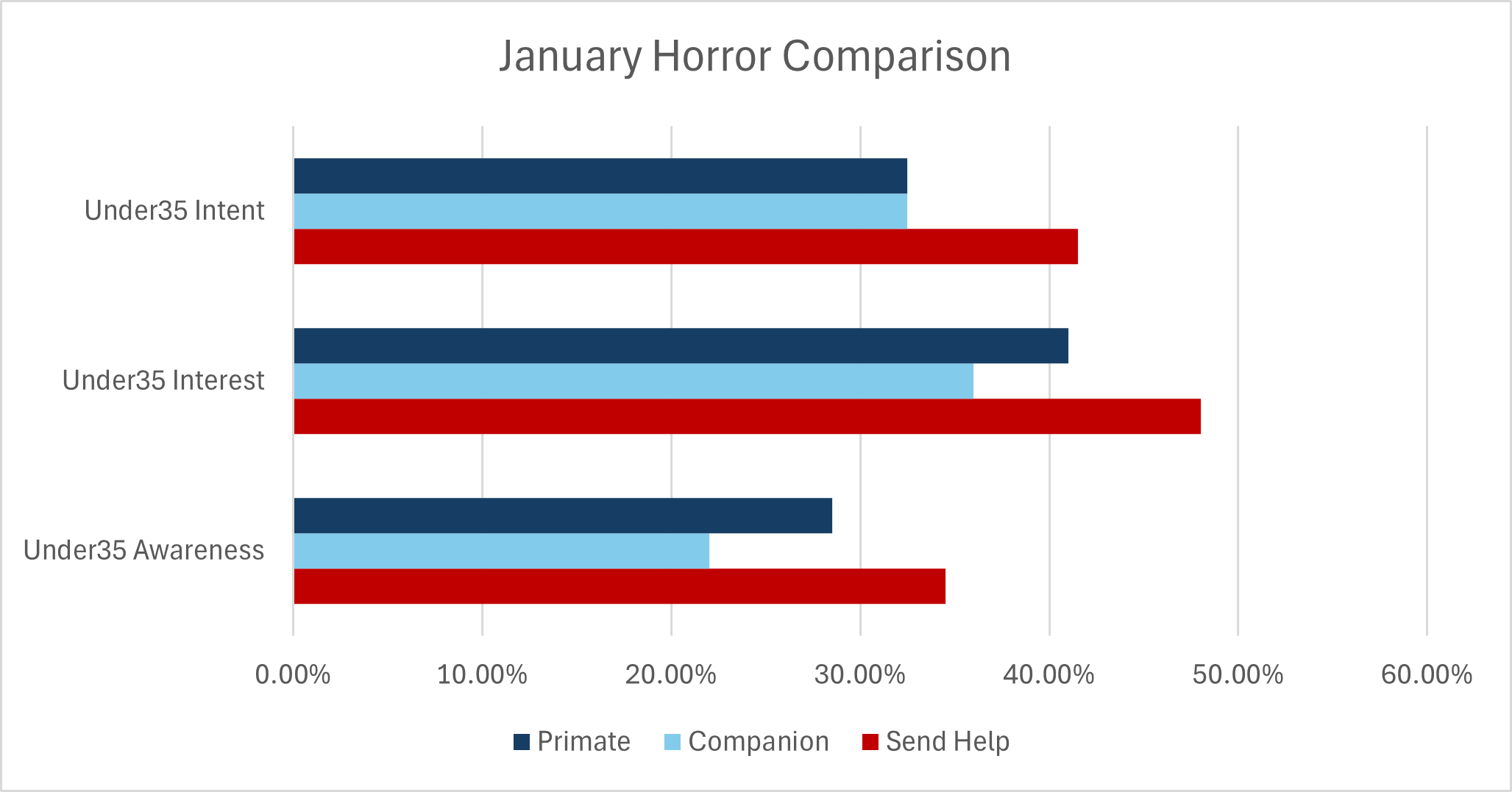
Send Help exceeds both solidly in awareness, interest, and theatrical intent, likely guaranteeing a $10 million-plus opening when only compared to these two films. This growth relative to the genre’s baseline shows not only an engaged hardcore horror audience, but also a bit of intrigue from the general public. This lays the groundwork for Send Help to potentially rev up towards the higher ends of our still reasonably modest projections.
Beyond a sense of opening “bigger than x,” Hollywood still needs to paint a clearer picture of the scope and narrative of potential audiences. We’ve established that Send Help’s interested audience is larger than the horror baseline. Now let’s bring in other films with similar interest levels to identify the ultimate potential, possible shortcomings, and opportunities all tied to box office performance.

Here, despite not being a sequel nor having the coveted summer release date, Send Help still manages to catch the interest at the same rates as higher performing horror-films such as Black Phone 2 and Weapons. However, before jumping to using these films as direct comps, small but important discrepancies become evident to distinguish the films from Send Help.
The movie matches Weapons in topline interest (blue) and theatrical intent (red) while winning in awareness. But Send Help’s conversion of awareness into theatrical intent is not as tight as Weapons, a factor that contributed to the latter’s opening weekend over-performance. While also matching the over-performing Black Phone 2, Send Help trails that sequel in awareness, specifically with the target under-35 demographic.
Although these examples are more lofty goals for Send Help, they show a potential growth path by aligning awareness, interest, and intent in similar ways. In terms of interest, the audience for Send Help is there and merely waiting to be activated.
Finally, the piece of the puzzle is looking beyond the standard “January horror” or “survival horror” sub-genre to find films most resembling Send Help in either current metrics or growth. Rather than finding where Send Help fits against superficial film comps, we want to use movies that help project a better idea of where this audience is and where it can possibly go.

Send Help is tracking nearly identically in all demographics with September horror feature Him. This provides a better initial projection range. And thanks to similar ratios and awareness metrics, the original Black Phone can be used as a best-case-scenario breakout comp.
Understanding growth is not just about monitoring upticks in awareness or interest. The pattern and path of the audience is instrumental. Locking in on a specific film from the onset and projecting based on comparative over-performances often leads to a lack of audience understanding (and ticked off studio executives come Monday morning). Sticking to the baseline film can underestimate the film’s true potential, while shooting too high can result in unrealistic expectations. By using analysis that incorporates a base, potential, and a similar audience snapshot, a proper narrative of the audience arises rather than arbitrary metrics or projection ranges.
From understanding the audience in where it stands, where its potential lies, and where it grows, audience performance becomes clearer. Taking the totality into account, strategy and planning for a successful opening becomes simpler, without help needed from your strategy and planning employee who happens to have an affinity for Survivor.